
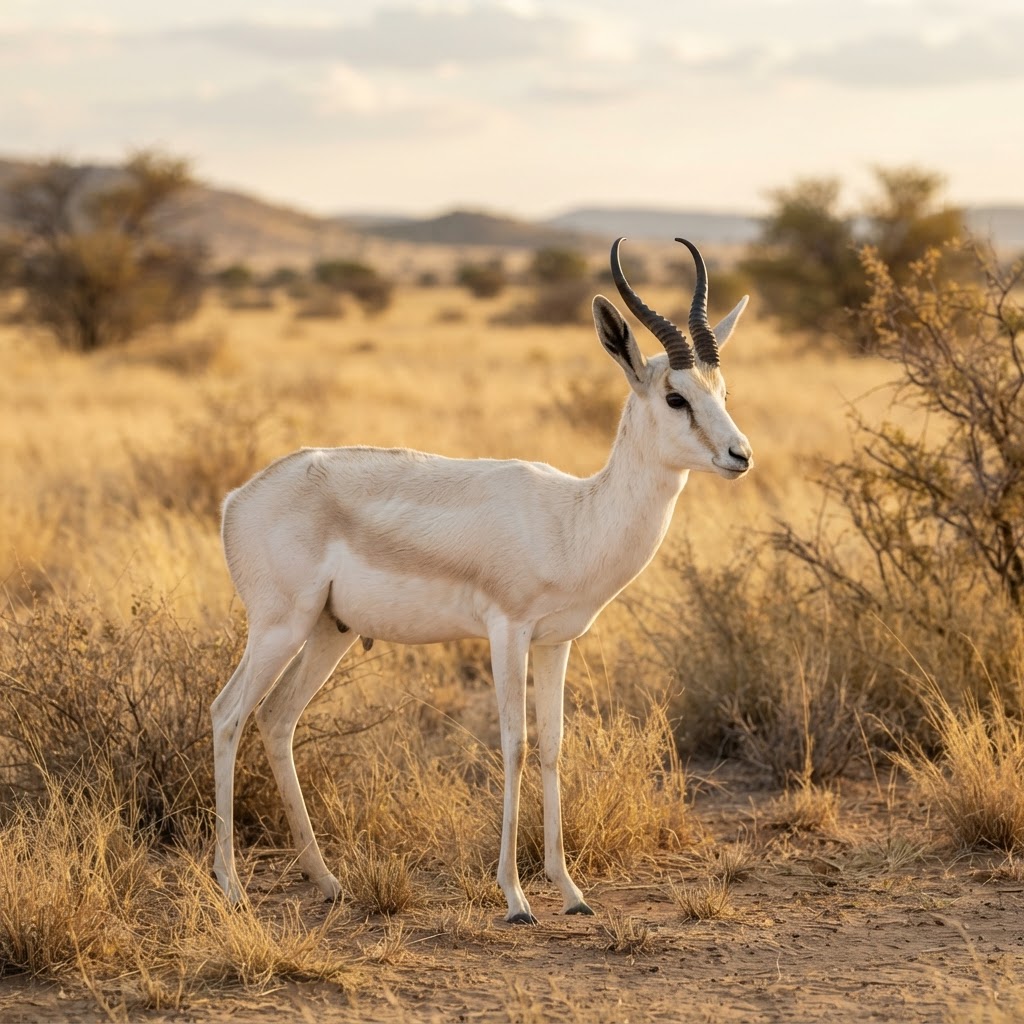
AI Generated
White Springbok
Discover the White Springbok, a unique color morph of the iconic African antelope. Learn about its striking white coat, pronking behavior, arid habitat, and conservation status.
Description
The White Springbok (Antidorcas marsupialis) is a captivating antelope species native to the arid and semi-arid regions of Southern Africa. A distinctive color morph of the more common Springbok, the White Springbok is characterized by its predominantly white coat, often adorned with a faint, light tan stripe along its flanks, in contrast to the rich reddish-brown coat of the typical Springbok. They retain the classic Springbok features: a slender build, long, graceful legs, and a prominent white facial blaze that extends from the forehead to the nose, bordered by dark stripes running from the eyes to the mouth. Both sexes possess striking, ringed horns that are black, sharp, and curve backward with tips pointing forward, typically measuring between 35 to 50 cm (14 to 20 inches) in length. Males are generally larger than females, standing about 75 cm (30 inches) at the shoulder and weighing around 42 kg (93 lbs).
A remarkable feature of the Springbok, including the white morph, is the dorsal flap of skin running along its back. This flap conceals a crest of stiff, white hair that can be raised in a spectacular display known as 'pronking' or 'stotting' when the animal is excited, alarmed, or displaying to potential mates. This unique pronking involves a stiff-legged leap into the air, with the back arched and the head pointing downwards, showcasing their agility and vitality.
Habitat & Range
White Springboks inhabit the open, treeless plains, grasslands, and savannas of Southern Africa, particularly thriving in the dry, arid to semi-arid regions of South Africa, Namibia, Botswana, and Angola. Their preferred habitats include areas with sparse vegetation, where they can easily spot predators. They are well-adapted to survive in harsh conditions, often found in environments where water is scarce. Their historical range has seen some fluctuations due to human encroachment and hunting, but conservation efforts have helped stabilize populations in many protected areas and private reserves.
Behavior
White Springboks are social animals, typically found in herds that can vary significantly in size depending on the season and availability of resources. During the wet season, when food is abundant, they may gather in large, mixed herds consisting of males, females, and young. In the dry season, smaller, more segregated groups are common, with nursery herds of females and their young, bachelor herds of males, and territorial males. They are diurnal, spending their days grazing and browsing. Their most famous behavior is pronking, a series of high, stiff-legged leaps, often performed when the animal is startled or as a display of fitness to predators. They are incredibly fast, capable of reaching speeds up to 88 km/h (55 mph), making them one of the fastest antelopes. This speed, combined with their agility and pronking, makes them adept at evading predators.
Diet
As mixed feeders, White Springboks have a varied diet consisting primarily of grasses, shrubs, and succulents. They are opportunistic feeders, adapting their diet to what is available in their arid environment. During dry periods, succulents become a crucial part of their diet, providing much-needed moisture. This ability to extract water from plants allows them to survive for long periods without drinking, making them highly resilient in drought-prone areas. They will also browse on leaves and flowers when available, demonstrating their adaptability to different vegetative states.
Hunting & Identification Notes
For hunters and researchers, identifying the White Springbok is straightforward due to its distinctive white coloration. The presence of the light tan flank stripe, while subtle, further distinguishes it. When observing or hunting, their pronking behavior is a clear identifier, as is their characteristic facial marking. They are often found in open plains, making them relatively easy to spot. Ethical hunting practices and adherence to local regulations are paramount to ensure the sustainable management of their populations. Researchers often study their adaptations to arid environments, social structures, and unique anti-predator behaviors.
Conservation Status
The Springbok species as a whole is classified as 'Least Concern' by the IUCN, owing to its widespread distribution and large, stable populations. The White Springbok, as a color morph, benefits from the overall robust conservation status of the species. However, like all wildlife, they face localized threats from habitat loss due to agricultural expansion and human settlement, as well as occasional poaching. Protected areas and game reserves play a critical role in safeguarding their populations and ensuring their long-term survival. Ranching and ecotourism also contribute to their conservation by providing economic incentives for habitat preservation.
Latest Trophies
