
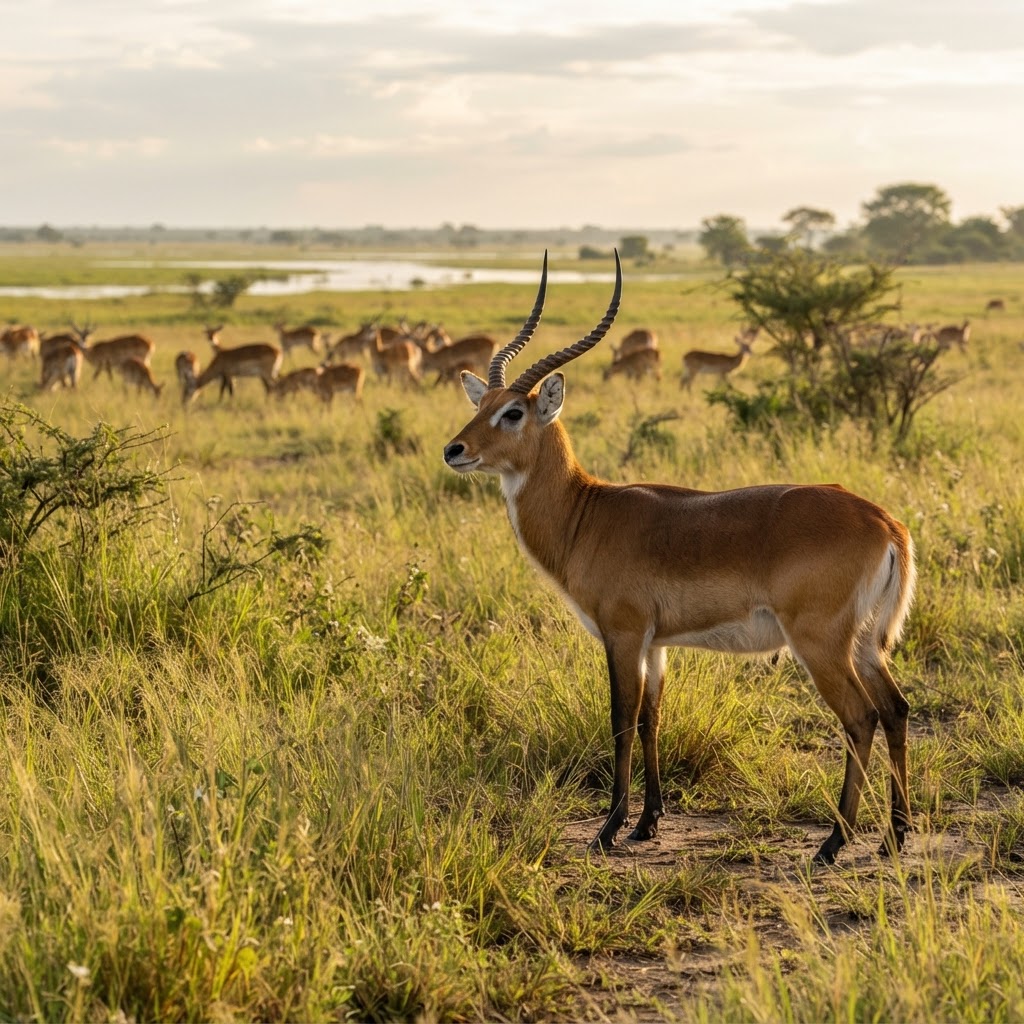
AI Generated
White-eared Kob
Kobus kob leucotis
The White-eared Kob is an antelope found in the savannas of South Sudan and Ethiopia, famous for its distinct white ear patches.
The White-eared Kob (Kobus kob leucotis) is a medium-sized antelope of northeastern Africa, best known for the striking contrast between the dark coat of mature males and the bright white markings around the ears, throat and face.
Adult males are larger and much darker than females, often becoming almost black at full maturity. Females and younger animals are more reddish-brown. Males carry strongly ridged horns that curve outward and upward, while females are hornless.
Habitat & Range
The White-eared Kob occurs mainly in South Sudan and neighboring parts of Ethiopia.
It is closely associated with open grasslands, floodplains and seasonally inundated savanna. Large populations move across the landscape in response to rainfall, flooding and changing grazing conditions.
Behavior
White-eared Kob are highly social and may form very large herds.
They are also known for major seasonal movements between wet- and dry-season ranges. During the breeding season, mature males establish territories and compete for access to females.
The species relies heavily on open terrain, herd vigilance and speed to avoid predators.
Diet
The White-eared Kob is primarily a grazer, feeding mainly on grasses and other herbaceous vegetation.
Fresh growth following rainfall and receding floodwaters is especially important, and seasonal forage availability strongly influences migration and herd distribution.
Hunting & Identification
White-eared Kob are typically hunted by spot-and-stalk in open floodplain and grassland country. Glassing from distance is often the best way to identify a mature male within a larger herd.
The open terrain frequently leads to moderate or long shooting distances. Flat-shooting plains-game rifles in the .243, .270 and 7mm classes are well suited when paired with appropriate expanding ammunition.
Mature males are easy to distinguish by their dark coat, white ear markings and well-developed horns. Older bulls generally show greater horn mass, heavier bases and a more pronounced black coloration.
Trophy evaluation focuses primarily on horn length, basal mass, spread, shape and symmetry.
Because other kob forms occur in neighboring regions, geography and the distinctive white ear markings are important for correct identification.
Conservation Status
The White-eared Kob is generally assessed as part of the wider Kob species complex, which is classified as Least Concern by the IUCN (2016).
Despite this classification, local populations can be affected by habitat disruption, hunting pressure, livestock competition and changes to traditional migration routes.
Sources
Mammal Diversity Database — Kobus kob
https://www.mammaldiversity.org/
IUCN Red List — Kob
Animal Diversity Web — Kobus kob