
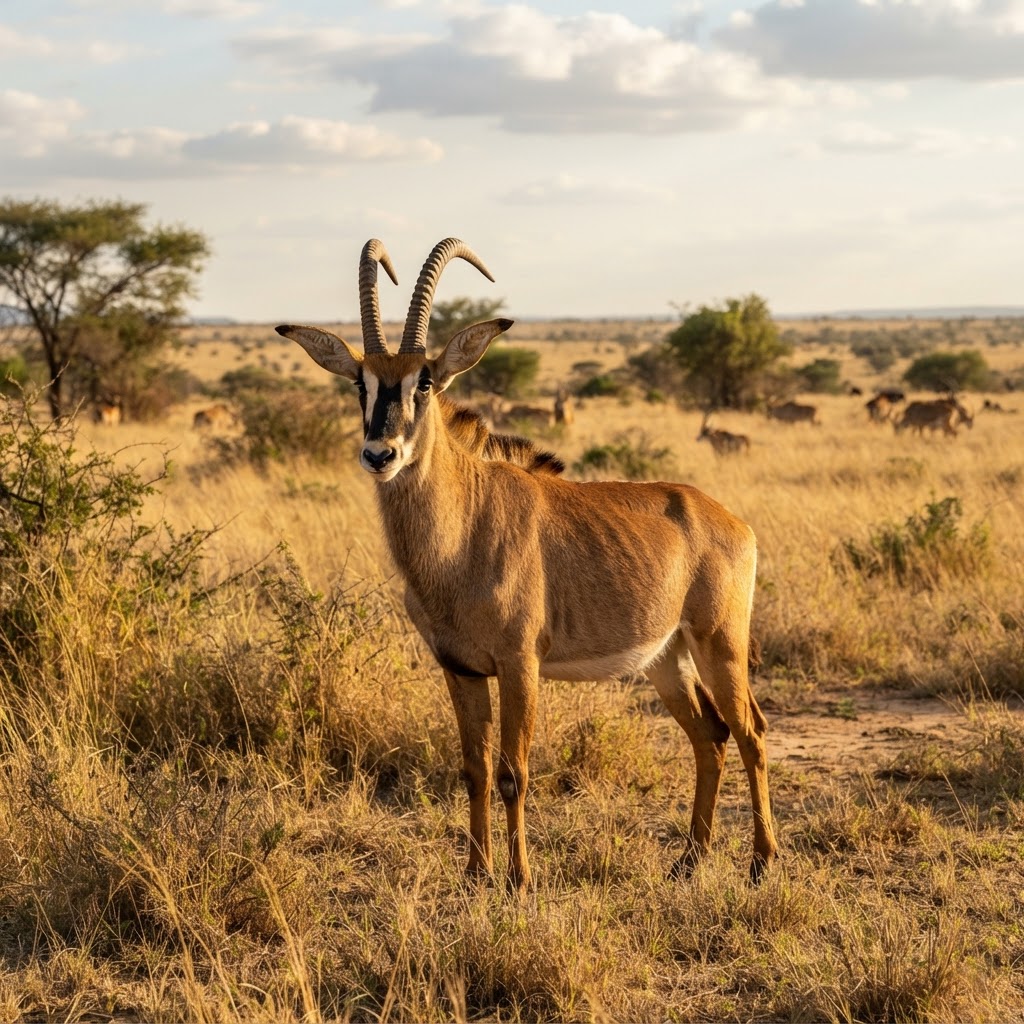
AI Generated
Western Roan Antelope
Hippotragus equinus koba
The Western Roan Antelope is a large and majestic antelope subspecies found in West Africa, known for its reddish-brown coat and impressive horns.
The Western Roan Antelope (Hippotragus equinus koba) is a large, powerfully built antelope found across parts of West and Central Africa. It is recognized by its reddish-brown to grey coat, bold black-and-white facial markings, long ears and the strongly curved horns carried by both sexes.
Adult males are larger and heavier than females and develop thicker horn bases, a stronger neck and a more muscular overall build. Both sexes carry heavily ridged horns, but those of mature bulls are generally longer, heavier and more deeply curved.
Habitat & Range
The Western Roan Antelope occurs across parts of West and Central Africa, including countries such as Senegal, Mali, Burkina Faso, Benin, Niger, Nigeria, Cameroon and neighboring regions.
It inhabits open woodland, wooded savanna and grassland, typically in areas with good grazing and access to water.
Behavior
Western Roan Antelope are social and are usually found in small to medium-sized herds.
Females and young form the core of the herd, while mature males may be territorial or remain alone for periods outside the breeding season.
Roan are alert and powerful animals and may stand their ground when threatened rather than immediately fleeing.
Diet
The Western Roan Antelope is primarily a grazer, feeding mainly on medium to tall grasses.
It prefers fresh, nutritious grazing but can also make use of coarser vegetation during dry periods. Seasonal rainfall strongly influences movement and habitat use.
Hunting & Identification
Western Roan Antelope are typically hunted by spot-and-stalk and by glassing open woodland, savanna and grassland edges during the cooler parts of the day.
Shots are usually taken at moderate range, although longer opportunities can occur in more open country. Medium to heavier plains-game rifles in the .30-caliber class and above are well suited, with cartridges such as the .30-06, .300 Winchester Magnum and similar rounds commonly used.
Mature bulls are identified by their heavier body, thicker neck, darker facial markings and more massive horn bases. Older males generally show greater horn length, deeper curvature and heavier overall horn development.
Trophy evaluation focuses primarily on horn length, basal mass, curvature, spread and symmetry.
Because several regional roan forms are recognized in traditional hunting classifications, geography is important when distinguishing the Western Roan from East African and southern populations.
Conservation Status
The Roan Antelope (Hippotragus equinus) is classified as Least Concern by the IUCN (2016).
Despite the global classification, Western Roan populations are often more fragmented and locally vulnerable due to habitat loss, livestock expansion, poaching and disruption of traditional savanna ecosystems.
Sources
Mammal Diversity Database — Hippotragus equinus
https://www.mammaldiversity.org/
IUCN Red List — Roan Antelope
Animal Diversity Web — Hippotragus equinus