
AI Generated
Western Hartebeest
Alcelaphus buselaphus major
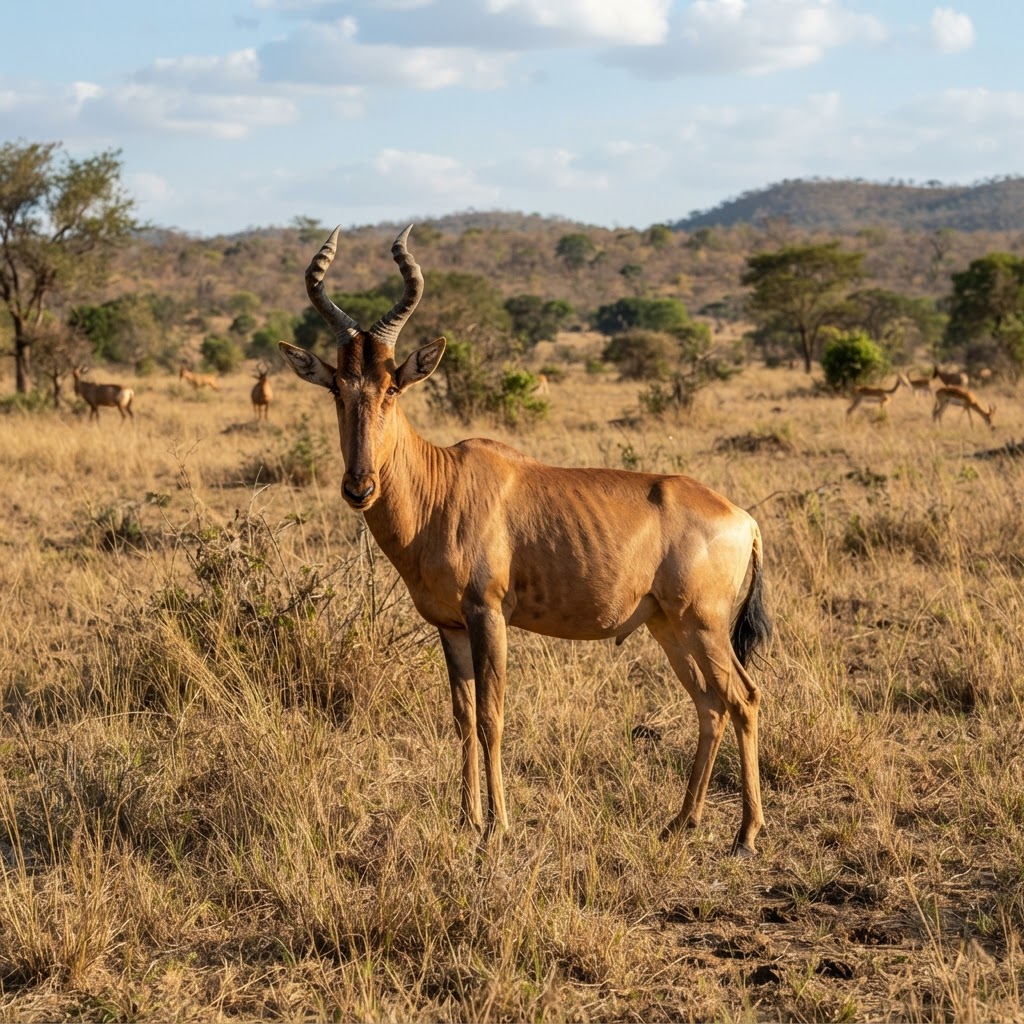
The Western Hartebeest is a subspecies of antelope native to West Africa, characterized by its reddish-brown coat and sharply angled horns.
Western Hartebeest
The Western Hartebeest (Alcelaphus major) is a large regional form of Hartebeest found across the savannas of West Africa. It has a long, narrow face, high shoulders, sloping back and a dull sandy-brown coat with darker markings on the front of the legs.
A narrow white stripe between the eyes is a characteristic field mark. Both males and females carry thick, strongly ringed horns, although mature males generally develop heavier bases.
Many modern taxonomic sources treat the Western Hartebeest as Alcelaphus buselaphus major within the wider Hartebeest species, Alcelaphus buselaphus.
Habitat & Range
The Western Hartebeest occurs from Senegal eastward through the West African savanna belt to northern Cameroon.
Its range includes parts of Senegal, Guinea, Mali, Burkina Faso, Côte d’Ivoire, Ghana, Togo, Benin, Niger, Nigeria and Cameroon.
It inhabits open grassland, wooded savanna and lightly wooded plains. The species favors landscapes with broad visibility and sufficient permanent or seasonal grazing.
Western Hartebeest generally avoid dense rainforest and extremely arid desert.
Behavior
Western Hartebeest are social and commonly live in small groups or larger herds.
Females and young move between feeding areas, while mature males may establish territories during the breeding season. Territorial bulls mark their surroundings and monitor females from elevated ground.
Hartebeest rely on sharp eyesight, endurance and speed to escape predators. Their long legs and sloping bodies are well adapted to sustained running across open terrain.
Activity is generally greatest during the cooler morning and late-afternoon periods.
Diet
The Western Hartebeest is primarily a grazer.
Its diet consists mainly of grasses, including relatively coarse species that remain available during dry periods. The long, narrow muzzle allows selective feeding among grass stems.
Seasonal rainfall strongly influences herd distribution, body condition and movement between grazing areas.
Hunting & Identification
Where legally hunted, Western Hartebeest are generally located by glassing open plains and wooded savanna before beginning a spot-and-stalk approach.
Mature bulls are identified by their heavier bodies, thicker necks and greater horn mass. However, body and horn differences between the sexes can be subtle at long range.
Viewed from the front, the horns form a broad U shape. They grow upward and outward, curve forward and then bend sharply backward near the tips.
Trophy evaluation focuses primarily on horn length, basal circumference, width, shape and symmetry. Worn or broken horn tips should be documented carefully.
The sandy coloration, white line between the eyes and geographical origin help distinguish the Western Hartebeest from Lelwel, Coke’s, Red and other regional Hartebeest forms.
Conservation Status
The Hartebeest (Alcelaphus buselaphus) is classified as Least Concern by the IUCN. The Western Hartebeest is not given a separate current global assessment under this combined taxonomic treatment.
Western populations have declined and become fragmented across substantial parts of their historical range.
Major threats include agricultural expansion, livestock competition, illegal hunting, fencing and the isolation of protected savanna areas.
Conservation depends on maintaining large connected grasslands, controlling unsustainable hunting and protecting movement between seasonal grazing areas.
Sources
Safari Club International Record Book — Western Hartebeest