
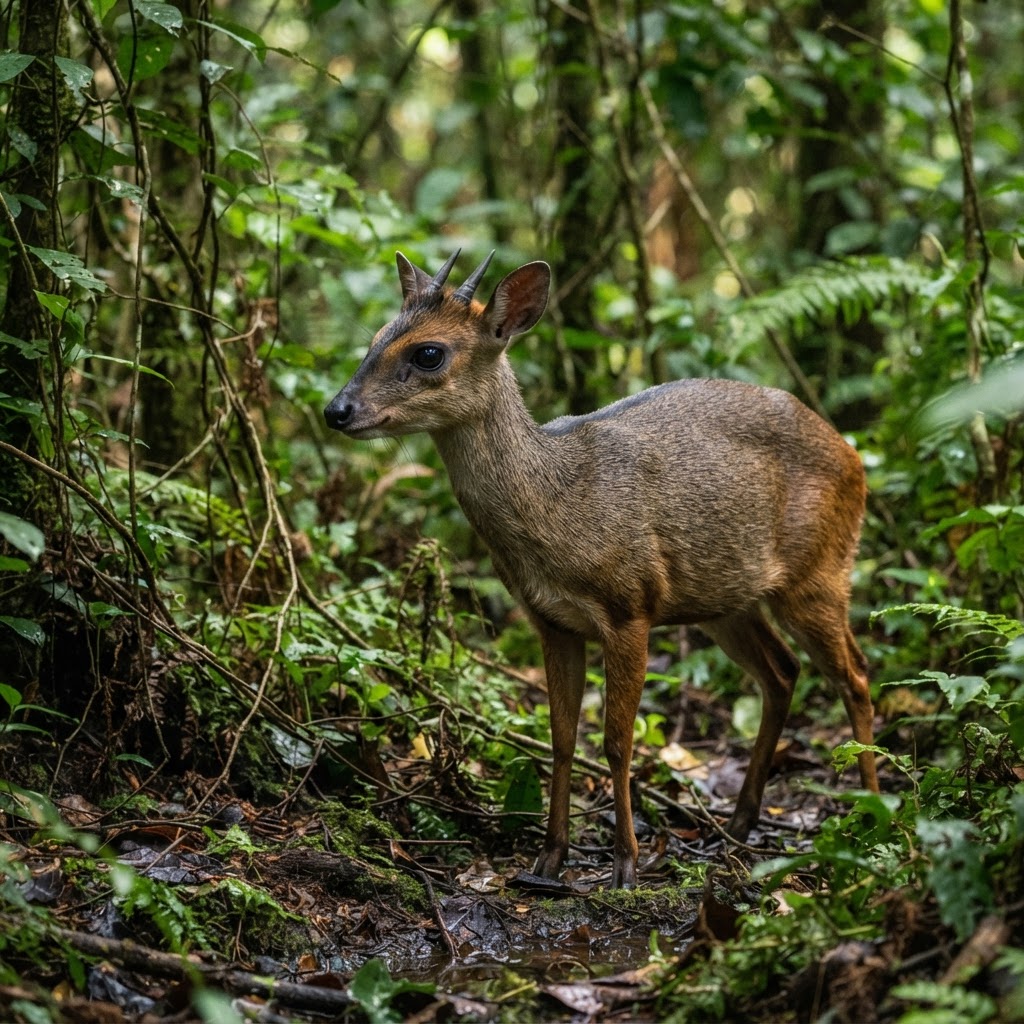
AI Generated
Western Bush Duiker
Sylvicapra grimmia coronata
The Western Bush Duiker is a small antelope found in West and Central Africa, known for its secretive nature and preference for dense bush.
Western Bush Duiker
The Western Bush Duiker (Sylvicapra grimmia coronata) is a small regional form of the widespread Bush or Common Duiker. It has a compact body, arched back, slender legs and a greyish coat often washed with yellow, orange or reddish tones.
A dark stripe extends from the nose toward the forehead, where it meets a crest of longer hair between the horns. Mature males normally carry short, straight horns; females are generally hornless.
Modern taxonomic sources include the Western Bush Duiker within the broader species Sylvicapra grimmia.
Habitat & Range
The Western Bush Duiker occurs across the savanna and woodland regions of western and parts of central Africa.
Its range extends through countries such as Senegal, Guinea, Mali, Burkina Faso, Côte d’Ivoire, Ghana, Togo, Benin, Nigeria, Cameroon and the Central African Republic, avoiding the interior of dense equatorial rainforest.
It inhabits dry woodland, wooded savanna, thorn scrub, agricultural margins and forest edges. It adapts well to disturbed landscapes when sufficient cover remains.
Behavior
Western Bush Duikers are generally solitary or encountered in pairs.
They are territorial and use scent glands located near the eyes to mark vegetation. Activity is concentrated around dawn, dusk and night, although animals may move during daylight in quiet areas.
When disturbed, they usually make a rapid dash into thick vegetation. The name “duiker” derives from an Afrikaans word referring to this characteristic diving movement into cover.
Bush Duikers frequently use established trails and may return repeatedly to favored feeding and resting areas.
Diet
The Western Bush Duiker is primarily a browser and frugivore.
Its diet includes leaves, shoots, herbs, flowers, seeds and fallen fruit. It may also consume cultivated crops, insects, eggs, carrion and small amounts of other animal matter.
This flexible diet allows it to survive across a broad range of seasonal and disturbed habitats.
Hunting & Identification
Where legally hunted, Western Bush Duikers are commonly pursued by slow walk-and-stalk, still-hunting or watching woodland edges, trails and feeding areas.
Shots are usually taken at short range because the animal is small, secretive and rarely remains exposed for long.
Mature males are identified by the short, sharply pointed horns rising from the forehead. Older males generally show greater horn length, heavier bases and more visible annulation.
Trophy evaluation focuses primarily on horn length, basal circumference and symmetry. The horns should be inspected for worn or broken tips and must be distinguished from the animal’s dark forehead crest.
Geographical documentation is important because SCI and other trophy systems distinguish Western, Southern, Angolan and East African Bush Duikers despite their inclusion within a single species by modern authorities.
Conservation Status
The Bush Duiker (Sylvicapra grimmia) is classified as Least Concern by the IUCN. The Western Bush Duiker does not receive a separate global assessment.
The species remains widespread and adaptable, but local populations may be affected by bushmeat hunting, wire snares, agricultural expansion and the removal of protective vegetation.
Its ability to survive in fragmented woodland and agricultural mosaics provides some resilience, although intensive hunting can cause rapid local declines.
Sources
Safari Club International Record Book — species index