
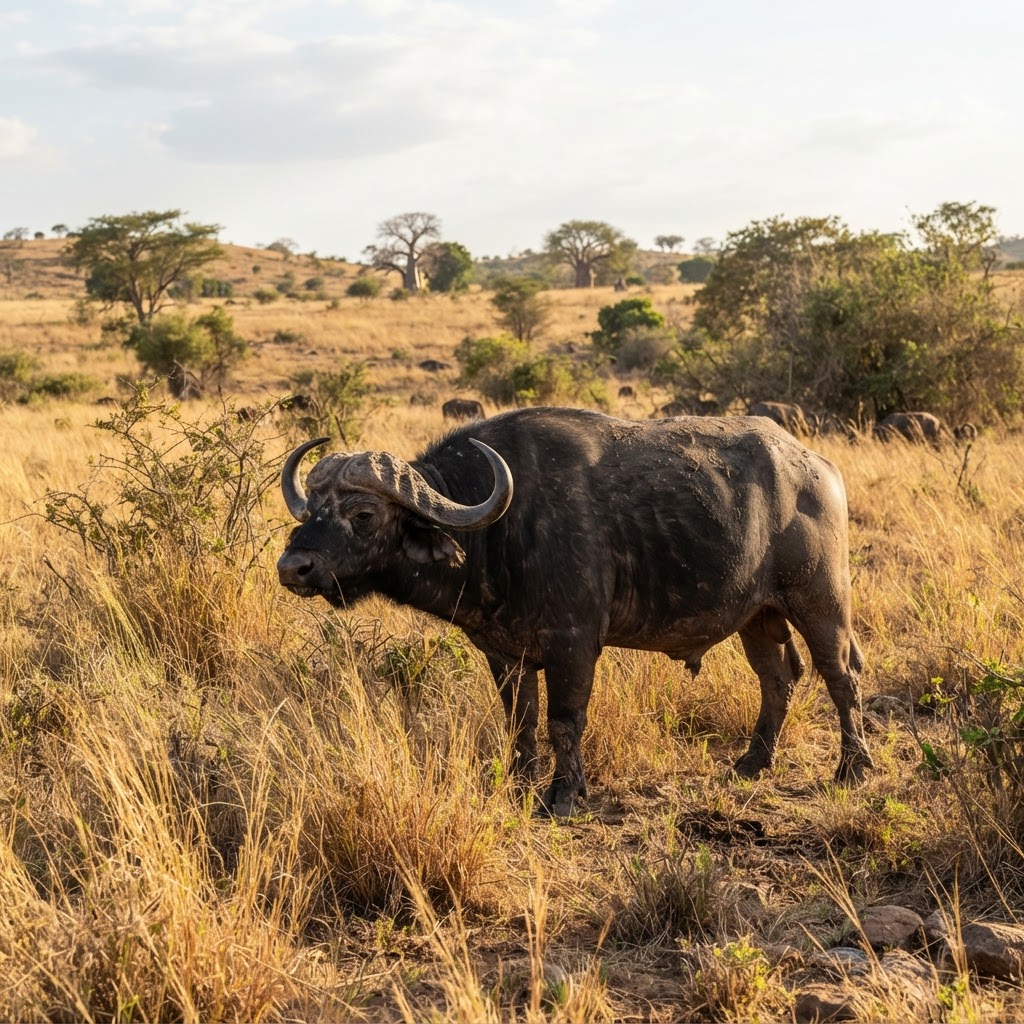
AI Generated
West African Savanna Buffalo
Syncerus caffer planiceros
The West African Savanna Buffalo is a smaller, red-hued subspecies, adapted to the mosaic of savannas and forests in West Africa.
West African Savanna Buffalo
The West African Savanna Buffalo (Syncerus caffer planiceros) is a regional form of the African Buffalo adapted to the savannas and woodlands of West Africa. It is smaller and more lightly built than the Cape Buffalo, with less massive horns and little or no developed frontal boss.
Its coloration is highly variable. Animals within the same herd may be dark brown, reddish, blackish or tan. Adult bulls are larger and more muscular than cows and generally develop heavier horn bases.
Modern taxonomic sources usually include this form within the wider African Buffalo species, Syncerus caffer.
Habitat & Range
The West African Savanna Buffalo occurs in the savanna and woodland belt north of the coastal rainforests of West Africa.
Its traditional SCI range extends from southern Senegal through northern Guinea, southern Mali, northern Côte d’Ivoire, southern Burkina Faso, northern Ghana, Togo and Benin, southwestern Niger, northern Nigeria and northern Cameroon.
SCI uses Cameroon’s eastern border as the practical division between West African and Central African Savanna Buffalo.
The species inhabits open woodland, wooded savanna, floodplains and grassland with dependable grazing, shade and water.
Behavior
West African Savanna Buffalo are highly social and generally live in herds containing cows, calves and younger bulls.
Mature bulls may remain with these herds, form small bachelor groups or become solitary. Herd size and movement vary with rainfall, water availability, grazing quality and hunting pressure.
Buffalo are most active during the cooler morning, evening and nighttime periods. They commonly rest in shade or near water during the hottest hours.
Like other African Buffalo, they are powerful and defensive animals. Wounded or isolated individuals can be particularly dangerous.
Diet
The West African Savanna Buffalo is primarily a grazer.
Its diet consists mainly of grasses, although leaves and other browse may be consumed when grazing quality declines.
Buffalo depend on regular access to water. Seasonal rainfall affects herd distribution, body condition and movement between feeding and drinking areas.
Hunting & Identification
West African Savanna Buffalo are commonly hunted by tracking fresh spoor, examining waterholes and glassing feeding areas or woodland openings.
Shots are usually taken at short to moderate range because animals often remain close to brush or wooded cover.
Mature bulls are identified by their heavier bodies, thick necks and more substantial horn bases. However, even old bulls generally lack the massive fused bosses characteristic of mature Cape Buffalo.
The horns usually sweep outward, backward and slightly upward. They are longer and heavier than those of the smaller Forest Buffalo but less massive than Cape Buffalo horns.
Trophy evaluation focuses primarily on total horn length, spread, circumference and symmetry under the applicable SCI method.
Suitable dangerous-game rifles, strongly constructed bullets and conservative shot placement are essential. Local minimum-caliber requirements must always be confirmed.
Conservation Status
The African Buffalo (Syncerus caffer) is classified as Near Threatened by the IUCN. The West African Savanna Buffalo does not receive a separate global assessment.
West African populations are generally smaller and more fragmented than those in many parts of eastern and southern Africa.
Important threats include habitat conversion, livestock expansion, illegal hunting, disease transmission from domestic cattle and the isolation of protected areas.
Conservation depends on maintaining connected savanna landscapes, protecting dependable water sources and managing hunting at sustainable levels.
Sources
Safari Club International Record Book — West African Savanna Buffalo