
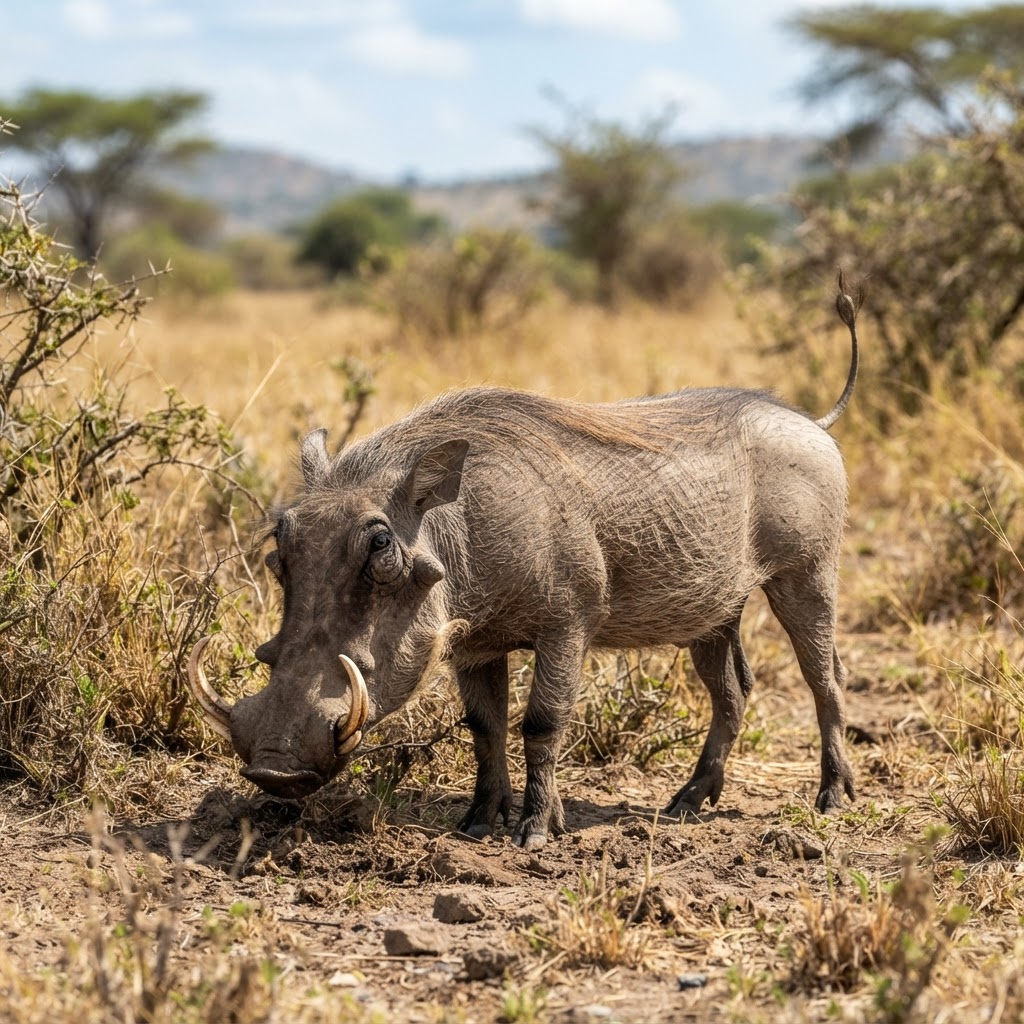
AI Generated
Warthog
Phacochoerus africanus
The Warthog (Phacochoerus africanus) is a wild member of the pig family found across Africa, known for its distinctive tusks and facial warts.
Introduction
The Warthog (Phacochoerus africanus) is a unique species of wild pig indigenous to the savannas and grasslands of sub-Saharan Africa. Characterized by its distinct physical traits—especially its tusks and facial warts—this animal plays an integral role in its ecosystem and carries cultural significance across various African societies.
Description
Warthogs are medium-sized ungulates, averaging 90 to 150 cm in length and standing about 50 to 80 cm tall at the shoulder. They combine a robust body with long, slender legs, and their most notable features are pronounced, curved tusks and a mane of coarse hair along their backs. Adult males typically weigh between 90 and 150 kg, whereas females are slightly lighter.
The facial warts, which give the Warthog its name, serve as protection during fights, particularly among males. They have a large, elongated head and a blunt snout, adapted for rooting in the soil for food. Their coloration ranges from brown to greyish, often displaying a dusty appearance due to their propensity for wallowing in mud.
Habitat & Range
Warthogs inhabit a range of environments but prefer areas with ample grassland and access to water sources. Their primary distribution spans across the grasslands, savannahs, and open woodlands of eastern and southern Africa, including countries like Kenya, Tanzania, Botswana, Namibia, and South Africa. Although they can tolerate diverse environments, they tend to avoid dense forests and arid desert regions.
Behavior
Warthogs are social animals, typically found in groups called sounders, which consist of females and their young. Males, especially those that are mature, usually venture alone or form temporary bachelor groups. They are predominantly diurnal, displaying activity during the day, which enhances their foraging opportunities.
Warthogs exhibit a unique behavior known as 'kneeling' when they eat, using their front legs to balance while rooting with their snouts. They are also known for their agility and can run swiftly, often reaching speeds up to 30 km/h (19 mph) if threatened. When alarmed, Warthogs will flee with their tails raised, providing a characteristic sight in the wild.
Diet
As omnivores, Warthogs primarily feed on grasses, roots, berries, and other vegetation. Their strong snouts are well-adapted for digging into the soil to unearth tubers and roots. In regions where grass is abundant, they will consume vast quantities, particularly during the rainy season when grass growth peaks. However, in drier months, they may supplement their diet with forbs and agricultural crops, which places them in conflict with local farmers.
Hunting & Identification Notes
For hunters and safari guides, identifying Warthogs can be relatively straightforward due to their unique physical features. When spotting Warthogs, one should look for their large heads, prominent tusks, and distinctive facial warts. They typically frequent open areas rather than dense bush.
When pursuing Warthogs, hunters should note their diurnal patterns, often foraging during the early morning and late afternoon. Understanding their behavior will enhance the chances of a successful hunt. It is essential to consider ethical hunting practices, and hunters should be aware of local regulations concerning Warthog populations.
Conservation Status
According to the International Union for Conservation of Nature (IUCN), the Warthog is currently listed as a species of least concern, due to its wide distribution and stable population in many areas. However, they face threats from habitat destruction, human encroachment, and hunting pressures in some regions. Conservation efforts are crucial in sustaining their populations, especially in areas where agriculture begins to encroach on their natural habitats. Protected areas and wildlife reserves are critical for maintaining viable populations of Warthogs and preserving the ecological balance within their environment.