
AI Generated
Tsessebe
Damaliscus lunatus lunatus
Discover the Tsessebe, one of Africa's fastest antelopes, known for its distinctive dark reddish-brown coat, uniquely ringed horns, and preference for open grasslands and floodplains.
Description
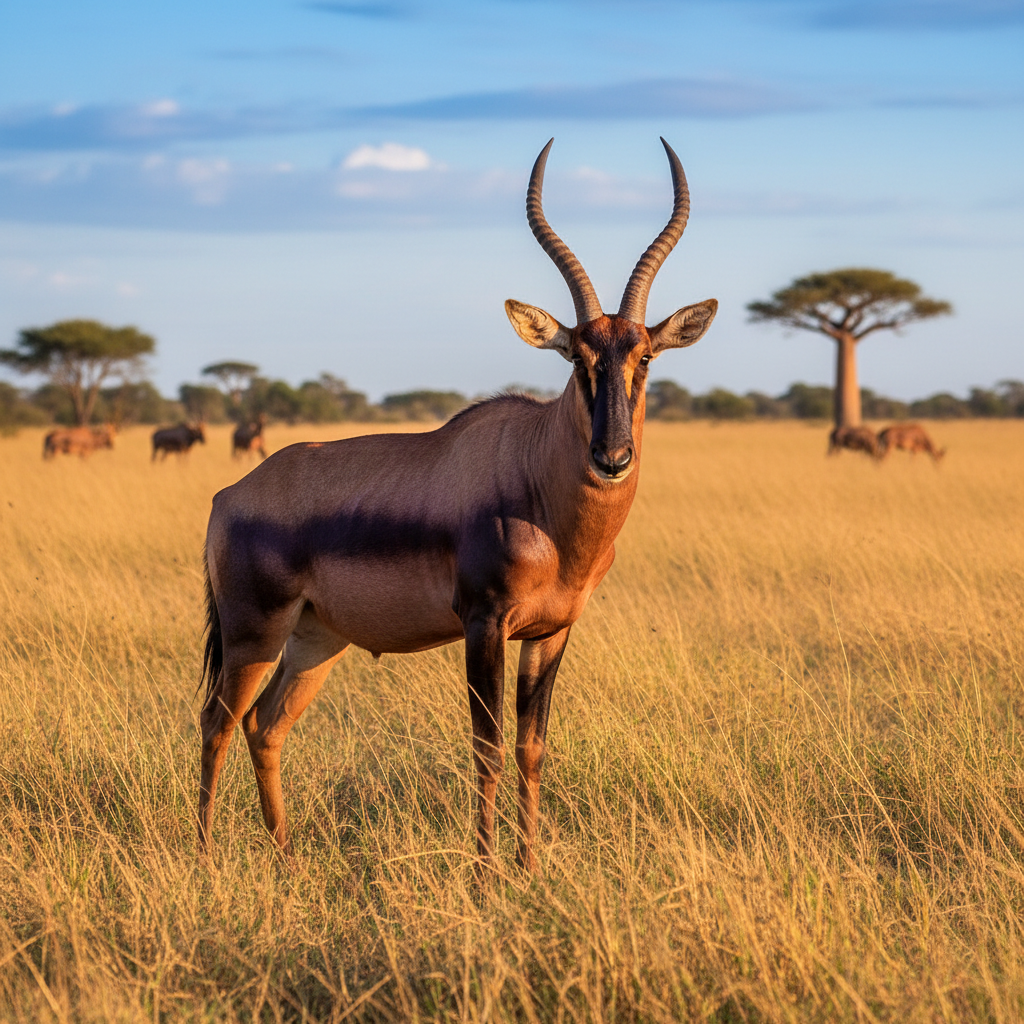
The Tsessebe (Damaliscus lunatus lunatus) is a medium-sized antelope, recognized as one of the fastest antelopes in Africa, capable of reaching speeds of up to 70 km/h (43 mph). It is a subspecies of the Topi/Sassaby and is characterized by its striking appearance. Tsessebes stand approximately 110-130 cm (43-51 inches) at the shoulder and weigh between 120-160 kg (265-350 lbs). Both sexes possess a distinctive, heavily ridged, lyre-shaped horn structure, which rises vertically from the head and then curves backward and slightly inward. The coat is a glossy dark reddish-brown, often with a purplish sheen, and typically has darker patches on the face, shoulders, hips, and lower legs. The legs themselves are slender, contributing to their remarkable speed and endurance. Their long, narrow face and high-set eyes give them excellent vision across the open plains they inhabit.
Habitat & Range
Tsessebes are primarily found in the open grasslands and floodplains of Southern Africa, with their main distribution across Botswana, northern South Africa, Namibia, Zambia, Zimbabwe, and Mozambique. They prefer flat to gently undulating savannas with good grass cover and easy access to water. Their presence is often indicative of healthy grassland ecosystems. Tsessebes are commonly seen in areas that have recently experienced fires, as they are drawn to the new, nutritious grass shoots that emerge after a burn. They avoid dense woodlands and mountainous regions, favoring clear lines of sight to detect predators.
Behavior
Tsessebes are highly social and diurnal animals, active during the day, particularly in the cooler morning and late afternoon hours. Their social structure typically consists of herds of females and their young, often numbering 6-10 individuals, and bachelor herds of non-territorial males. Adult males are highly territorial, defending their chosen areas fiercely, using scent marking and vocalizations, and sometimes engaging in violent clashes with rival males. During the mating season, these territorial males will attempt to gather and defend harems of females. Tsessebes are known for their alert and vigilant nature, often standing on elevated positions (like termite mounds) to scan their surroundings. When threatened, they perform a rocking canter, which can quickly turn into a full gallop.
Diet
As obligate grazers, Tsessebes feed almost exclusively on grasses. They are selective grazers, preferring medium-height, perennial grasses and are particularly fond of the fresh, nutritious growth that appears after seasonal burns. Their diet is highly dependent on the quality and availability of grasses, and they will move between different grazing areas to find the best forage. While they can go for periods without drinking, they generally require access to water daily, especially during the dry season when the moisture content of grasses is lower. This reliance on specific grass types makes them sensitive indicators of grassland health.
Hunting & Identification Notes
The Tsessebe is readily identifiable by its unique dark reddish-brown coat with a purplish sheen, its distinctive horn shape (lyre-shaped, heavily ridged, and curving backward then slightly inward), and its overall lean, athletic build. Both sexes have horns, though those of the males are typically heavier and more impressive. Their long, narrow face and slightly humped shoulders also aid in identification. When hunting, their speed and keen senses make them a challenging quarry. They are wary and will often bolt at the first sign of danger. Spotting them in open grasslands requires good optics and patience, and a long-range shot is often necessary. Ethical hunting focuses on mature bulls, and assessing horn quality is crucial for trophy hunters.
Conservation Status
The Tsessebe (Damaliscus lunatus lunatus) is currently classified as 'Least Concern' by the IUCN Red List. This designation reflects a relatively stable and widespread population, particularly within protected areas and well-managed private game reserves. However, the species has experienced significant regional declines due to habitat loss and fragmentation caused by agricultural expansion, fencing, and human settlement. Poaching also remains a threat in some areas. Despite these localized pressures, large populations persist in strongholds like Botswana and the Kruger National Park in South Africa. Conservation efforts focus on protecting their grassland habitats, managing populations sustainably, and mitigating threats from human activities. Wildlife ranching has also played a positive role in reintroducing Tsessebes to suitable areas, contributing to their overall conservation status.