
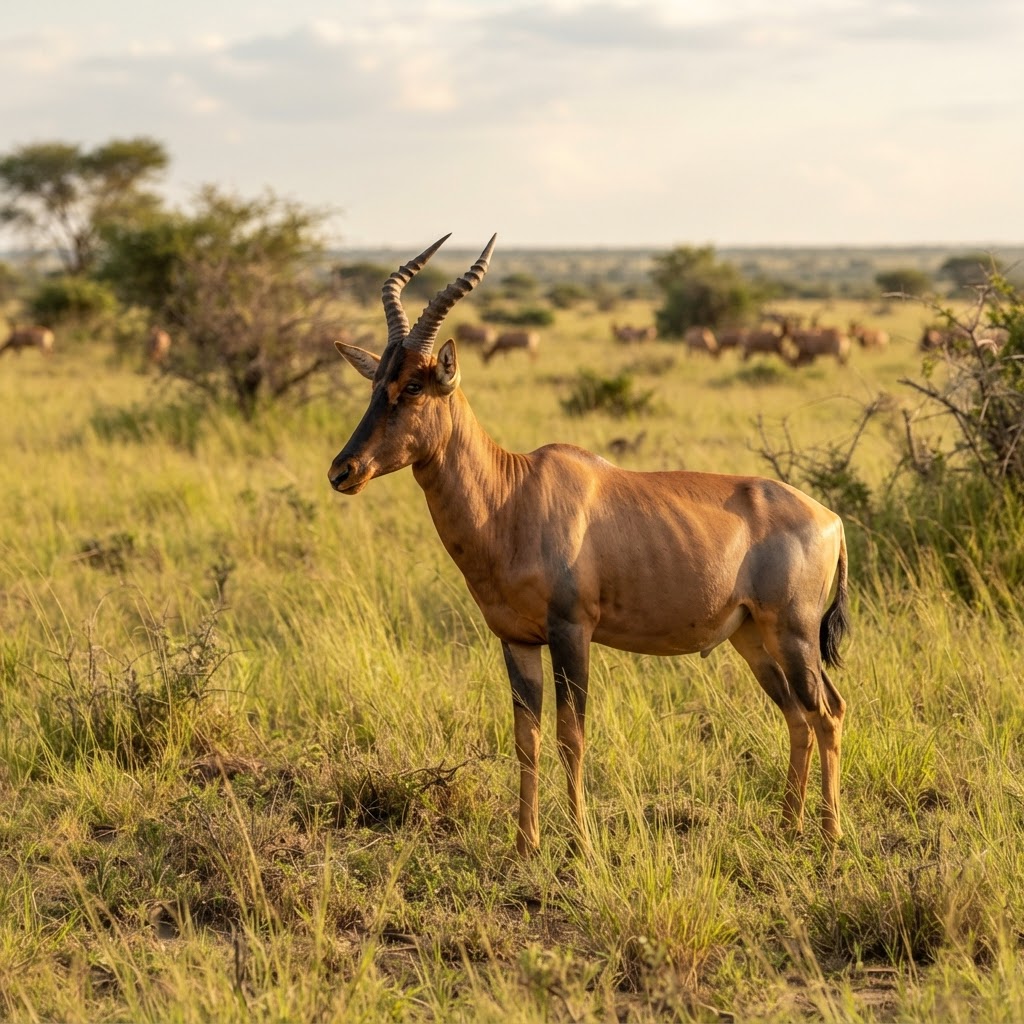
AI Generated
Tiang
Damaliscus lunatus tiang
The Tiang is a subspecies of topi antelope native to the grasslands of East Africa, known for its striking coat and powerful build.
Tiang
The Tiang (Damaliscus lunatus tiang) is a large, fast-running antelope of northeastern Africa and a regional form of the Topi–Tsessebe complex. It has a rich reddish-brown coat with dark bluish-black patches across the shoulders, hips and upper legs.
Both sexes carry strongly ringed, lyre-shaped horns. Mature males are generally heavier and have thicker horn bases, while females tend to be more lightly built.
Modern taxonomic sources include the Tiang within the wider species Damaliscus lunatus. Some alternative classifications recognize it as a separate species, Damaliscus tiang.
Habitat & Range
The Tiang occurs primarily in South Sudan, western and southwestern Ethiopia, extreme northeastern Uganda and northwestern Kenya.
It inhabits open grassland, wooded savanna, seasonal floodplains and broad river basins. Large populations are particularly associated with the extensive grasslands and wetlands of the Sudd and neighboring ecosystems.
Tiang may undertake long seasonal movements in response to rainfall, flooding and the availability of fresh grazing.
Behavior
Tiang are highly social and may gather in large herds.
Females and young often move together across open grassland, while mature males establish territories in productive feeding or breeding areas. Territorial bulls advertise with postures, scent marking and ritualized displays.
The species relies on speed, stamina and herd vigilance to escape predators. Its elongated head and high shoulders produce the sloping back characteristic of the genus Damaliscus.
Activity is generally greatest during the cooler morning and late-afternoon periods.
Diet
The Tiang is primarily a grazer.
Its diet consists mainly of grasses, with a preference for fresh, nutritious growth. Seasonal burning, rainfall and receding floodwater can create new feeding areas and strongly influence herd movements.
Access to productive grassland is especially important for females during calving and lactation.
Hunting & Identification
Where legally hunted, Tiang are generally located by glassing open plains, floodplains and lightly wooded savanna before beginning a spot-and-stalk approach.
Both sexes carry horns, making body structure and horn mass important when identifying a mature male. Adult bulls usually have thicker necks, heavier bodies and more substantial horn bases.
The horns curve outward and backward before turning upward. Compared with the Korrigum, Tiang horns are generally shorter, slimmer and less sharply upturned at the tips.
Trophy evaluation focuses primarily on horn length, basal circumference, shape and symmetry. Horn tips should be examined carefully for wear or breakage.
Geographical origin is essential for distinguishing the Tiang from Korrigum, Topi and Tsessebe in traditional trophy classifications.
Conservation Status
The wider species Damaliscus lunatus is classified as Least Concern by the IUCN. The Tiang does not currently receive a separate global assessment under this taxonomic treatment.
South Sudan still supports exceptionally important migratory populations, but reliable monitoring is difficult across parts of the range.
Local threats include illegal hunting, armed conflict, livestock competition, agricultural expansion, fencing and disruption of seasonal migration routes.
Protecting connected grassland and floodplain systems is critical because the Tiang depends on access to widely separated seasonal feeding areas.
Sources
Safari Club International Record Book — Tiang