
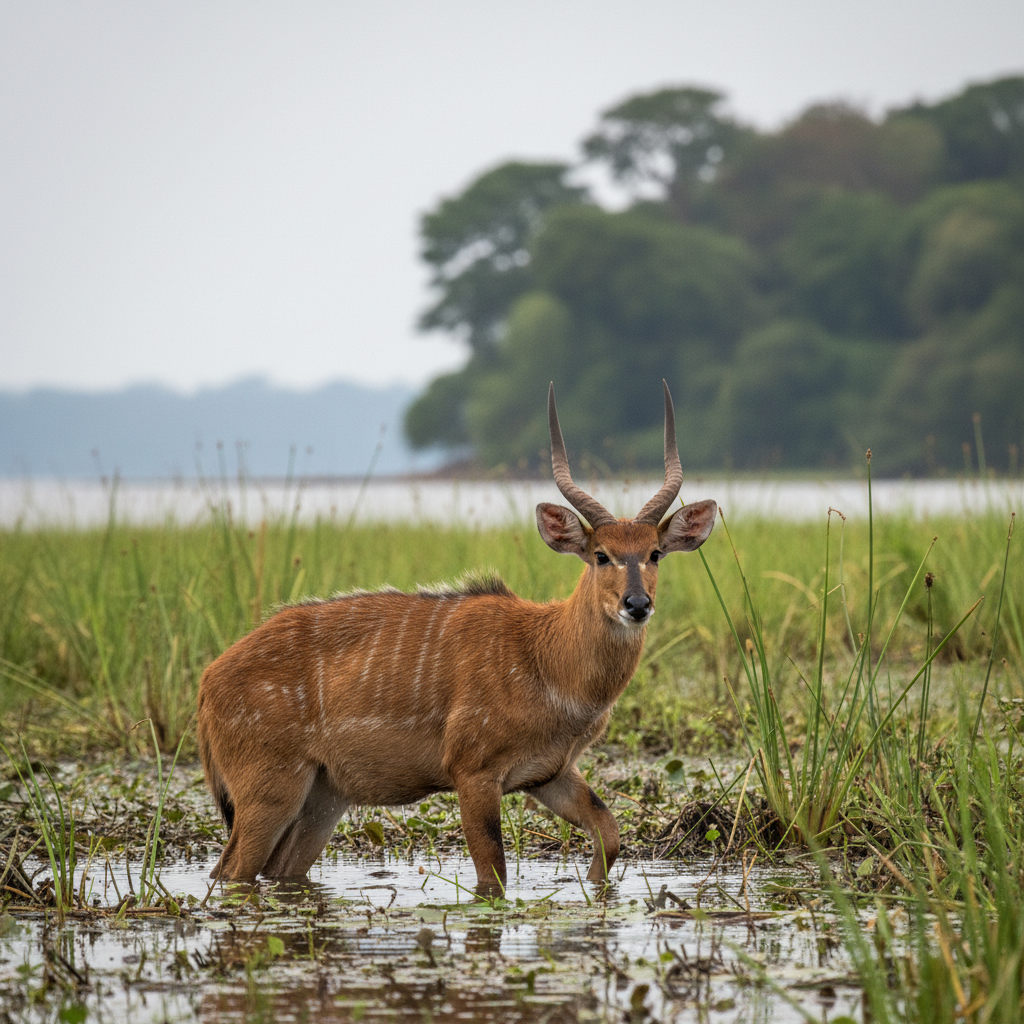
AI Generated
Ssese Islands Sitatunga
Tragelaphus spekii
The Ssese Islands Sitatunga is a unique subspecies of water-adapted antelope endemic to Uganda's Ssese Islands, characterized by its long, splayed hooves.
Introduction
The Ssese Islands Sitatunga (Tragelaphus spekii) is a rare subspecies of sitatunga, an aquatic antelope found predominantly on the Ssese Islands in Lake Victoria, Uganda. Known for its remarkable adaptations to swampy habitats, this elusive creature is distinguished by its long, splayed hooves, which facilitate movement through marshy environments.
Description
The Ssese Islands Sitatunga is characterized by its elongated body, long legs, and striking features. Males can weigh between 100 to 125 kg, while females are generally smaller, ranging from 50 to 90 kg. Males exhibit a shaggy, dark brown or grey coat, adorned with white vertical stripes and markings on their faces and legs, while females are typically reddish-brown with similar markings but lack the impressive spiral horns present in males, which can reach up to 90 cm in length. The Ssese Islands Sitatunga is well adapted to its swampy habitat, possessing specialized anatomical features such as elongated hooves and flexible ankles, allowing it to traverse muddy terrain effortlessly.
Habitat & Range
This unique species is primarily found in the dense papyrus swamps, marshes, and flooded forests of the Ssese Islands, which are part of Uganda’s Lake Victoria region. The islands provide a crucial habitat for the sitatunga due to their abundant water sources and rich vegetation. The Ssese Islands Sitatunga is adapted to living in this particular environment and is rarely found in other geographical locations. As a semi-aquatic species, it relies on the wetlands for escape from predators and foraging opportunities.
Behavior
The Ssese Islands Sitatunga exhibits a shy and elusive demeanor, often retreating deeper into dense vegetation when threatened. They are primarily crepuscular, being most active during dawn and dusk, which helps them avoid the heat of the day and reduces the likelihood of encountering predators. These antelopes are social animals, typically forming small groups consisting of females and their young, while males may prefer solitary living or associate with females during mating season. They are known to be excellent swimmers and can often be seen diving beneath the surface of water to escape threats.
Diet
The Ssese Islands Sitatunga is a herbivore that primarily feeds on a variety of aquatic and semi-aquatic plants, including grasses, sedges, and leaves found in their wetland habitat. Their diet is also supplemented by browsing on foliage from nearby trees and shrubs. The sitatunga's unique digestive system allows it to break down fibrous plant materials efficiently, which is vital given the nutrient-poor quality of wetland vegetation.
Hunting & Identification Notes
For those interested in hunting or observing the Ssese Islands Sitatunga, it is important to note that this species prefers hidden, secluded locations within marshy habitats. The best identification features include their long, flexible hooves and distinct coat patterns. Experienced hunters will recognize the unique spiral horns of males and their size differentials compared to females. Due to their elusive nature, quiet approach and a keen awareness of the sitatunga's behavioral patterns are essential for successful sighting.
Conservation Status
The Ssese Islands Sitatunga is currently classified as Vulnerable on the IUCN Red List, primarily due to habitat loss and degradation linked to human activities such as agriculture and urbanization in the region. Conservation efforts focus on protecting wetland habitats and promoting sustainable land use practices. Additionally, local communities are being engaged in conservation initiatives to ensure the survival of this unique subspecies. Preservation of the Ssese Islands and its ecosystems is crucial not only for the Ssese Islands Sitatunga but also for the rich biodiversity of the region.