
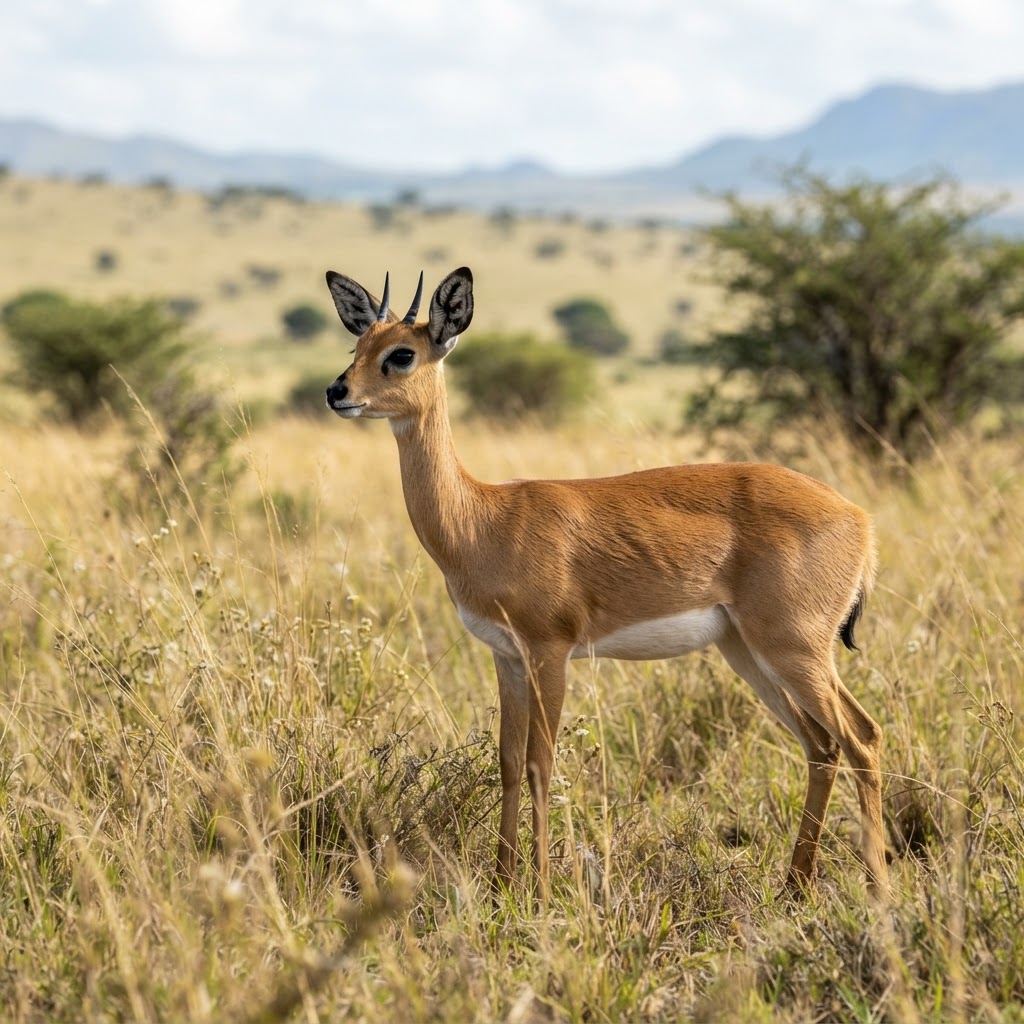
AI Generated
Southern Oribi
Ourebia ourebi ourebi
The Southern Oribi is a small, slender antelope native to Southern Africa, characterized by its reddish-brown coat and white underparts.
Southern Oribi
The Southern Oribi (Ourebia ourebi ourebi) is a small, slender antelope associated with the grasslands and open savannas of southern Africa. It has a reddish-fawn coat, white underparts, large ears and a distinctive dark scent gland below each ear.
Adult males carry short, straight horns with ringed bases. Females are hornless and generally similar to males in body size and coloration.
Modern taxonomic sources usually include the Southern Oribi within the wider species Ourebia ourebi. The subspecies name remains useful in traditional geographical and trophy classifications.
Habitat & Range
The Southern Oribi occurs primarily in eastern South Africa and neighboring parts of Eswatini, Mozambique and Zimbabwe.
It favors open grassland, lightly wooded savanna, floodplains and moist upland meadows. Suitable habitat normally contains a mixture of short feeding areas and taller grass used for concealment.
Oribi generally avoid dense woodland and severely overgrazed land. Appropriate fire and grazing patterns are important for maintaining the varied grass structure they require.
Behavior
Southern Oribi commonly live alone, in pairs or in small groups consisting of an adult male, one or more females and their young.
They are most active during the early morning and late afternoon but may feed throughout the day in cool or undisturbed conditions.
When threatened, an Oribi initially crouches or hides in the grass. If danger approaches too closely, it escapes with a fast, bounding run and may produce a sharp whistle.
Pairs or small groups occupy relatively stable home ranges and mark their surroundings using scent glands.
Diet
The Southern Oribi is primarily a grazer.
Its diet consists mainly of fresh, nutritious grasses, supplemented by herbs and other soft vegetation. It selects high-quality growth and may respond quickly to newly burned or recently grazed areas.
Seasonal rainfall and grassland management strongly influence food availability, distribution and breeding success.
Hunting & Identification
Where legally hunted, Southern Oribi are generally located by slowly glassing open grassland during the cooler parts of the day.
Shots are usually taken at short to moderate range. The animal’s small size and tendency to remain motionless in grass can make it difficult to detect and assess.
Only males carry horns. Mature males are identified by their straight, sharply pointed horns, which rise almost vertically before leaning slightly backward.
Trophy evaluation focuses primarily on horn length, basal circumference and symmetry. Horn tips should be inspected for wear or breakage.
Correct geographical identification is essential because several regional Oribi forms occur across sub-Saharan Africa and may be separated in traditional trophy systems.
Conservation Status
The Oribi (Ourebia ourebi) is classified as Least Concern by the IUCN, but the Southern Oribi does not receive a separate global assessment.
Populations in southern Africa are often fragmented and can decline rapidly where natural grassland is converted to agriculture, forestry or settlement.
Additional threats include illegal hunting with dogs, wire snares, inappropriate burning, excessive livestock grazing and poorly timed grass cutting.
Conservation depends on protecting connected grassland, maintaining suitable burning and grazing regimes and working with private landowners whose properties support many surviving populations.
Sources
Safari Club International Record Book — species index
Mammal Diversity Database — Ourebia ourebi
IUCN Red List assessment referenced by the Mammal Diversity Database