
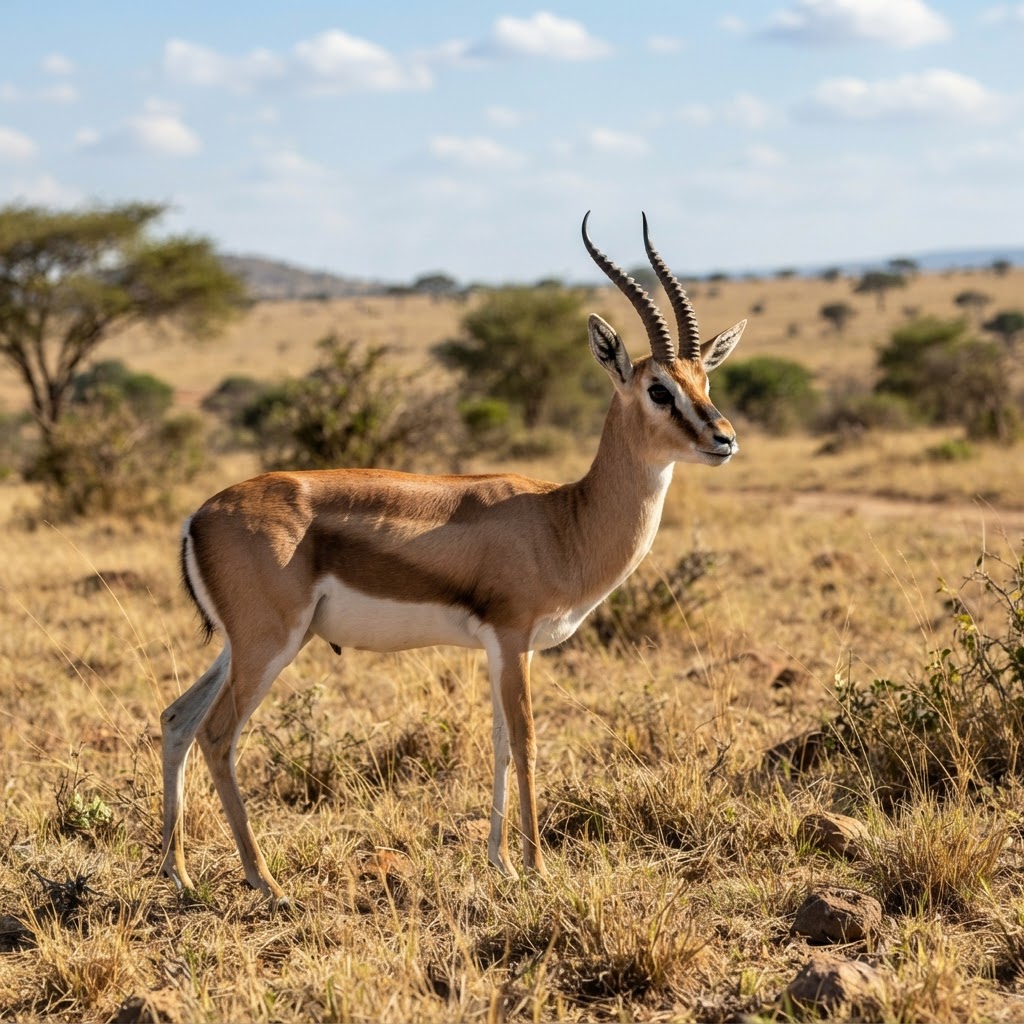
AI Generated
Soemmerring Gazelle
Nanger soemmerringii
The Soemmerring's Gazelle is a graceful antelope native to the Horn of Africa, distinguished by its long, curved horns and pale coat.
Soemmerring’s Gazelle
Soemmerring’s Gazelle (Nanger soemmerringii) is a large, pale gazelle native to the Horn of Africa. It is recognized by its white rump, sandy-brown coat and strongly contrasting facial pattern of dark stripes surrounding a broad white blaze.
Adult males are larger and more heavily built than females. Both sexes may carry horns, although those of mature males are substantially longer, thicker and more strongly curved.
The scientific name is sometimes written Nanger soemmerringi, but the Mammal Diversity Database uses Nanger soemmerringii, reflecting the spelling in the original species description.
Habitat & Range
Soemmerring’s Gazelle occurs primarily in Djibouti, Eritrea, Ethiopia, northern Somalia and eastern Sudan.
It inhabits dry grassland, open acacia savanna, semi-desert plains and lightly wooded scrub. The species generally favors flat or gently rolling landscapes with broad visibility and access to seasonal grazing.
Its distribution is fragmented, and many populations are isolated by agriculture, settlements, roads and livestock development.
Behavior
Soemmerring’s Gazelles are social and may occur in small groups or larger herds, depending on season and forage availability.
Mature males can establish territories during breeding periods, while females and young move between feeding areas. Herd structure may change as animals gather around temporary concentrations of fresh vegetation.
The species relies on sharp eyesight, vigilance and speed to avoid predators. Activity is usually greatest during the cooler morning and late-afternoon periods.
Diet
Soemmerring’s Gazelle is a mixed feeder.
It grazes grasses and also browses leaves, shoots, herbs and other soft vegetation. Its ability to obtain much of its moisture from food enables it to occupy dry environments with limited permanent surface water.
Seasonal rainfall strongly influences movement, herd size and body condition.
Hunting & Identification
Where legally hunted, Soemmerring’s Gazelle is generally located by glassing open plains, dry savanna and lightly wooded country before beginning a careful spot-and-stalk approach.
Mature males are identified by their heavier bodies, thicker necks and long, ringed horns. The horns curve backward before turning upward and inward near the tips.
Trophy evaluation focuses primarily on horn length, basal circumference, shape and symmetry. Horn tips should be examined carefully for wear or breakage.
The bold facial markings, pale body, white rump and relatively heavy build help distinguish Soemmerring’s Gazelle from Dorcas, Speke’s and other gazelles occurring in northeastern Africa.
Geography is particularly important for correct trophy classification because several regional forms have been described and traditional hunting systems may recognize distinctions not retained by modern taxonomic authorities.
Conservation Status
Soemmerring’s Gazelle is classified as Vulnerable by the IUCN.
The species is threatened by habitat degradation, agricultural expansion, livestock competition, drought, illegal hunting and political instability across portions of its range.
Many populations are declining or increasingly isolated. Conservation priorities include protecting dry savanna habitat, maintaining movement between seasonal grazing areas and controlling unsustainable hunting.
Sources
Safari Club International Record Book — species index