
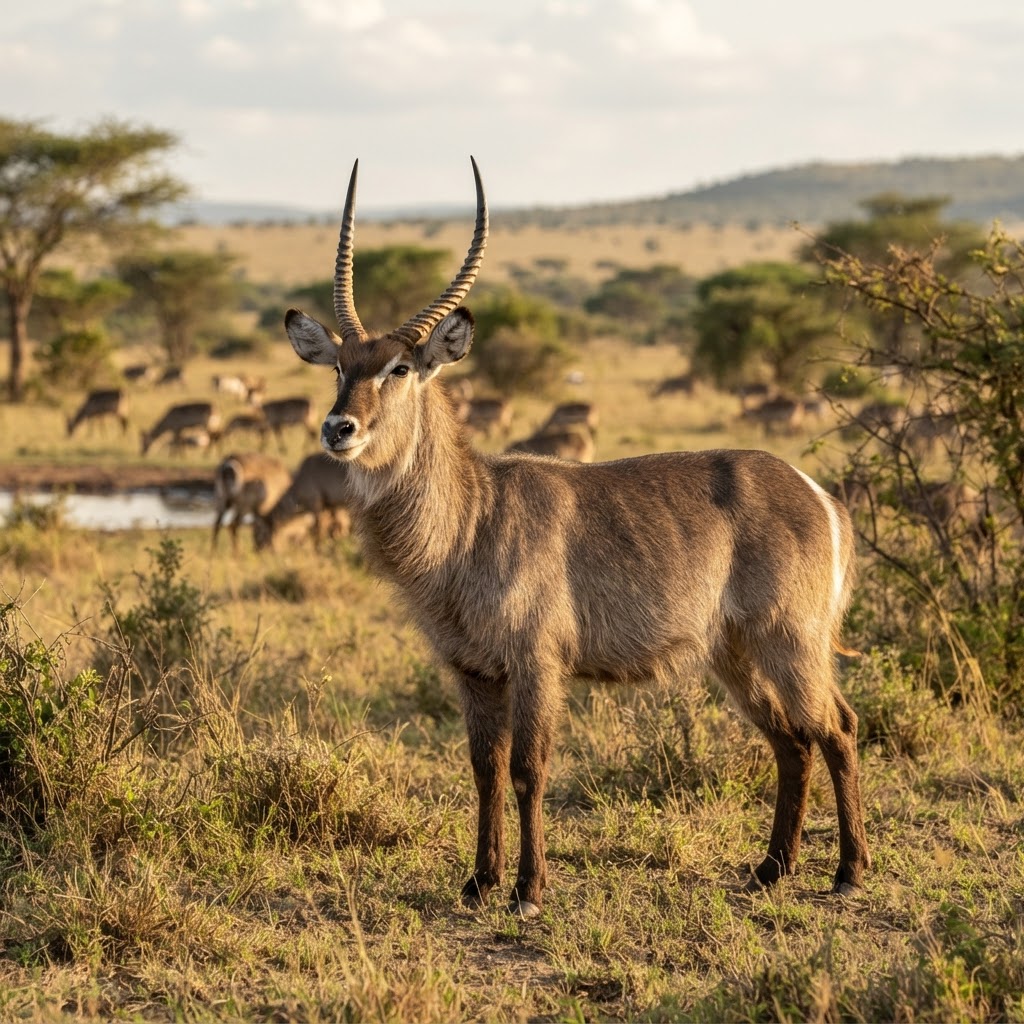
AI Generated
Sing-sing Waterbuck
Kobus ellipsiprymnus defassa
The Sing-sing Waterbuck is a large antelope found in central and west Africa, easily identified by its shaggy coat and distinctive white facial markings.
Sing-sing Waterbuck
The Sing-sing Waterbuck (Kobus ellipsiprymnus defassa) is a large, heavily built African antelope traditionally treated as a regional form of the Defassa Waterbuck. It is distinguished by the broad white patch covering the rump rather than the elliptical white ring characteristic of the Common Waterbuck.
Adult males are larger and darker than females and carry long, strongly ringed horns that sweep backward before curving upward and forward. Females are hornless.
Modern taxonomic sources generally include the Defassa forms within the wider Waterbuck species, Kobus ellipsiprymnus, rather than recognizing them as a separate species.
Habitat & Range
The Sing-sing Waterbuck is associated primarily with western Africa, particularly the savanna and woodland regions extending from Senegal eastward through parts of the West African interior.
It inhabits open woodland, wooded savanna, grassland, river valleys and floodplains. Waterbuck normally remain close to permanent water and rarely occupy extremely arid environments.
Dense vegetation provides resting and escape cover, while nearby grassland supplies the bulk of their food.
Behavior
Sing-sing Waterbuck are social. Females and young animals commonly form small herds, while mature bulls may live alone or defend territories overlapping the movements of female groups.
They are most active during the cooler morning and late-afternoon periods. During the heat of the day, they often rest in woodland, tall vegetation or shaded areas near water.
When disturbed, Waterbuck generally move toward dense cover or water. Their coarse coat contains oily skin secretions that produce a noticeable musky odor.
Diet
The Sing-sing Waterbuck is primarily a grazer.
Its diet consists mainly of medium-length and tall grasses, particularly fresh growth near rivers, wetlands and floodplains. It may also consume herbs and limited browse when preferred grasses are unavailable.
Its dependence on water and productive grazing strongly influences daily movement and local distribution.
Hunting & Identification
Sing-sing Waterbuck are commonly hunted by glassing river valleys, woodland margins, floodplains and open feeding areas during the cooler parts of the day.
Mature bulls are identified by their heavier bodies, thick necks, darker coloration and well-developed horns. Older bulls usually show greater horn length, heavier bases, pronounced ridging and worn tips.
Trophy evaluation focuses primarily on horn length, basal circumference, shape and symmetry. Only males carry horns.
The broad, solid white rump patch is an important field mark. It distinguishes the Sing-sing and other Defassa-type Waterbuck from the Common or Ellipsen Waterbuck, which displays a clearly defined white ring around the rump.
Geographical origin should also be documented carefully because traditional trophy classifications divide Waterbuck into regional forms that are not always recognized by modern mammal taxonomy.
Conservation Status
The Waterbuck (Kobus ellipsiprymnus) is classified as Least Concern by the IUCN. The Sing-sing form does not have a separate global assessment.
The species remains widespread, but some local populations are affected by habitat conversion, livestock competition, drought, illegal hunting and the loss of dependable water sources.
Protected areas and responsibly managed hunting concessions can conserve suitable riverine and savanna habitat. Maintaining connections between water sources and seasonal feeding areas is particularly important.
Sources
Safari Club International Record Book — species index