
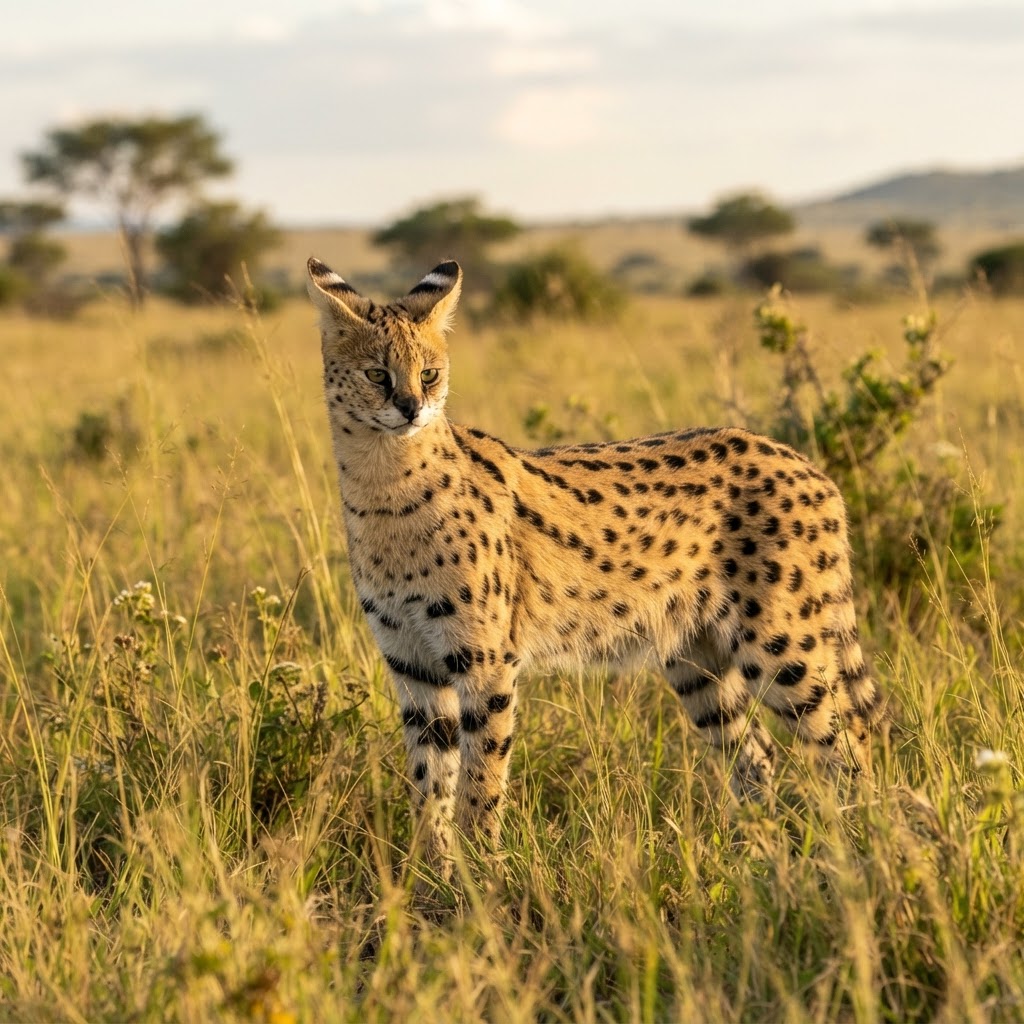
AI Generated
Serval
Leptailurus serval
The Serval is a medium-sized wild cat native to Africa, known for its long legs, large ears, and spotted coat.
The Serval (Leptailurus serval) is a medium-sized African wild cat recognized by its exceptionally long legs, large rounded ears and golden-yellow coat covered with black spots and stripes. Its slender build and long limbs make it particularly well adapted to hunting in tall grass and wetland habitats.
Adult males are generally larger and heavier than females. Both sexes share the same distinctive markings, although coat color and spot patterns vary between individuals and regions.
Habitat & Range
The Serval occurs widely across sub-Saharan Africa, with its strongest populations in eastern and southern Africa.
It is most closely associated with wetlands, grasslands, reed beds, marshes and savanna areas with tall vegetation and reliable water. Servals are less common in dense rainforest and extremely arid desert environments.
Behavior
Servals are primarily solitary and territorial.
They are most active during the early morning, evening and night, although daytime activity is also common in undisturbed areas.
Servals rely heavily on their exceptional hearing to locate prey hidden in grass. Their long legs allow them to see over vegetation and make high vertical leaps when catching birds or small mammals.
Diet
The Serval is a specialized predator that feeds mainly on small mammals.
Rodents make up a large part of the diet, but servals also hunt birds, frogs, reptiles, insects and other small vertebrates. Their hunting style often involves listening carefully before making a sudden leap onto concealed prey.
Hunting & Identification
Where legally hunted, servals are usually encountered opportunistically, hunted by slow walk-and-stalk, or located around grasslands, wetland edges and areas with high rodent activity.
Shots are generally taken at short to moderate range. Light centerfire rifles such as the .22 centerfire, .243 and similar calibers are suitable where legal, with appropriate expanding ammunition.
The Serval is easily identified by its very long legs, disproportionately large ears and black-spotted golden coat. The ears are especially distinctive, with bold black-and-white markings on the rear.
Trophy assessment generally focuses on overall body size and skull measurements rather than horn or tusk dimensions.
Care should be taken not to confuse the Serval with the Caracal, which has a more uniform reddish coat, shorter legs and distinctive black ear tufts.
Conservation Status
The Serval is classified as Least Concern by the IUCN (2015).
The species remains widespread, although local populations may be affected by wetland loss, agricultural development, persecution and illegal trade.
Sources
Mammal Diversity Database — Leptailurus serval
https://www.mammaldiversity.org/
IUCN Red List — Serval
Animal Diversity Web — Leptailurus serval