
AI Generated
Salt Dik-dik
Madoqua saltiana
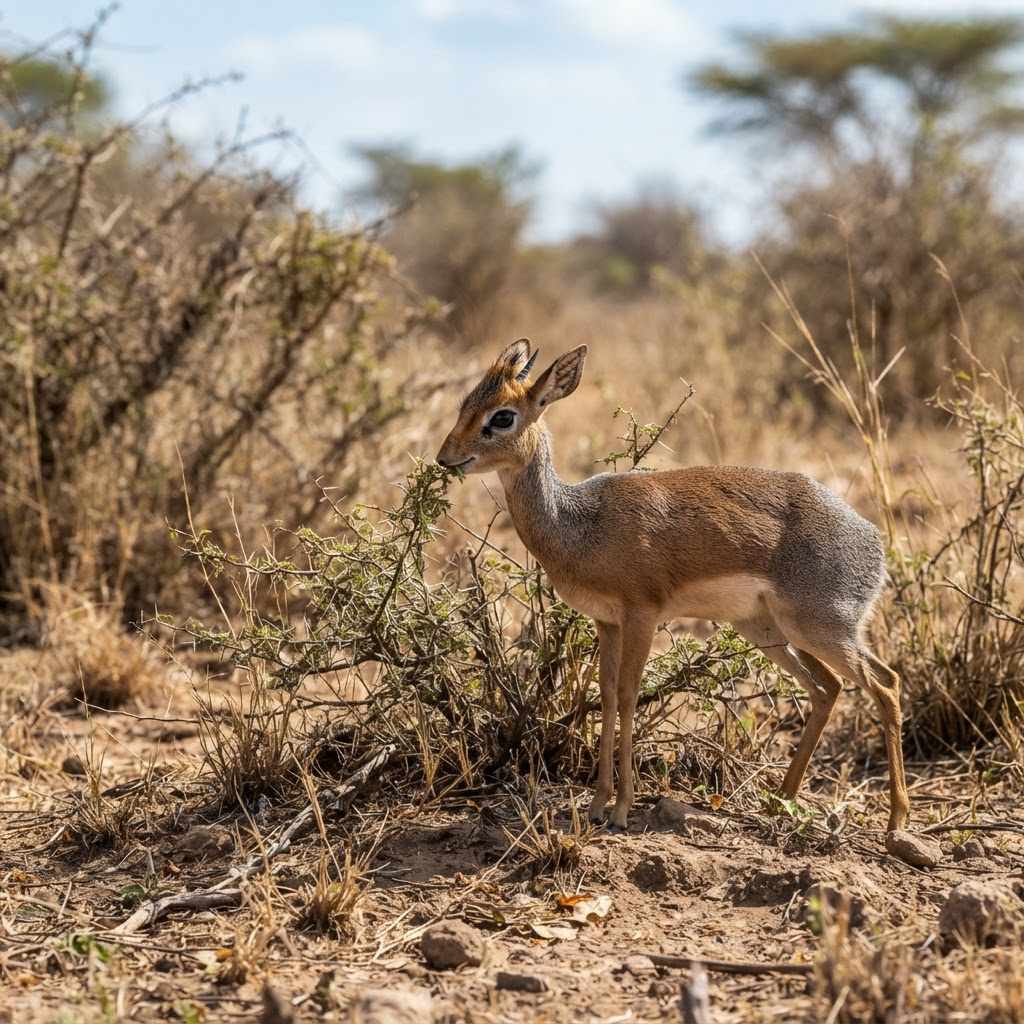
The Salt's Dik-dik is a small, shy antelope found in arid regions of northeastern Africa, characterized by its reddish-brown coat and pointed snout.
The Salt’s Dik-dik (Madoqua saltiana) is a very small antelope of the Horn of Africa, adapted to some of the driest landscapes on the continent. It is recognized by its delicate build, elongated snout, large eyes and ears, and the short, straight horns carried by males.
Adult males are generally similar in size to females but are the only sex to carry horns. The coat varies from grey-brown to reddish depending on region and habitat, with paler underparts and subtle facial markings.
Habitat & Range
Salt’s Dik-dik occurs mainly in Ethiopia, Eritrea, Djibouti, Somalia and neighboring parts of northeastern Africa.
It inhabits dry bushland, thorn scrub, rocky slopes and semi-desert terrain, often in areas with sparse vegetation and very limited surface water.
Behavior
Salt’s Dik-dik usually live alone or in monogamous pairs and maintain relatively small territories.
They are most active during the cooler hours of the morning, late afternoon and evening, avoiding the most intense heat of the day.
When disturbed, they rely on quick bursts of speed and dense cover rather than prolonged running.
Diet
Salt’s Dik-dik is primarily a browser, feeding on leaves, shoots, herbs, flowers and other soft plant material.
It obtains most of the moisture it needs from vegetation and can survive for long periods without drinking standing water.
Hunting & Identification
Where legally hunted, Salt’s Dik-dik is typically taken by slow walk-and-stalk or by carefully glassing thornbush, rocky slopes and dry scrub during the cooler parts of the day.
Shots are usually taken at short to moderate range. Light centerfire rifles such as the .22 centerfire, .243 and similar calibers are appropriate where legal, using suitable expanding ammunition.
Mature males are identified by the presence of short, straight horns, which may be partly hidden by forehead hair.
Trophy evaluation focuses mainly on horn length, basal mass and symmetry.
Correct identification is important because several dik-dik forms occur in northeastern Africa, and geography is often an important part of traditional trophy classification.
Conservation Status
Salt’s Dik-dik is classified as Least Concern by the IUCN (2016).
Although the species remains widespread in suitable habitat, local populations may be affected by habitat degradation, livestock competition, drought and hunting pressure.
Sources
Mammal Diversity Database — Madoqua saltiana
https://www.mammaldiversity.org/
IUCN Red List — Salt’s Dik-dik
Animal Diversity Web — Madoqua saltiana