
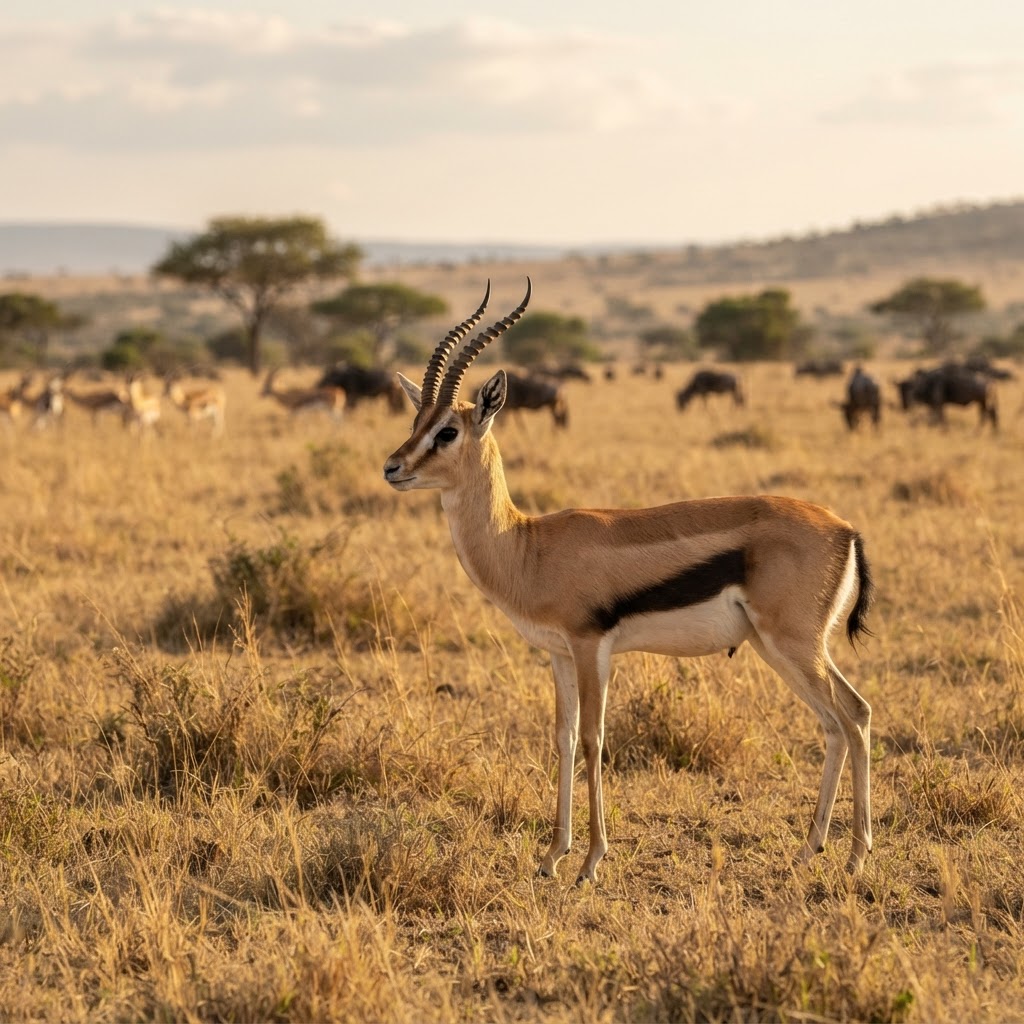
AI Generated
Roberts Gazelle
Nanger granti robertsi
The Roberts' Gazelle is an East African subspecies of Grant's gazelle, known for its elegant appearance and arid habitat.
The Roberts Gazelle (Nanger granti robertsi) is a regional form of Grant’s Gazelle associated primarily with northern Tanzania. It is a large, pale gazelle recognized by its sandy-brown coat, white underparts and long, strongly ringed horns.
Adult males are larger and more heavily built than females, with longer and thicker horns that curve backward before turning outward near the tips. Females are smaller and may carry much shorter horns. Modern taxonomic sources generally treat robertsi within the wider Grant’s Gazelle species rather than as a separate species. Mammal Diversity
Habitat & Range
Roberts Gazelle is associated mainly with northern Tanzania and the surrounding East African savanna system.
It inhabits open grassland, dry savanna, semi-arid plains and lightly wooded country. These open habitats provide good visibility and access to the grasses and browse on which the gazelle depends.
Behavior
Roberts Gazelles are social and may occur in small groups or larger herds depending on season and habitat.
Mature males may establish territories during the breeding season, while females and young move between feeding areas.
They are highly alert and rely on speed, endurance and excellent eyesight to detect and escape predators.
Diet
Roberts Gazelle is a mixed feeder, grazing on grasses while also browsing leaves, shoots and other vegetation.
Its ability to obtain much of its moisture from food allows it to live in relatively dry environments and reduces its dependence on permanent surface water.
Hunting & Identification
Roberts Gazelle is typically hunted by spot-and-stalk in open grassland and dry savanna. Glassing from elevated ground is often used to locate a mature male and plan an approach.
The open terrain commonly results in moderate to long shooting distances. Flat-shooting plains-game rifles in the .243, .270 and 7mm classes are well suited when paired with appropriate expanding ammunition.
Mature males are identified by their larger body and long, heavily ringed horns. Older males generally show greater horn length, heavier bases and stronger outward curvature.
Trophy evaluation focuses primarily on horn length, basal mass, shape and symmetry.
Geography is particularly important for correct trophy classification. Although Nanger granti robertsi remains a recognized name in some taxonomic and traditional hunting systems, the Mammal Diversity Database currently treats robertsi as a synonym within Nanger granti. Mammal Diversity
Conservation Status
Grant’s Gazelle (Nanger granti) is classified as Least Concern by the IUCN (2024). The Roberts form does not currently have a separate global IUCN assessment. Mammal Diversity
Local populations may nevertheless be affected by habitat conversion, fencing, livestock competition and fragmentation of traditional grazing areas.
Sources
Mammal Diversity Database — Nanger granti
https://www.mammaldiversity.org/taxon/1006165/
ITIS — Nanger granti / Nanger granti robertsi
https://www.itis.gov/servlet/SingleRpt/SingleRpt?search_topic=TSN&search_value=898226
NCBI Taxonomy — Nanger granti
https://www.ncbi.nlm.nih.gov/Taxonomy/Browser/wwwtax.cgi?id=27591
GBIF — Nanger granti