
AI Generated
Red River Hog
Potamochoerus porcus
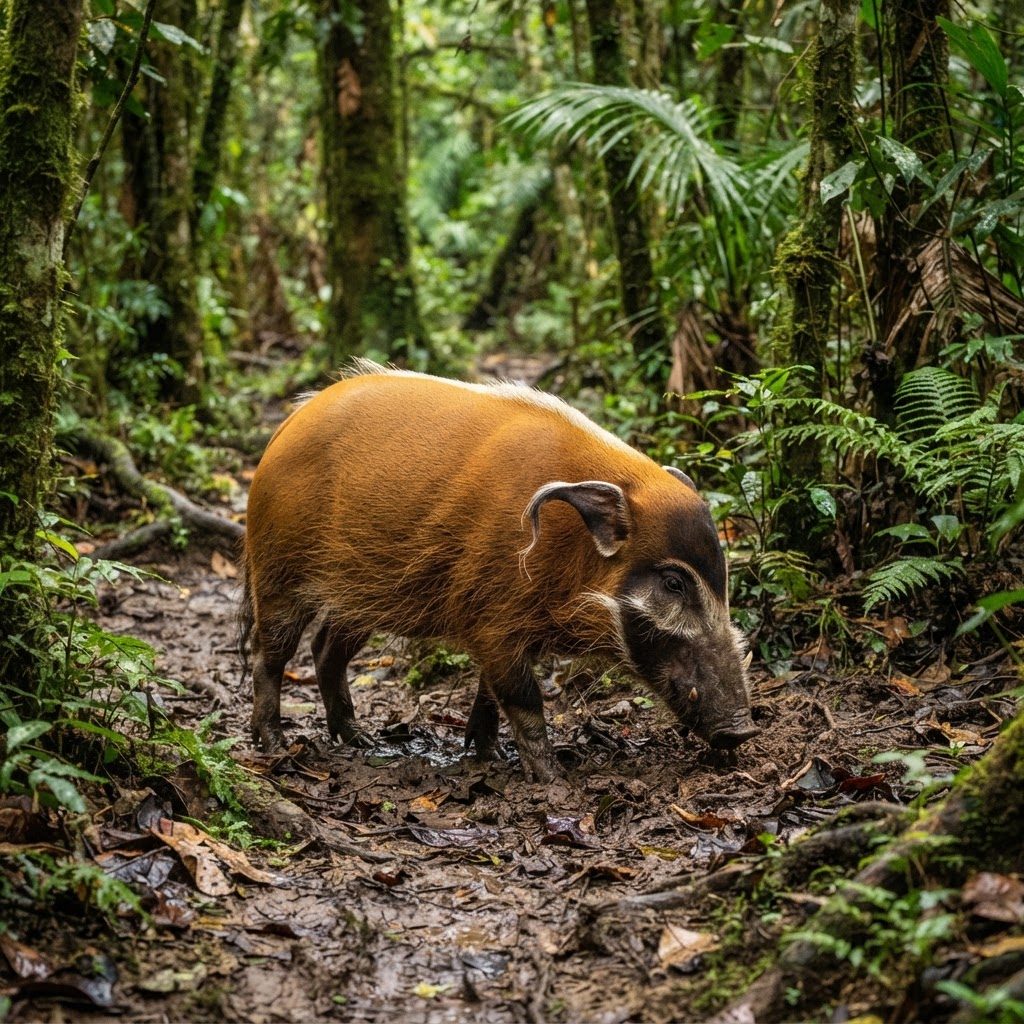
The Red River Hog is a wild pig native to the African rainforests, characterized by its striking reddish-brown fur and prominent facial tufts.
The Red River Hog (Potamochoerus porcus) is a striking wild pig found in the forests and woodland regions of West and Central Africa. It is recognized by its bright reddish coat, white facial markings, elongated ears with prominent tufts and the dark stripe running along the back.
Adult males are larger and heavier than females and develop broader heads, more pronounced facial swellings and larger canine tusks. Both sexes have a stocky body, strong legs and a relatively long tail.
Habitat & Range
The Red River Hog occurs across much of West and Central Africa, including countries such as Senegal, Guinea, Côte d’Ivoire, Ghana, Nigeria, Cameroon, Gabon, the Republic of the Congo and the Democratic Republic of the Congo.
It inhabits tropical rainforest, swamp forest, riverine woodland, secondary forest and dense bush. It is particularly associated with areas offering thick cover, water and abundant food.
Behavior
Red River Hogs are highly social and usually live in small family groups.
They are primarily nocturnal, becoming most active from late afternoon through the night. During the day they rest in dense vegetation.
They are intelligent, alert animals and communicate through grunts, squeals and scent marking. When disturbed, they usually retreat quickly into thick cover.
Diet
The Red River Hog is omnivorous.
Its diet includes roots, tubers, fruit, seeds, grasses, insects, eggs, carrion and small vertebrates. It frequently roots through the forest floor in search of food and may also feed in agricultural areas.
Hunting & Identification
Red River Hogs are typically hunted by tracking, still-hunting, baiting where legal, or by waiting near feeding areas and forest clearings.
Because they are mainly nocturnal and remain close to heavy cover, shots are generally taken at short to moderate range. Medium plains-game rifles in the .270, 7mm and .30-caliber classes are well suited, with sturdy expanding ammunition recommended for mature boars.
Mature males are identified by their heavier body, broader head, pronounced facial swellings and larger tusks. Older boars usually appear darker and more heavily built through the shoulders.
Trophy evaluation focuses primarily on tusk length, tusk mass and overall maturity.
The combination of reddish coloration, white facial markings and long ear tufts makes the species easy to distinguish from other African wild pigs.
Conservation Status
The Red River Hog is classified as Least Concern by the IUCN (2016).
The species remains widespread and adaptable, although local populations may be affected by habitat loss, bushmeat hunting and conflict with farmers where animals raid crops.
Sources
Mammal Diversity Database — Potamochoerus porcus
https://www.mammaldiversity.org/
IUCN Red List — Red River Hog
Animal Diversity Web — Potamochoerus porcus