
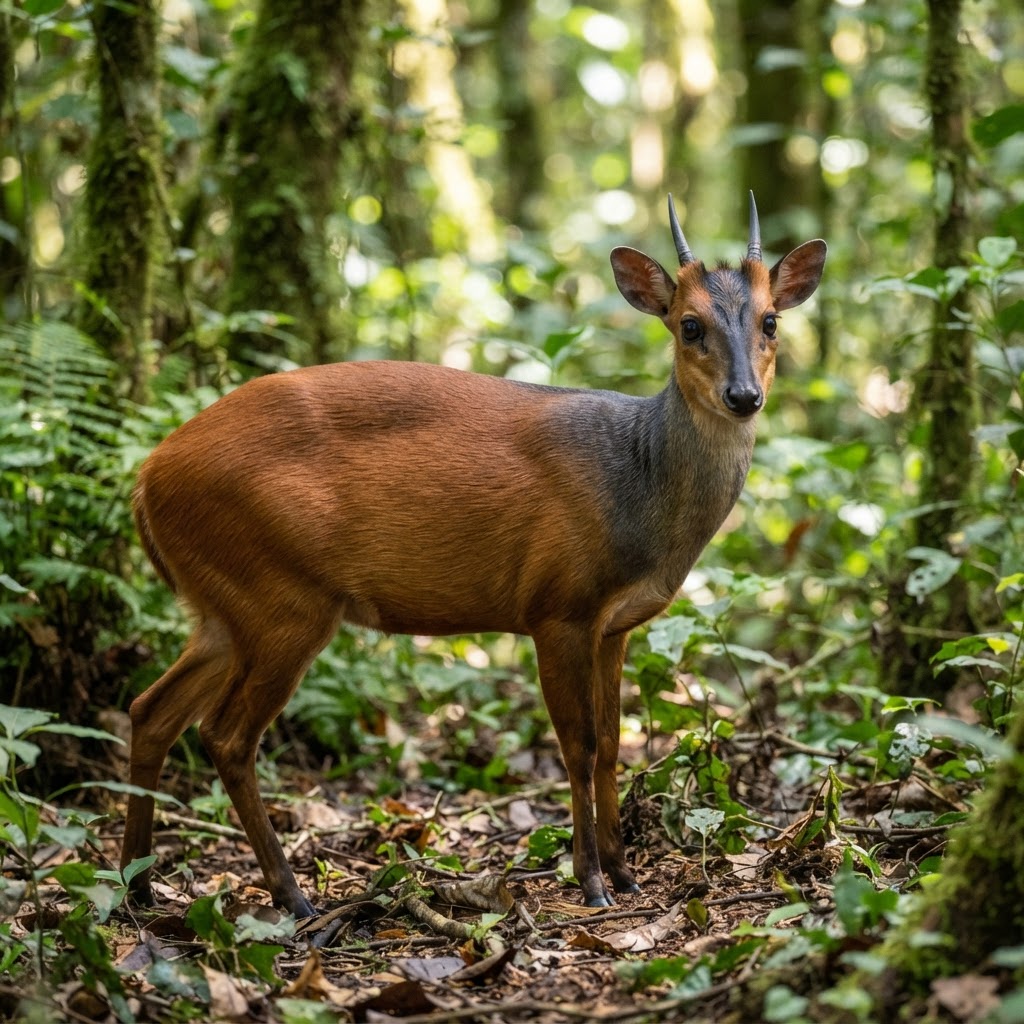
AI Generated
Red-flanked Duiker
Cephalophus rufilatus
The Red-flanked Duiker is a small antelope native to West and Central Africa, easily recognized by its reddish-brown coat and dark flank stripe.
The Red-flanked Duiker (Cephalophus rufilatus) is a small forest and woodland antelope found across West and Central Africa. It is recognized by its reddish-brown flanks, darker back, compact body and short, straight horns.
Adult males and females are similar in size, although males generally show slightly heavier horn development. Both sexes have a low, rounded body shape suited to moving quickly through dense vegetation.
Habitat & Range
The Red-flanked Duiker occurs across parts of West and Central Africa, including Senegal, Guinea, Côte d’Ivoire, Ghana, Nigeria, Cameroon and neighboring regions.
It inhabits woodland, forest margins, gallery forest, savanna thickets and dense bush, often close to water. It is more tolerant of open and secondary habitats than some of the larger forest duikers.
Behavior
Red-flanked Duikers are generally solitary or found in pairs.
They are most active during the early morning, late afternoon and night, spending much of the day concealed in thick vegetation.
When disturbed, they rely on short, rapid bursts of speed and dense cover rather than prolonged running.
Diet
The Red-flanked Duiker is primarily a browser and frugivore.
Its diet includes leaves, shoots, herbs, flowers, seeds and fallen fruit. Like several other duiker species, it may also consume insects and small amounts of animal matter when available.
Hunting & Identification
Red-flanked Duikers are typically hunted by slow walk-and-stalk, still-hunting and careful observation along forest edges, trails, clearings and feeding areas.
Shots are usually taken at short range because visibility is often limited and the animal rarely remains exposed for long. Light plains-game rifles such as the .22 centerfire, .243 and similar cartridges are suitable where legal, using appropriate expanding ammunition.
Mature males are identified primarily by horn development and overall head structure. Trophy evaluation focuses mainly on horn length, basal mass and symmetry.
The reddish flanks, darker dorsal area and relatively small body size help distinguish the Red-flanked Duiker from Bay, Peters’ and Yellow-backed Duikers in overlapping regions.
Conservation Status
The Red-flanked Duiker is classified as Least Concern by the IUCN (2016).
The species remains widespread, although local populations may be affected by bushmeat hunting, habitat conversion, agricultural expansion and fragmentation of woodland and forest habitat.
Sources
Mammal Diversity Database — Cephalophus rufilatus
https://www.mammaldiversity.org/
IUCN Red List — Red-flanked Duiker
Animal Diversity Web — Cephalophus rufilatus