
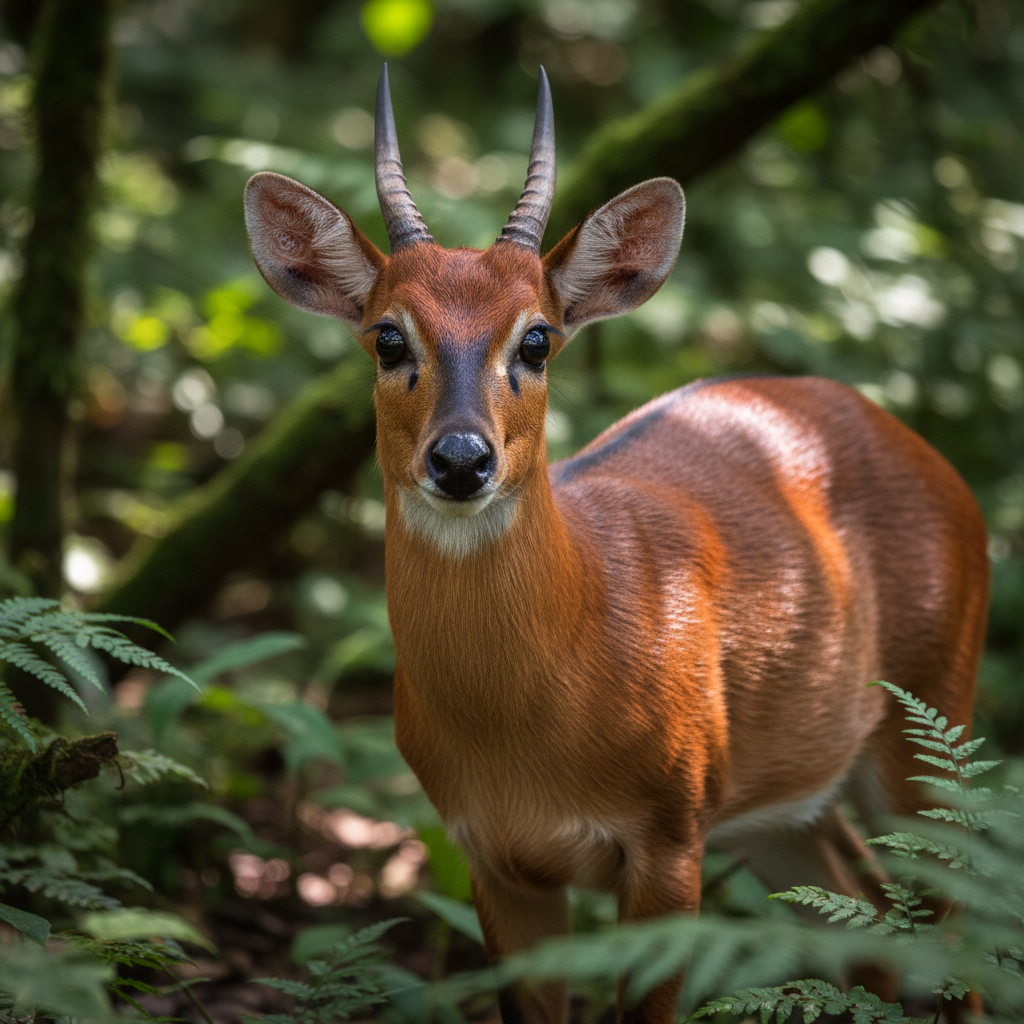
AI Generated
Ogilby Duiker
Philantomba ogilbyi
The Ogilby Duiker (Philantomba ogilbyi) is a small forest dweller found in West and Central Africa. This profile covers its biology, habitat, and conservation status.
# Ogilby Duiker (Philantomba ogilbyi)
The Ogilby Duiker is a small antelope species native to the dense rainforests of West and Central Africa. Known scientifically as Philantomba ogilbyi, this elusive creature is primarily found in the countries of Gabon, the Republic of the Congo, and parts of Cameroon and Nigeria. Characterized by its shy nature, the Ogilby Duiker is well-adapted to its forest habitat and plays a significant role in its ecosystem.
Description
The Ogilby Duiker is a small, stocky antelope, seldom exceeding a height of 75 cm (30 in) at the shoulder and weighing between 25 to 50 kg (55 to 110 lbs). Its coat is a rich reddish-brown, which provides excellent camouflage among the forest undergrowth. One of its defining features is the white stripe running down the face and a faint white ring around its eyes, giving it a distinctive appearance.
Males possess short, straight horns that can reach up to 20 cm (8 in) in length, while females are hornless. The Ogilby Duiker has a compact body, long legs, and a short tail, adaptations that aid in maneuvering through dense foliage. Their large, expressive eyes and keen hearing make them agile and alert predators of their natural surroundings.
Habitat & Range
Ogilby Duikers inhabit the lowland rainforests of West and Central Africa. They favor dense underbrush areas where they can find shelter from predators, and they are often associated with swamp forests and the edges of clearings where food is abundant.
The typical range of the Ogilby Duiker extends from the coastal rainforests of Nigeria to the more inland areas of Gabon and the Republic of the Congo. Their preference for forest habitats limits their distribution, making them susceptible to habitat destruction due to logging and agriculture.
Behavior
Ogilby Duikers are primarily solitary or found in small groups, typically consisting of a mother and her offspring. They are crepuscular, meaning they are most active during dawn and dusk. During the day, they seek shelter in dense vegetation to avoid predators such as leopards and large birds of prey.
These animals exhibit a cautious and secretive demeanor, often freezing in place when they sense danger, relying on their camouflage to avoid detection. They are also known to communicate through a variety of vocalizations and scent markings to establish territory and attract mates.
Diet
The Ogilby Duiker is a herbivore, primarily feeding on a diet of leaves, fruits, and flowers that are abundant in their forest habitat. Their selective feeding habits allow them to thrive on the rich vegetation that characterizes rainforest ecosystems. This browsing behavior also plays a crucial role in seed dispersal, contributing to the health and regeneration of their environment.
Hunting & Identification Notes
For hunters and wildlife enthusiasts, identifying the Ogilby Duiker can be challenging due to its elusive nature and camouflage. When in search of Ogilby Duikers, look for signs such as droppings and browsing marks on vegetation.
During the early morning or late afternoon, observers may spot these animals near water sources or in clearings. Notably, males can be identified by their horns and the unique white facial markings, while females are typically smaller and lack horns.
Conservation Status
The Ogilby Duiker is currently classified as Near Threatened by the International Union for Conservation of Nature (IUCN). The primary threats to their population include habitat loss from logging, agricultural expansion, and poaching for bushmeat.
Conservation efforts are essential to protect their remaining habitats and to mitigate hunting pressures. Efforts include establishing protected areas within their range, monitoring populations, and raising awareness about the species and its ecological importance.
In conclusion, the Ogilby Duiker is a remarkable species that exemplifies the rich biodiversity found in the rainforests of Africa. Understanding its biology and conservation needs is vital for preserving this unique antelope in its natural habitat.