
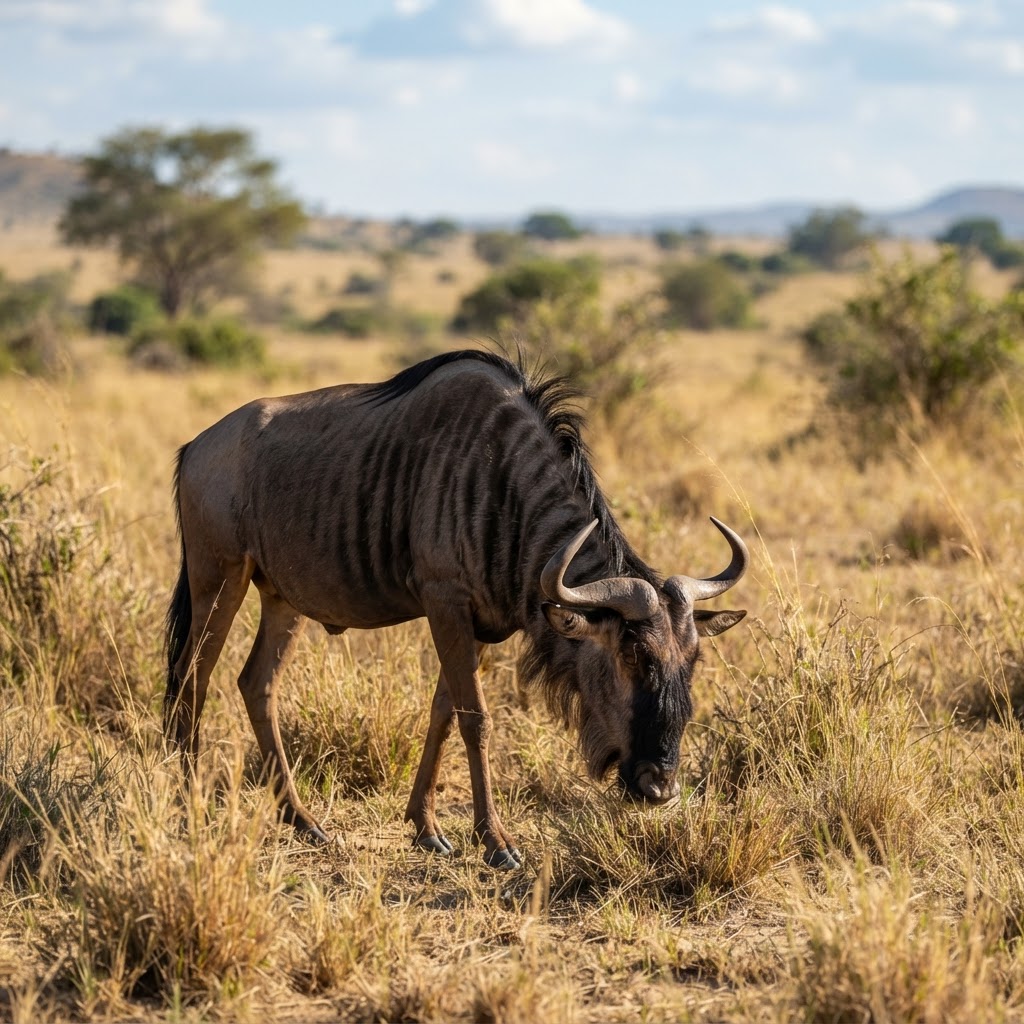
AI Generated
Nyasa Wildebeest
Connochaetes taurinus johnstoni
The Nyasa Wildebeest is a subspecies of blue wildebeest found in southeastern Africa, recognizable by its darker coat and distinct markings.
The Nyasa Wildebeest (Connochaetes taurinus johnstoni) is a regional form of Blue Wildebeest found in southeastern Africa. It has the characteristic heavy shoulders, sloping back, broad muzzle and curved horns of the blue wildebeest, with a grey-brown coat marked by darker vertical striping.
Adult males are larger and more heavily built than females, with thicker horn bases and a more muscular neck and shoulder area. Both sexes carry horns, although mature bulls develop greater mass and a more imposing overall appearance.
Habitat & Range
The Nyasa Wildebeest is associated mainly with parts of Malawi, northern Mozambique and neighboring areas of southeastern Africa.
It inhabits open grassland, savanna and lightly wooded plains, particularly where seasonal grazing and access to water are available.
Behavior
Nyasa Wildebeest are social antelope and usually occur in herds.
Females and young often form larger groups, while mature bulls may hold territories or associate in bachelor groups outside the breeding season.
They are alert, mobile animals and rely on speed, herd vigilance and open terrain to avoid predators.
Diet
The Nyasa Wildebeest is primarily a grazer, feeding mainly on grasses.
It prefers fresh, nutrient-rich growth and may shift feeding areas in response to seasonal rainfall, fire and changes in grass quality.
Hunting & Identification
Nyasa Wildebeest are typically hunted by spot-and-stalk in open savanna and grassland. Long-range glassing can be useful for identifying a mature bull before beginning an approach.
Shots are usually taken at moderate range, although the open terrain can produce longer opportunities. Medium to heavier plains-game rifles in the .270, 7mm and .30-caliber classes are well suited, with cartridges such as the .30-06 and .300 Winchester Magnum commonly used.
Mature bulls are identified by their heavier body, thick neck, larger horn bases and darker overall appearance.
Trophy evaluation focuses primarily on horn spread, basal mass, shape and symmetry. Older bulls generally show heavier bosses and more worn horn tips.
Because several regional forms of Blue Wildebeest are recognized in traditional hunting classifications, geography is important when identifying the Nyasa form.
Conservation Status
The Blue Wildebeest (Connochaetes taurinus) is classified as Least Concern by the IUCN (2016).
The Nyasa form has a more restricted regional distribution than the species as a whole, and local populations may be affected by habitat loss, livestock competition, disease and hunting pressure.
Sources
Mammal Diversity Database — Connochaetes taurinus
https://www.mammaldiversity.org/
IUCN Red List — Blue Wildebeest
Animal Diversity Web — Connochaetes taurinus