
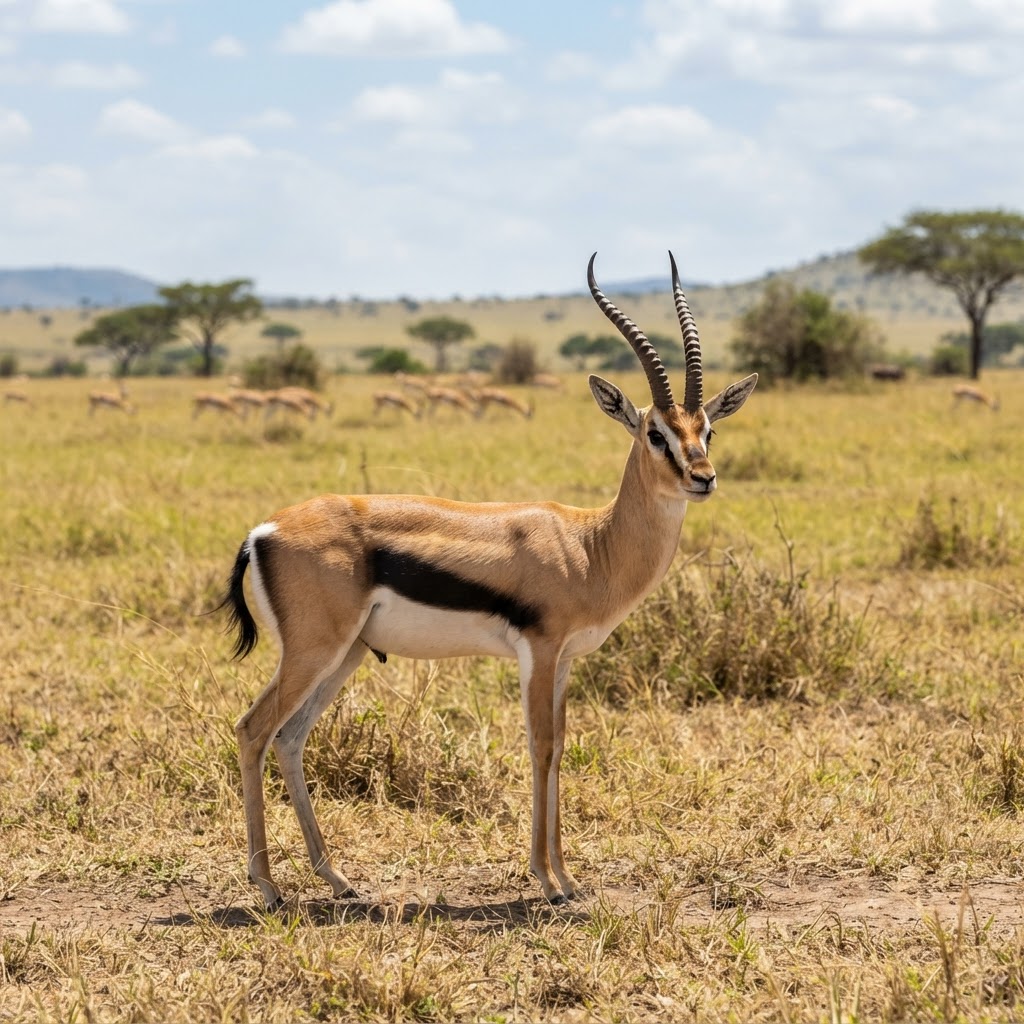
AI Generated
Northern Grant Gazelle
Nanger granti granti
The Northern Grant's Gazelle is a subspecies of Grant's gazelle inhabiting the northern parts of its range in East Africa.
The Northern Grant’s Gazelle (Nanger granti, traditionally classified in hunting records as Nanger granti lacuum) is a large, pale gazelle of East Africa. It is recognized by its sandy-brown coat, white underparts, contrasting facial markings and the long, strongly ringed horns carried by males. SCI continues to recognize Northern Grant Gazelle as a separate trophy category. Safari Club International
Adult males are larger and more heavily built than females and develop long horns that curve backward before turning outward and slightly forward near the tips. Females are lighter and may carry much shorter horns.
Habitat & Range
Northern Grant’s Gazelle occurs primarily in northern Kenya and adjacent parts of East Africa.
It inhabits dry savanna, open grassland, semi-arid plains and lightly wooded country. The species is especially well adapted to environments with limited surface water and can obtain much of its moisture from vegetation.
Modern mammal taxonomy generally treats Grant’s Gazelle as Nanger granti, while older and hunting-based classifications recognize several geographic forms. mammaldiversity.org
Behavior
Northern Grant’s Gazelles are social and may occur alone, in small groups or in larger herds depending on season and habitat.
Mature males may establish territories, while females and young move more freely between feeding areas.
They rely heavily on excellent eyesight and speed in open country and are most active during the cooler hours of the morning and afternoon.
Diet
The Northern Grant’s Gazelle is a mixed feeder, grazing on grasses while also browsing leaves, shoots and other vegetation.
Its ability to obtain moisture from food allows it to remain in dry areas for extended periods without regularly drinking standing water.
Hunting & Identification
Northern Grant’s Gazelles are typically hunted by spot-and-stalk in open savanna and semi-arid plains. Glassing from elevated ground is often used to locate a mature male before planning an approach.
The open terrain frequently produces moderate to long shooting distances. Flat-shooting plains-game rifles in the .243, .270 and 7mm classes are well suited when paired with appropriate expanding ammunition.
Mature males are identified by their larger body and long, heavily ringed horns. Older males generally show greater horn length, stronger basal mass and more developed outward curvature.
Trophy evaluation focuses primarily on horn length, basal mass, shape and symmetry. SCI lists Northern Grant Gazelle separately from Southern Grant, Roberts, Peters and Bright gazelles in its trophy-measuring system. Safari Club International
Geography is especially important for correct classification because Grant’s Gazelle taxonomy has changed considerably, and modern authorities do not recognize all of the traditional hunting subspecies. itis.gov
Conservation Status
Grant’s Gazelle (Nanger granti) is classified as Least Concern by the IUCN (2016). media.eol.org
The species remains relatively widespread, although some populations are affected by habitat conversion, livestock competition and fragmentation of traditional grazing areas.
Sources
Mammal Diversity Database — Nanger granti
https://www.mammaldiversity.org/taxon/1006165/
IUCN Red List — Grant’s Gazelle
https://www.iucnredlist.org/species/8971/50186774
Safari Club International — Measuring Manual
https://safariclub.org/wp-content/uploads/2023/12/SCI-Measuring-Manual-Sept-2023.pdf
Animal Diversity Web — Nanger granti