
AI Generated
Northern Gerenuk
Litocranius walleri walleri
The Northern Gerenuk is a long-necked antelope found in the Horn of Africa, known for its ability to stand on hind legs to browse.
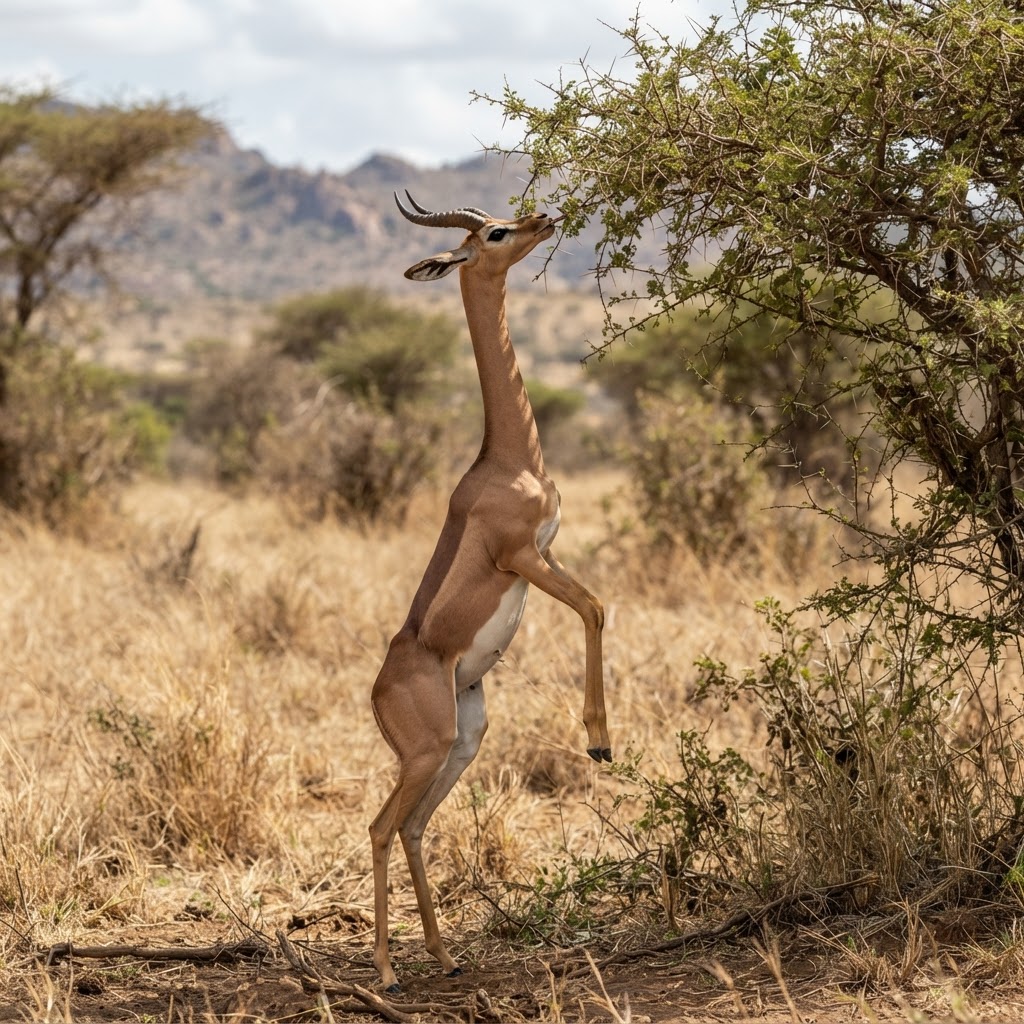
The Northern Gerenuk (Litocranius walleri sclateri) is a distinctive long-necked antelope found in the arid and semi-arid regions of the Horn of Africa. It is immediately recognizable by its slender body, exceptionally long neck, small head and the lyre-shaped horns carried by males.
Adult males are slightly larger and heavier than females and are the only sex to carry horns. The coat is typically reddish-brown to sandy in color, with lighter underparts and darker shading along the back.
Habitat & Range
The Northern Gerenuk occurs mainly in Ethiopia, Somalia and neighboring parts of northeastern Africa.
It inhabits dry bushland, thorn scrub and semi-desert environments, especially areas dominated by acacia and other browse plants. It is highly adapted to arid landscapes and can survive for long periods without drinking free-standing water.
Behavior
Northern Gerenuk are generally found alone, in pairs or in small groups.
They are most active during the cooler parts of the day and spend much of their time browsing. One of their most distinctive behaviors is standing upright on the hind legs to reach leaves and shoots well above the browsing height of many other antelope.
They are alert and rely on quick acceleration and dense bush for protection.
Diet
The Northern Gerenuk is primarily a browser, feeding on leaves, shoots, flowers and fruits from shrubs and small trees.
Its long neck and ability to stand upright allow it to reach food sources unavailable to most other antelope. Much of its water requirement is obtained directly from vegetation.
Hunting & Identification
Northern Gerenuk are typically hunted by spot-and-stalk in open thornbush and semi-arid terrain. Glassing from elevated positions can be effective for locating mature males before beginning an approach.
Shots are usually taken at moderate range, although the open terrain can lead to longer opportunities. Flat-shooting plains-game rifles in the .243, .270 and 7mm classes are well suited when paired with appropriate expanding ammunition.
Mature males are identified by their long, lyre-shaped horns, slightly heavier body and darker neck and back.
Trophy evaluation focuses mainly on horn length, basal mass, shape and symmetry.
The Northern Gerenuk should be distinguished from southern gerenuk forms by geography and traditional hunting classification.
Conservation Status
The Gerenuk (Litocranius walleri) is classified as Near Threatened by the IUCN (2016).
Populations are affected by habitat degradation, livestock competition, drought, agricultural expansion and hunting pressure in parts of their range.
Sources
Mammal Diversity Database — Litocranius walleri
https://www.mammaldiversity.org/
IUCN Red List — Gerenuk
Animal Diversity Web — Litocranius walleri