
AI Generated
Nile Lechwe
Kobus megaceros
The Nile Lechwe is an endangered antelope found in the wetlands of South Sudan and Ethiopia, known for its water-adapted lifestyle.
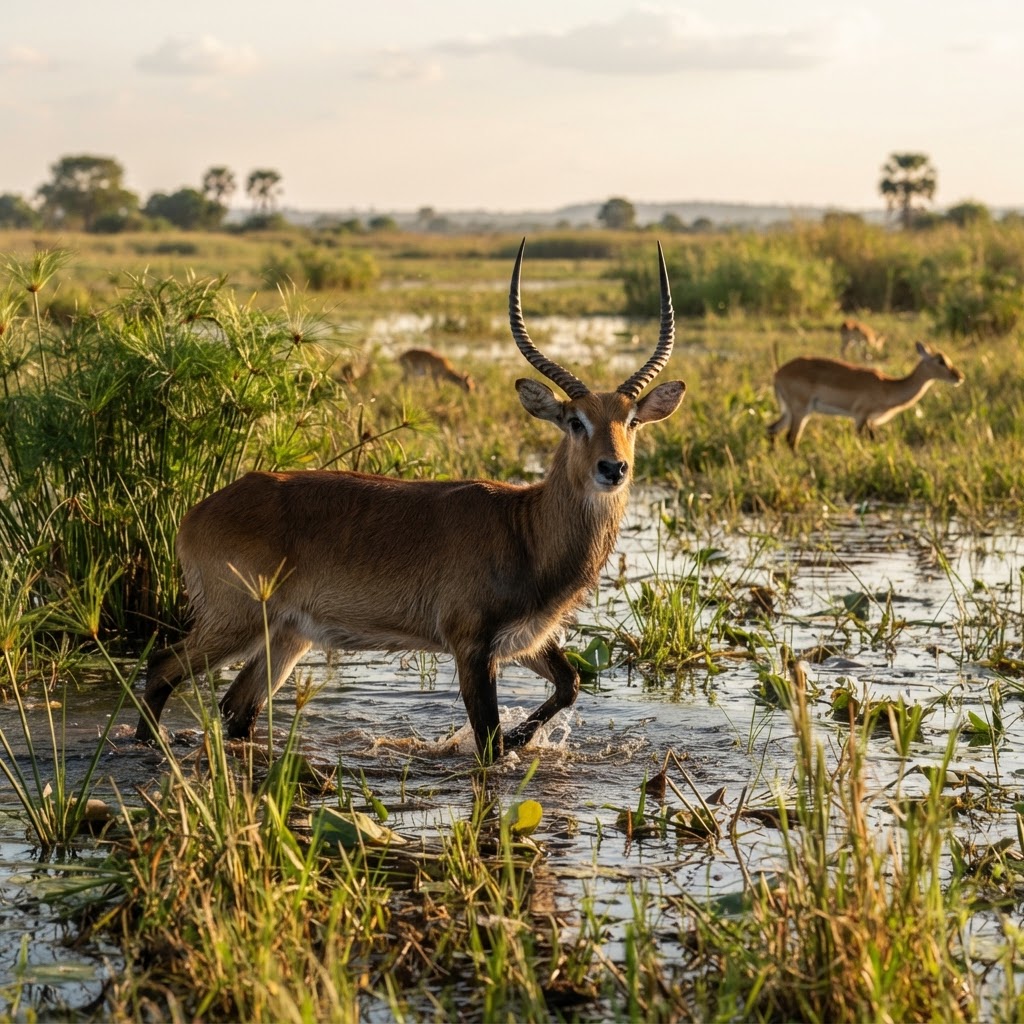
The Nile Lechwe (Kobus megaceros) is a medium-sized wetland antelope native to the floodplains and marshes of South Sudan and western Ethiopia. Mature males are particularly striking, with a dark chocolate-brown coat, prominent white markings and long, strongly curved horns.
Adult males are substantially darker and heavier than females. Females are hornless and retain a lighter golden to reddish-brown coloration. Both sexes have elongated hooves and adaptations that help them move efficiently through flooded grasslands and shallow water.
Habitat & Range
The Nile Lechwe has a restricted distribution centered on the Sudd wetlands of South Sudan, with smaller populations extending into western Ethiopia.
It is closely associated with permanent and seasonally flooded grasslands, swamps, marshes and river systems. Seasonal changes in water level strongly influence where herds feed, rest and breed.
Behavior
Nile Lechwe are highly social and often occur in large herds.
Females and young typically form groups, while adult males may establish territories during the breeding season and compete for access to females.
They are excellent swimmers and are highly adapted to moving through shallow water and flooded vegetation. When threatened, they often escape toward wetter ground where their specialized hooves give them an advantage.
Diet
The Nile Lechwe is primarily a grazer, feeding on grasses, sedges and aquatic vegetation.
Fresh growth exposed by changing water levels is especially important, and seasonal flooding plays a major role in both forage quality and herd movement.
Hunting & Identification
Where legal hunting is permitted, Nile Lechwe are typically hunted by spot-and-stalk in open floodplain and wetland country. Long periods of glassing are often required to locate a mature male among larger groups.
Because the terrain is generally very open, shots may be taken at moderate to longer range. Flat-shooting plains-game rifles in the .270, 7mm and .30-caliber classes are well suited when used with appropriate expanding bullets.
Mature bulls are identified by their dark coat, heavier body, white shoulder and facial markings, and long, sweeping horns.
Trophy evaluation focuses primarily on horn length, basal mass, spread, curvature and symmetry. Older bulls usually show darker coloration and heavier horn bases.
Conservation Status
The Nile Lechwe is classified as Endangered by the IUCN, with the current species assessment dating from 2016.
Its restricted range makes the species particularly vulnerable to habitat alteration, oil development, livestock pressure, hunting and disruption of natural flood regimes in the Sudd ecosystem.
Sources
Mammal Diversity Database — Kobus megaceros
https://www.mammaldiversity.org/taxon/1006366/
IUCN Red List — Nile Lechwe
https://www.iucnredlist.org/species/11034/50189176
Animal Diversity Web — Kobus megaceros