
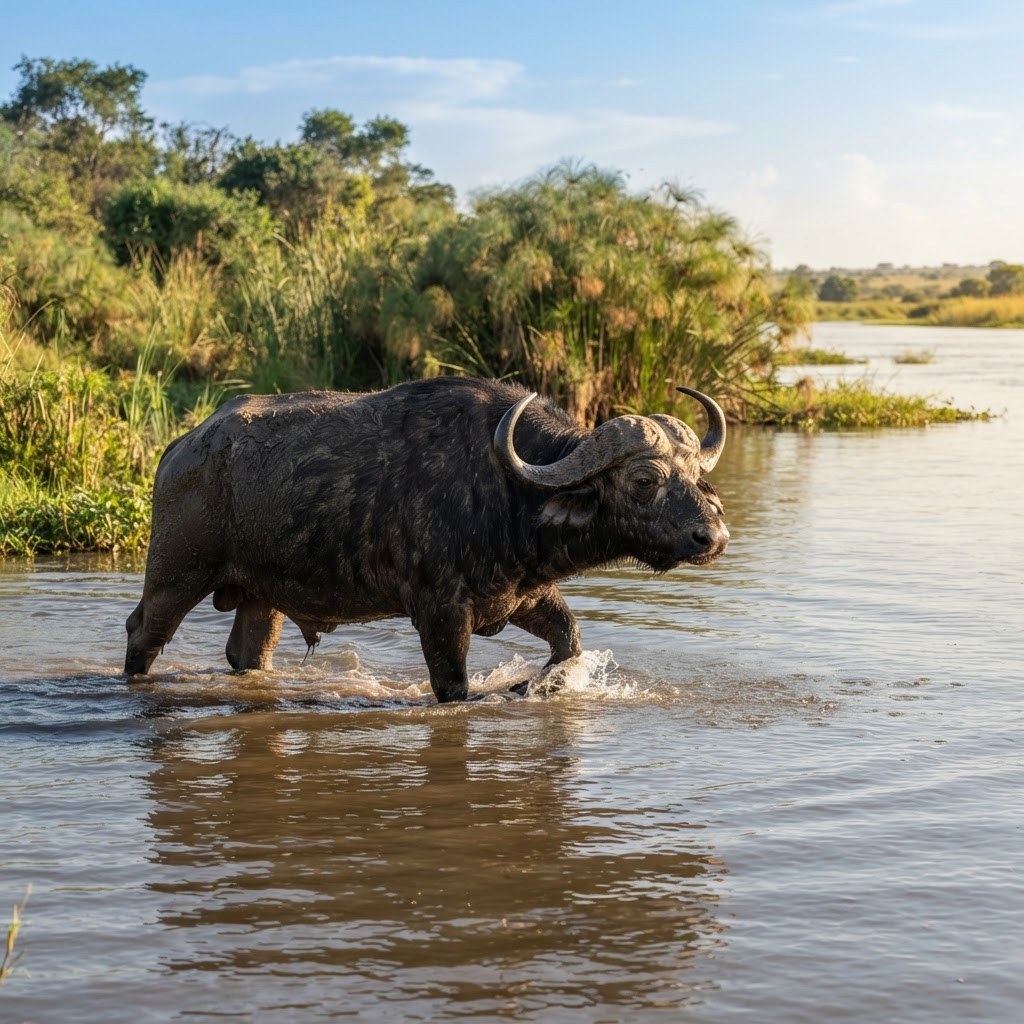
AI Generated
Nile Buffalo
Syncerus caffer aequinoctialis
The Nile Buffalo is a subspecies of African buffalo found near the Nile River, distinguished by its large horns and dark coat.
The Nile Buffalo (Syncerus caffer aequinoctialis) is a large African buffalo found mainly in northeastern Central Africa and the Upper Nile region. It is intermediate in size between the Cape Buffalo and the smaller Central African savanna forms, with a brownish to dark-brown coat and comparatively flatter, less massive horns. Scirecordbook
Adult males are larger and heavier than females and typically weigh around 500–590 kg (1,100–1,300 lbs). Mature bulls develop thicker horn bases and a more powerful neck and shoulder structure, although the bosses are generally less massive than those of Cape Buffalo. Scirecordbook
Habitat & Range
The Nile Buffalo occurs principally in South Sudan, Uganda and northeastern parts of the Democratic Republic of the Congo. In traditional SCI trophy classification, all buffalo from Uganda are regarded as Nile Buffalo. Scirecordbook
It inhabits savanna, open woodland, floodplains and riverine areas, generally where reliable grazing and water are available.
Behavior
Nile Buffalo are highly social and usually live in herds consisting of females, calves and younger bulls.
Older bulls may become solitary or form small bachelor groups. Like other African buffalo, they are most active during the cooler parts of the day and often rest near water or in shaded cover during midday.
Buffalo are powerful and defensive animals, particularly when wounded or separated from a herd.
Diet
The Nile Buffalo is primarily a grazer, feeding mainly on grasses.
Seasonal rainfall strongly influences grazing quality, herd movement and access to water. During dry periods, buffalo may travel considerable distances between feeding areas and permanent water sources.
Hunting & Identification
Nile Buffalo are typically hunted by tracking fresh spoor and walk-and-stalk, often around water sources, feeding grounds and established movement routes.
Shots are generally taken at short to moderate range, especially in woodland or tall grass. Heavy dangerous-game rifles are appropriate, with the .375 H&H commonly regarded as a practical starting point and larger cartridges such as the .416 class frequently used where legal.
Mature bulls are identified by their heavier body, thick neck and developed horn bases. Compared with Cape Buffalo, Nile Buffalo generally have smaller, flatter horns and less massive bosses. SCI also notes that their horns typically do not sweep downward as deeply as those of Cape Buffalo. Scirecordbook
Trophy evaluation focuses primarily on horn spread, mass, boss development, shape and symmetry.
Correct identification and geographic classification are especially important because the Nile Buffalo grades morphologically into other Central African buffalo forms. Recent genetic research also suggests that Nile, Sudan and Forest Buffalo belong to a broader West-Central genetic lineage despite their traditional subspecies classifications. Congen Africa
Conservation Status
The African Buffalo (Syncerus caffer) is classified as Near Threatened by the IUCN (2019), based on an assessment completed in 2018. The Nile Buffalo is not currently given a separate global IUCN category from the species as a whole. collections.snm.ku.dk
Local populations may be affected by habitat fragmentation, disease, livestock competition, poaching and disruption of large savanna ecosystems.
Sources
Safari Club International — Nile Buffalo
https://www.scirecordbook.org/nile-buffalo/
ConGen Africa — African Buffalo
https://www.congenafrica.com/african-buffalo/
IUCN Red List — African Buffalo
https://www.iucnredlist.org/species/21251/50195031
Cambridge University Press — Ecology and Management of the African Buffalo
https://www.cambridge.org/core/books/ecology-and-management-of-the-african-buffalo/