
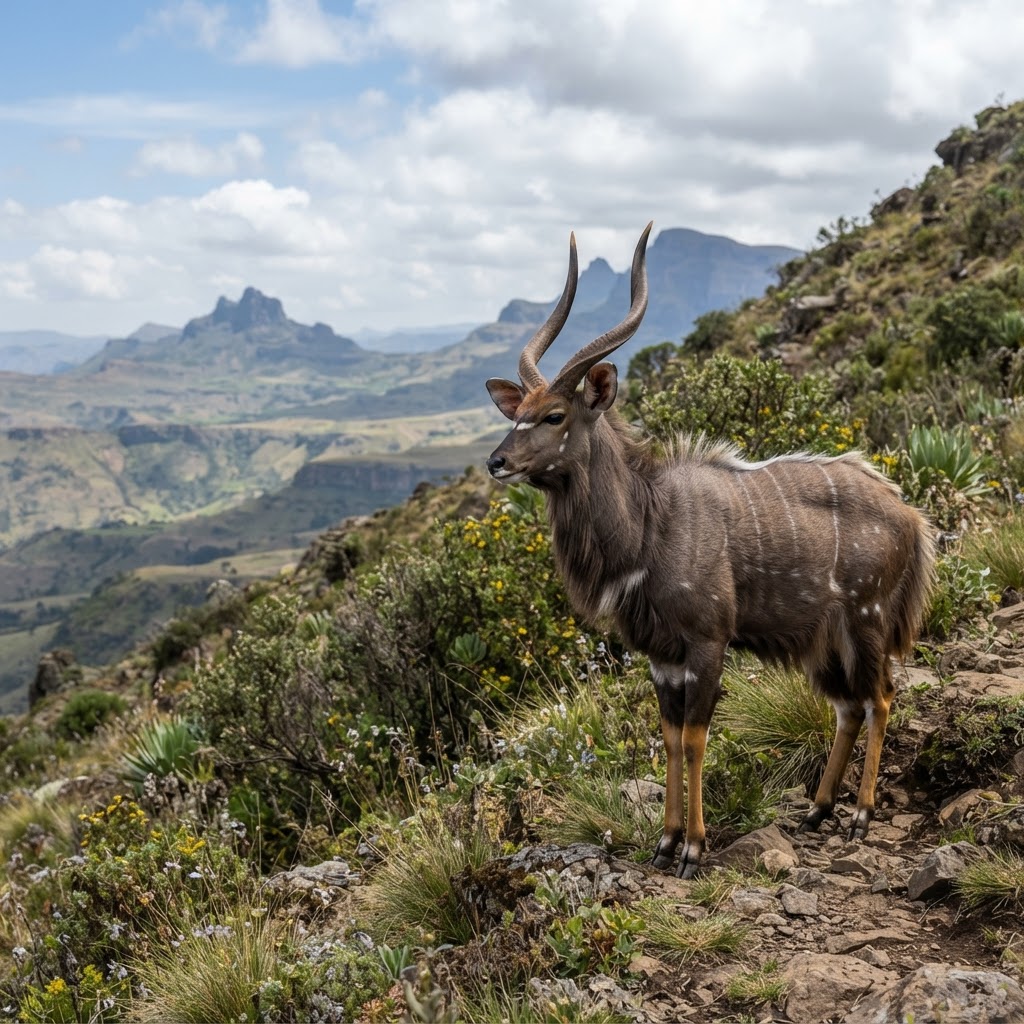
AI Generated
Mountain Nyala
Tragelaphus buxtoni
The Mountain Nyala is a large, endemic antelope found in the Ethiopian Highlands, known for its spiral horns and striking coloration.
The Mountain Nyala (Tragelaphus buxtoni) is a large, highland antelope endemic to Ethiopia. It is recognized by its grey-brown coat, pale body stripes and the long spiral horns carried by adult males.
Adult males are considerably larger and darker than females and develop a heavier neck and shoulders with age. Females are hornless and generally lighter in color. Mature bulls can become very dark, particularly around the neck, chest and shoulders.
Habitat & Range
The Mountain Nyala is found only in the highlands of Ethiopia, primarily in the Bale Mountains and surrounding areas.
It inhabits montane woodland, high-altitude grassland, heathland and forest edges, often between roughly 2,000 and 4,000 meters above sea level. The species is closely associated with rugged terrain and highland vegetation.
Behavior
Mountain Nyala are generally found alone or in small groups, although larger concentrations may occur in productive feeding areas.
Females and young often form loose groups, while mature bulls may be solitary outside the breeding season.
They are most active during the cooler parts of the day and often move between forest cover and open highland feeding areas.
Diet
The Mountain Nyala is primarily a browser but also feeds on grasses and herbs.
Its diet includes leaves, shoots, shrubs, grasses and other highland vegetation, with feeding patterns changing according to season and altitude.
Hunting & Identification
Where hunting is legally permitted, Mountain Nyala are typically hunted by spot-and-stalk in steep, open highland terrain. Glassing from ridgelines and elevated positions is often the key method for locating mature bulls.
Shots can be taken at moderate to long range because of the open mountain environment and limited cover. Flat-shooting rifles in the .270, 7mm and .30-caliber classes are commonly used, with calibers such as .300 Winchester Magnum particularly well suited to the combination of distance, altitude and body size.
Mature bulls are identified by their darker coloration, heavy body, thick neck and long spiral horns. Older bulls usually show greater horn mass, deeper spiral development and more worn horn tips.
Trophy evaluation focuses primarily on horn length, basal mass, spiral development, spread and symmetry.
Because the species is endemic to Ethiopia and occurs only in a restricted highland range, correct location and legal documentation are especially important.
Conservation Status
The Mountain Nyala is classified as Vulnerable by the IUCN (2016).
Its limited distribution makes it particularly vulnerable to habitat loss, agricultural expansion, livestock pressure and fragmentation of highland ecosystems.
Sources
Mammal Diversity Database — Tragelaphus buxtoni
https://www.mammaldiversity.org/
IUCN Red List — Mountain Nyala
Animal Diversity Web — Tragelaphus buxtoni