
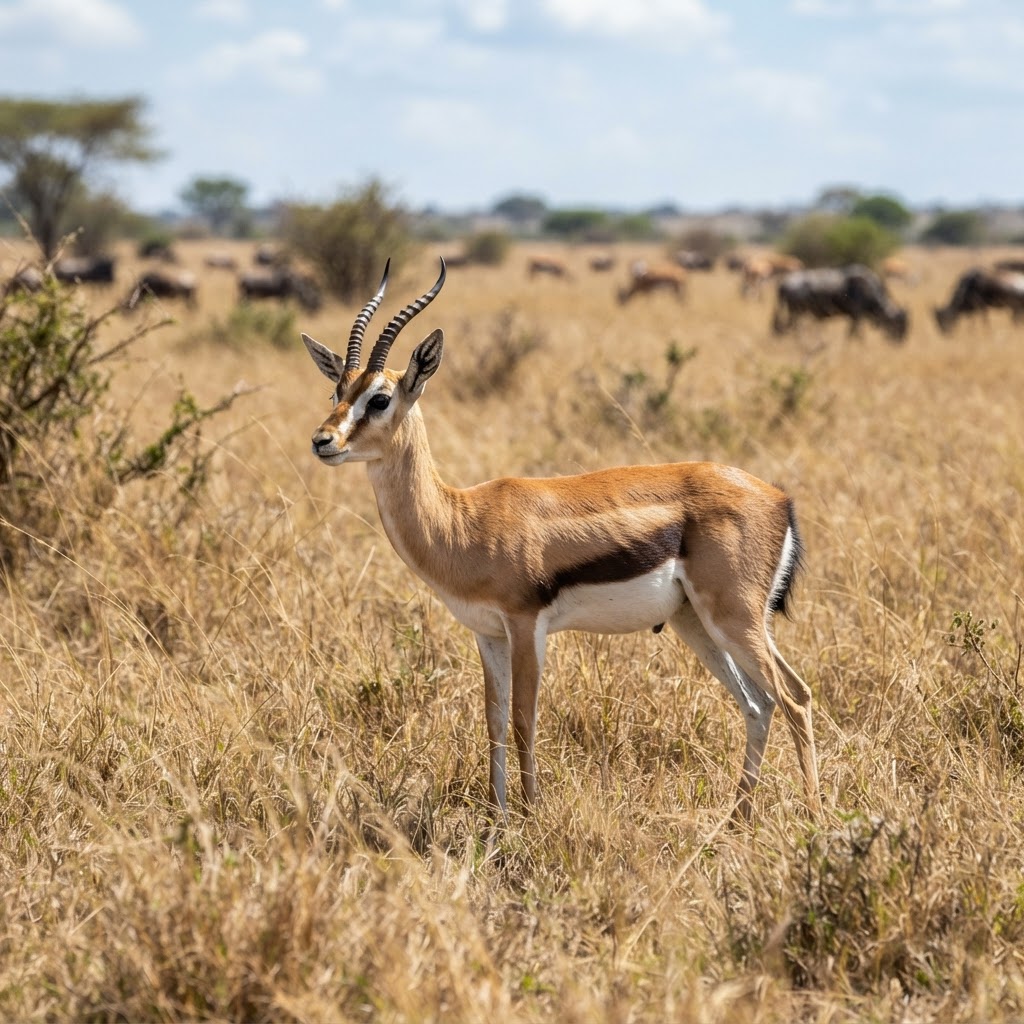
AI Generated
Mongalla Gazelle
Eudorcas albonotata
The Mongalla Gazelle is a graceful antelope found in the grasslands of South Sudan, known for its swift movements and striking markings.
The Mongalla Gazelle (Eudorcas albonotata) is a medium-sized gazelle native to the floodplains and open grasslands of South Sudan. It is recognized by its slender build, reddish-brown upperparts, pale underparts and the long, ringed horns carried by males.
Adult males are slightly larger and heavier than females and develop longer, more strongly curved horns. Females may carry much shorter horns or be hornless. Modern taxonomy generally recognizes the Mongalla Gazelle as a distinct species rather than a subspecies of the Red-fronted Gazelle. mammaldiversity.org
Habitat & Range
The Mongalla Gazelle is found primarily in South Sudan, particularly in the open floodplains and savannas east of the White Nile. Its distribution may extend marginally into neighboring Ethiopia. mammaldiversity.org
It inhabits open grassland, seasonally flooded plains and lightly wooded savanna, where good visibility and fresh grazing are available.
Behavior
Mongalla Gazelles are social and commonly occur in small to medium-sized herds.
They are most active during the cooler parts of the day and rely heavily on speed and good eyesight to detect and escape predators.
Seasonal rainfall and flooding can influence local movement as animals follow fresh grazing across the plains.
Diet
The Mongalla Gazelle is primarily a grazer, feeding mainly on grasses and other low-growing vegetation.
Fresh green growth is particularly important, and feeding patterns are strongly influenced by seasonal rainfall and changing conditions across the floodplains.
Hunting & Identification
Where legally hunted, Mongalla Gazelle are typically pursued by spot-and-stalk in open grassland and floodplain country. Long periods of glassing can be necessary to identify a mature male and plan an approach.
The open terrain can produce moderate to long shooting distances. Flat-shooting plains-game rifles in the .243, .270 and 7mm classes are suitable when paired with appropriate expanding ammunition.
Mature males are identified by their heavier body and longer, well-developed horns. Trophy evaluation focuses primarily on horn length, basal mass, curvature and symmetry.
Correct identification is particularly important because the Mongalla Gazelle was historically grouped with the Red-fronted Gazelle. Geography, coloration and horn structure should therefore be considered together.
Conservation Status
The Mongalla Gazelle is classified as Least Concern by the IUCN (2024). The Mammal Diversity Database also recognizes Eudorcas albonotata as a distinct living species and records the same conservation status. mammaldiversity.org
Despite its current classification, the species has a relatively restricted distribution, making the conservation of South Sudan’s large floodplain and savanna ecosystems important for its long-term survival.
Sources
Mammal Diversity Database — Eudorcas albonotata
https://www.mammaldiversity.org/taxon/1006141/
IUCN Red List — Mongalla Gazelle
https://www.iucnredlist.org/species/8992/50188208
Mammals of Africa — Mongalla Gazelle taxonomy and distribution
https://www.bloomsbury.com/uk/mammals-of-africa-volume-vi-9781408122570/