
AI Generated
Menelik Bushbuck
Tragelaphus scriptus meneliki
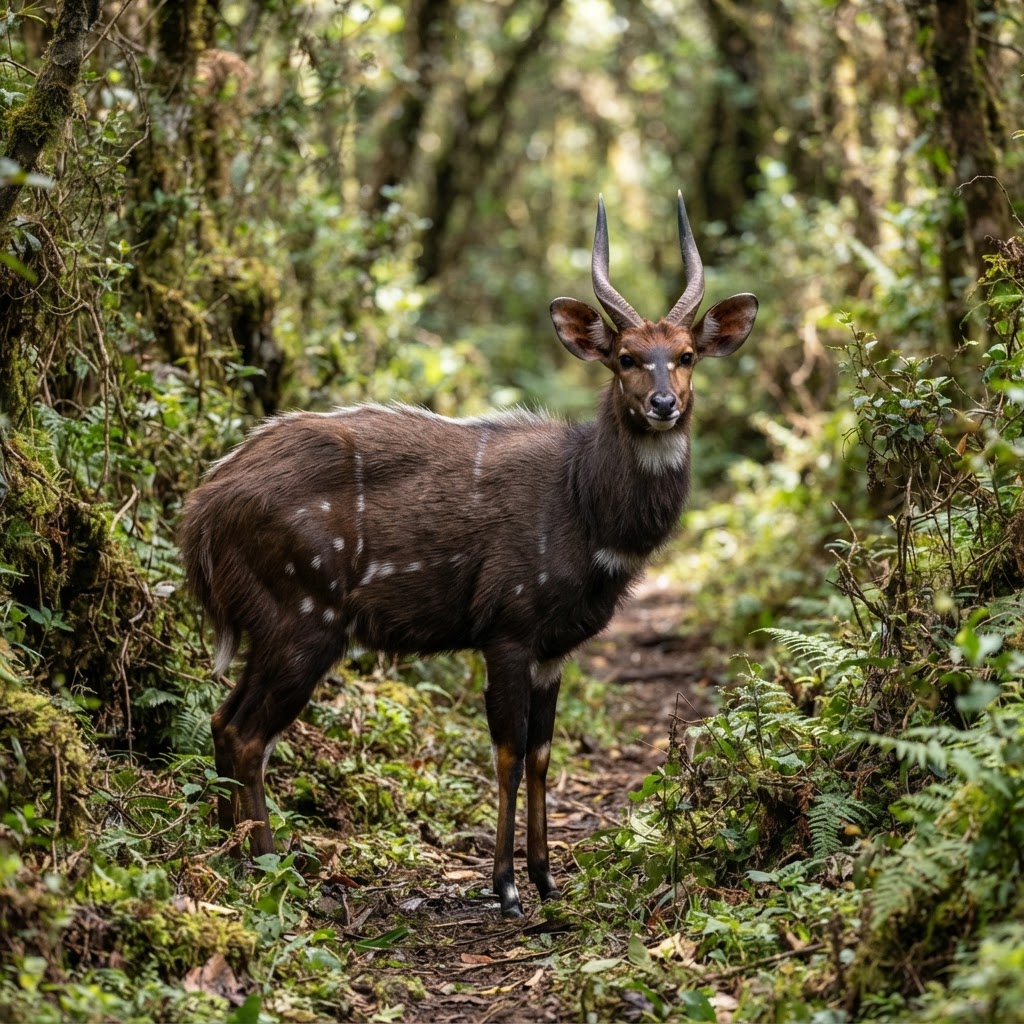
The Menelik's Bushbuck is an elusive subspecies native to the highlands of Ethiopia, characterized by its shaggy dark coat.
The Menelik’s Bushbuck (Tragelaphus scriptus meneliki) is a medium-sized, highland bushbuck found primarily in Ethiopia. It is a dark, secretive antelope adapted to montane forest and dense highland vegetation, with mature males developing the characteristic spiral horns of the bushbuck group.
Adult males are larger and substantially darker than females, often becoming deep brown to almost black with age. Females are hornless and usually lighter and more reddish-brown. Mature males also develop a heavier neck and shoulders.
Habitat & Range
The Menelik’s Bushbuck is associated mainly with the Ethiopian highlands.
It inhabits montane forest, wooded valleys, dense bush, forest margins and other areas with substantial cover, often at relatively high elevations. Its distribution is closely linked to Ethiopia’s remaining highland forest systems.
Behavior
Menelik’s Bushbuck are generally solitary and highly secretive.
They are most active during the early morning, late afternoon and night, spending much of the day concealed in dense vegetation.
When disturbed, they may remain motionless in cover before suddenly breaking away. Their dark coloration and preference for thick vegetation can make mature males particularly difficult to spot.
Diet
The Menelik’s Bushbuck is primarily a browser, feeding on leaves, shoots, herbs, shrubs and other soft vegetation.
It may also consume fallen fruit and fresh grasses when available, especially around forest edges and clearings.
Hunting & Identification
Menelik’s Bushbuck are typically hunted by slow walk-and-stalk, tracking and glassing forest edges, valleys, clearings and other openings during early morning and late afternoon.
Shots are usually taken at short to moderate range because the animal spends much of its time close to dense cover. Medium plains-game rifles in the .270, 7mm and .30-caliber classes are well suited when paired with appropriate expanding ammunition.
Mature males are identified by their very dark coloration, heavier build, thick neck and well-developed spiral horns. Older rams generally show greater horn mass, deeper spiral development and a more imposing body shape.
Trophy evaluation focuses primarily on horn length, basal mass, spiral development and symmetry.
Because Ethiopia supports more than one traditionally recognized bushbuck form, geography is especially important when distinguishing Menelik’s Bushbuck from the Abyssinian Bushbuck in hunting and trophy classifications.
Conservation Status
Menelik’s Bushbuck is generally assessed as part of the broader Bushbuck complex. The Bushbuck is classified as Least Concern by the IUCN (2016).
Local highland populations may nevertheless be affected by forest loss, agricultural expansion, habitat fragmentation and hunting pressure.
Sources
Mammal Diversity Database — Tragelaphus scriptus
https://www.mammaldiversity.org/
IUCN Red List — Bushbuck
Animal Diversity Web — Tragelaphus scriptus