
AI Generated
Livingstone Eland
Taurotragus oryx livingstonei
Explore the majestic Livingstone Eland, the heaviest antelope in Africa, known for its distinctive stripes and impressive size. Learn about its habitat, behavior, and conservation status.
Description
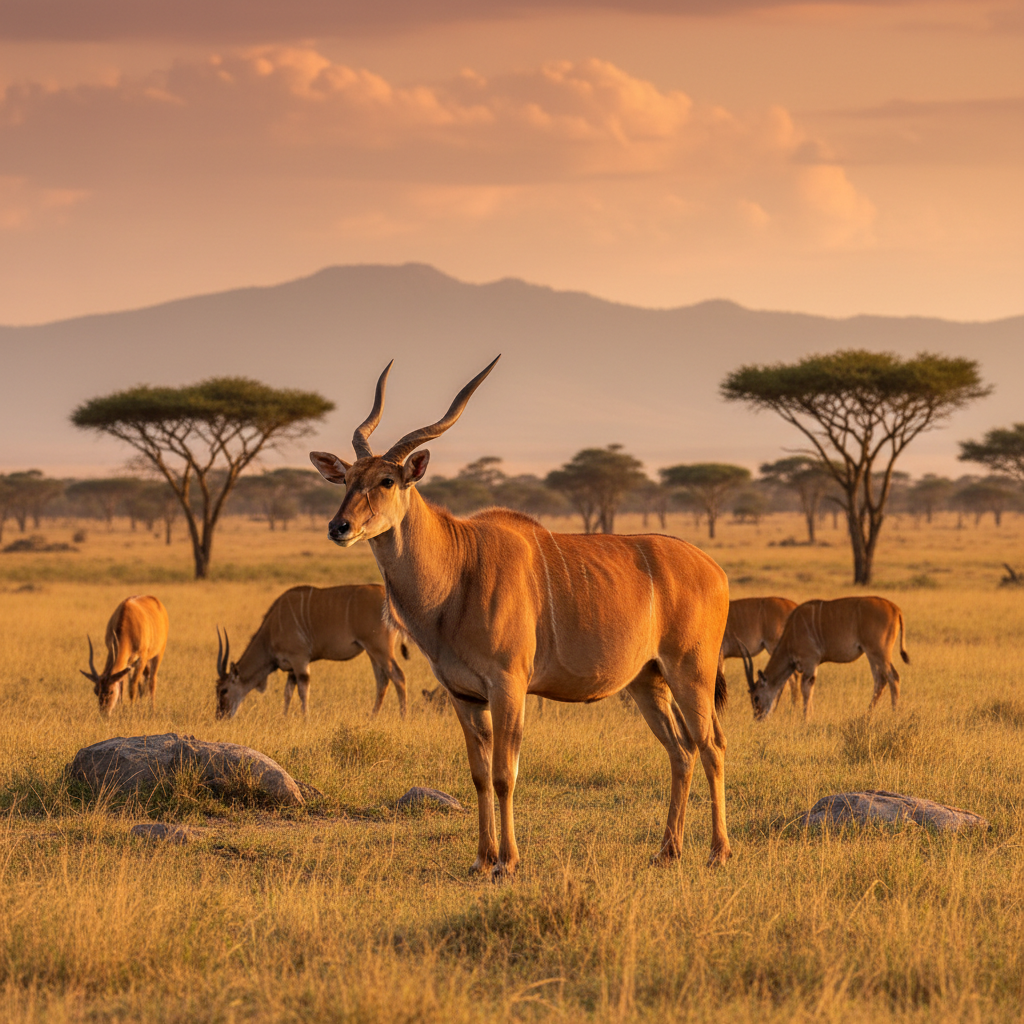
The Livingstone Eland (Taurotragus oryx livingstonei) is a magnificent subspecies of the common eland, revered as the largest and heaviest antelope in Africa. Named after the famed missionary and explorer Dr. David Livingstone, this majestic creature is an iconic symbol of the central and southeastern African wilderness. Adult males, known as bulls, can stand over 1.8 meters (6 feet) at the shoulder and weigh an astonishing 450 to 900 kg (990 to 2000 lbs), with some individuals even exceeding this. Females, or cows, are considerably smaller but still impressive, typically weighing between 300 to 600 kg (660 to 1320 lbs). The Livingstone Eland is characterized by its tawny-brown coat, which is often adorned with 8-12 distinct, narrow white vertical stripes on its flanks, a feature that helps differentiate it from other eland subspecies. Older bulls develop a dense mop of dark hair on their foreheads, a dewlap that hangs from their throat, and a bluish-grey tinge to their coat, particularly around the neck and shoulders. Both sexes possess large, spiral horns that are heavy and ridged at the base, tapering to sharp points, with the bulls' horns being notably thicker and longer, spiraling upward and outward.
Habitat & Range
The Livingstone Eland's primary range extends across central and southeastern Africa, particularly in countries like Zambia, Mozambique, Malawi, and parts of Tanzania and the Democratic Republic of Congo. They inhabit a variety of environments, including light woodland, open plains, floodplains, and savanna grasslands, often favoring areas with a mix of bush and trees that provide both browse and cover. They are well-adapted to these diverse landscapes, often found in regions characterized by miombo woodlands and riverine ecosystems. Their distribution can be quite localized, with specific populations thriving in areas like the Zambezi Delta, where favorable conditions allow for robust numbers. Access to water is important, though they can derive much of their moisture from their diet, allowing them to traverse drier areas.
Behavior
Livingstone Eland are generally social animals, forming herds that can range from small family groups of 5-10 individuals to larger aggregations of up to 50 or more, especially during the wet season when food is abundant. Herds are typically composed of females and their young, while adult males often form bachelor groups or lead a more solitary existence, joining female herds primarily for breeding. Despite their immense size, elands are surprisingly agile; they can jump over fences more than 2 meters (6 feet) high from a standing start. They are primarily diurnal, grazing and browsing during the cooler parts of the day and resting in the shade during the intense midday heat. Elands are known for their calm demeanor, but when alarmed, they can move with surprising speed. They communicate through a series of grunts, bellows, and a distinctive click made by their hooves as they walk, believed to be caused by the tendons slipping over the bone.
Diet
The Livingstone Eland is predominantly a browser, feeding on a wide variety of leaves, shoots, buds, and fruits from trees and shrubs. However, they are opportunistic and will also graze on grasses, particularly during the wet season when fresh, green pastures are available. Their diet is highly adaptable, allowing them to utilize available vegetation across their diverse habitats. They have a preference for certain forbs and can obtain sufficient moisture from their diet, enabling them to survive in areas where surface water is scarce. This dietary flexibility is a key factor in their success across varied African landscapes, allowing them to maintain their large body mass.
Hunting & Identification Notes
For hunters and researchers, the Livingstone Eland is unmistakable due to its colossal size and distinctive white vertical stripes against a tawny background. The presence of a prominent dewlap and the mop of dark hair on the forehead of mature bulls are also key identification features. When compared to the Cape Eland, the Livingstone Eland typically has more distinct and numerous stripes, and often a more pronounced black facial marking. Hunting Livingstone Eland is considered a significant challenge due to their wariness, exceptional senses, and resilience. They require careful stalking and precise shot placement. Identifying a trophy bull often involves assessing horn length, spiral integrity, and the overall body size and age indicated by the facial mop and body color. Given their large size, appropriate caliber firearms are essential for ethical hunting.
Conservation Status
The Livingstone Eland subspecies, like the common eland (Taurotragus oryx) as a whole, is currently classified as 'Least Concern' by the International Union for Conservation of Nature (IUCN). This status reflects a relatively stable and widespread population, although local populations may experience declines due to habitat loss, human encroachment, and unsustainable hunting pressures in certain regions. The species is well-represented in numerous national parks, game reserves, and private conservancies across its range, particularly in countries like Zambia and Mozambique. Conservation efforts focus on managing protected areas effectively, combating poaching, and promoting sustainable land use practices. The economic value derived from photographic safaris and regulated hunting also plays a role in providing incentives for the conservation of their habitats.