
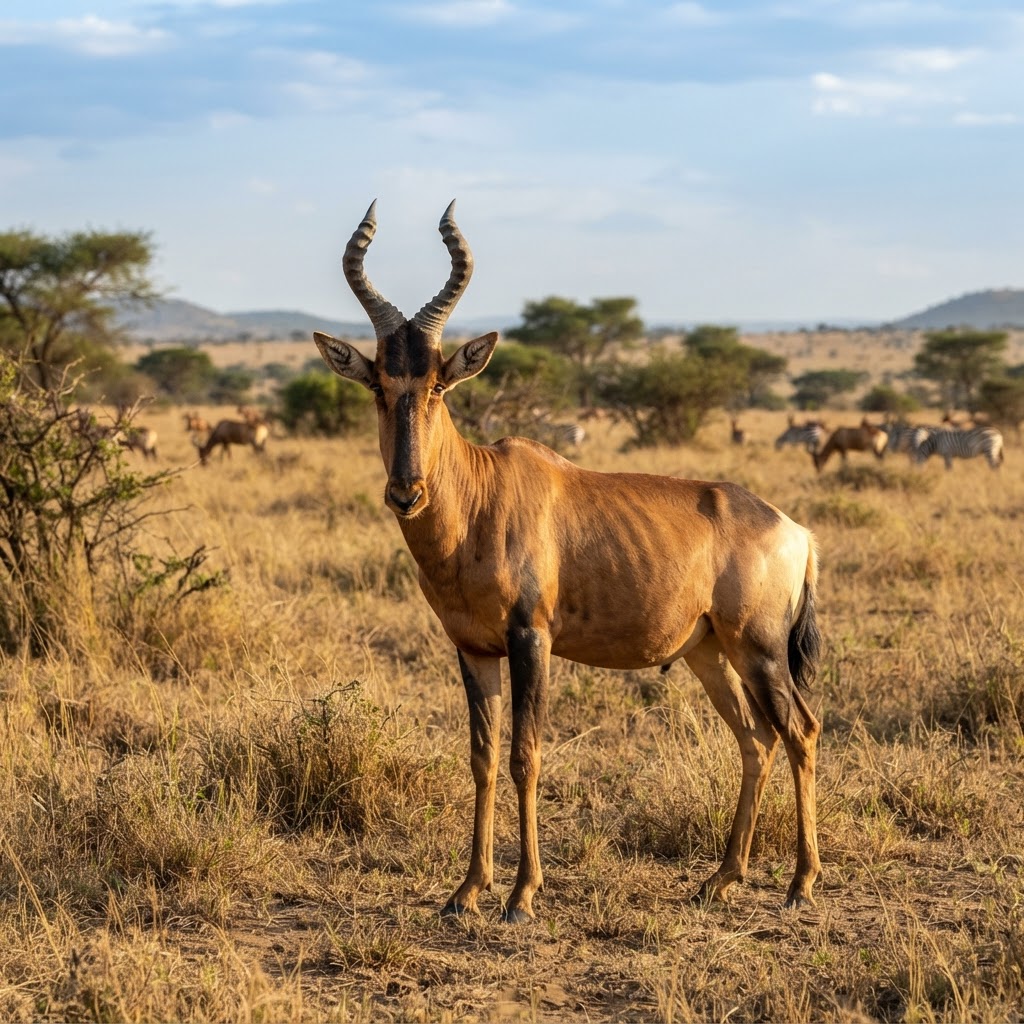
AI Generated
Lelwel Hartebeest
Alcelaphus buselaphus lelwel
The Lelwel Hartebeest is a large African antelope, a subspecies of the common hartebeest, known for its distinctive long, narrow face and high forehead.
The Lelwel Hartebeest (Alcelaphus buselaphus lelwel) is a large antelope of Central and East Africa, recognized by its elongated face, high shoulders, sloping back and strongly ridged horns. Its coat is generally reddish-brown to tan, with darker shading on the face and shoulders.
Adult males are heavier than females and develop thicker horn bases, a stronger neck and a more robust build. Both sexes carry horns, although mature bulls usually show greater mass and more pronounced wear.
Habitat & Range
The Lelwel Hartebeest occurs across parts of Central and East Africa, including South Sudan, Uganda, the Central African Republic and neighboring regions.
It inhabits open savanna, grassland and lightly wooded plains, often favoring areas with productive grazing and good visibility.
Behavior
Lelwel Hartebeest are social and usually occur in small to medium-sized herds.
Females and young form the core of the herd, while mature males may become territorial during the breeding season. They are highly alert and rely on excellent eyesight and speed to detect and escape predators.
Diet
The Lelwel Hartebeest is primarily a grazer, feeding mainly on grasses.
It can make efficient use of relatively coarse vegetation and may remain in areas where more selective grazers have moved on. Seasonal rainfall strongly influences grazing quality and herd movement.
Hunting & Identification
Lelwel Hartebeest are typically hunted by spot-and-stalk in open savanna and grassland. Glassing from elevated positions is often used to locate a mature bull before beginning an approach.
The open terrain can result in moderate to long shooting distances. Flat-shooting plains-game rifles in the .270, 7mm and .30-caliber classes are commonly used with suitable expanding ammunition.
Mature bulls are identified by their heavier body, thicker neck and more substantial horn bases. Older males usually show increased horn mass, stronger ridging and more worn tips.
Trophy evaluation focuses primarily on horn length, basal mass, width, shape and symmetry.
Because several hartebeest forms occur across Central and East Africa, geography and horn configuration are important for correct trophy classification.
Conservation Status
The Hartebeest is classified as Least Concern by the IUCN (2016).
Lelwel populations have declined in parts of their range due to habitat conversion, livestock competition, hunting pressure and fragmentation of open grassland ecosystems.
Sources
Mammal Diversity Database — Alcelaphus buselaphus
https://www.mammaldiversity.org/
IUCN Red List — Hartebeest
Animal Diversity Web — Alcelaphus buselaphus