
AI Generated
Korrigum
Damaliscus lunatus korrigum
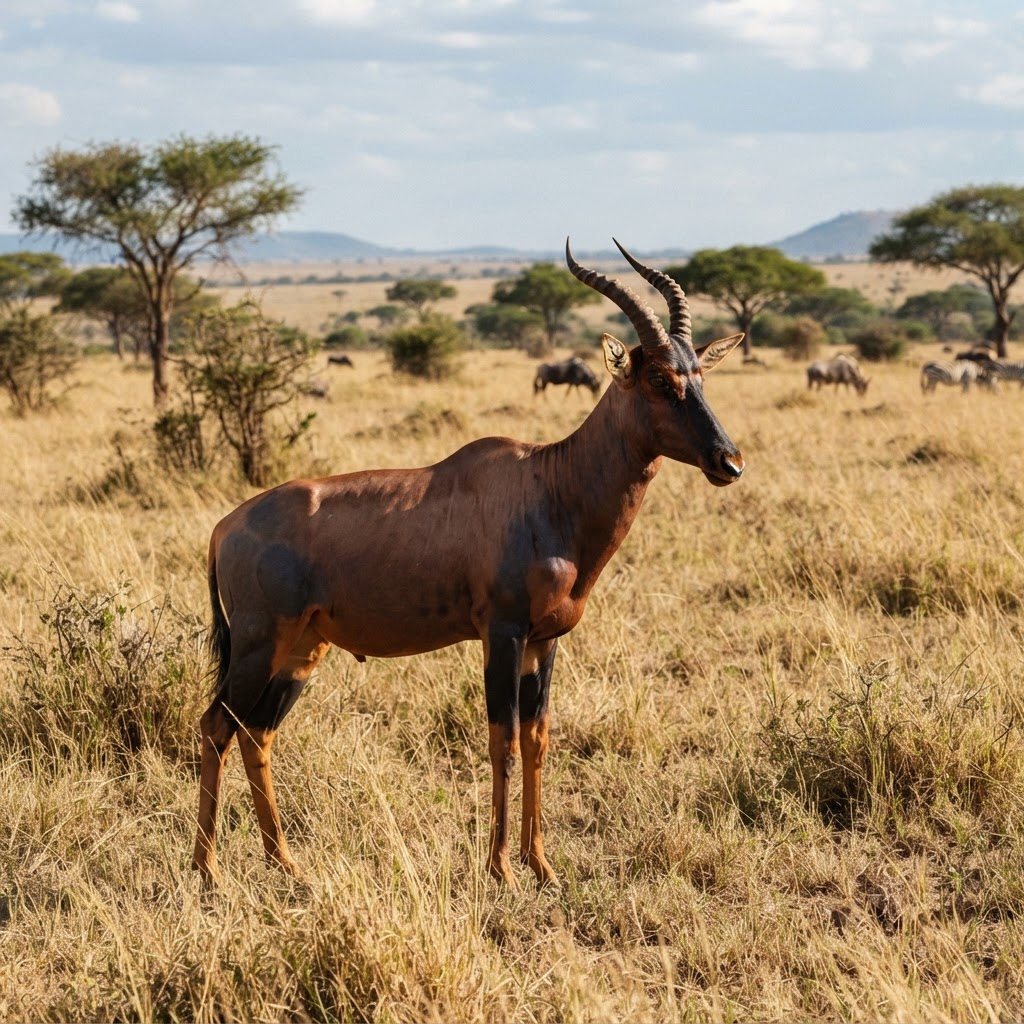
The Korrigum is a subspecies of topi antelope found in the savannas of West and Central Africa, recognized by its distinctive markings.
The Korrigum (Damaliscus lunatus korrigum) is a large, long-legged antelope of the savannas and floodplains of West and Central Africa. Also historically known as the Senegal Hartebeest, it belongs to the topi complex and is recognized by its reddish-brown coat, elongated head, sloping back and strongly ridged horns carried by both sexes.
Adult males are generally heavier than females and develop thicker horn bases and a more muscular neck and shoulders. The horns curve outward and upward before turning inward at the tips, creating the characteristic shape associated with topi and korrigum.
Habitat & Range
The Korrigum once had a broad distribution across the Sahel and savanna regions of West and Central Africa but has disappeared from much of its historical range.
Remaining populations are concentrated mainly in parts of northern Cameroon, Chad, Benin and neighboring protected landscapes. Important habitat includes open savanna, seasonally flooded grassland and lightly wooded plains. Wikipedia
Behavior
Korrigum are social antelope and usually occur in herds, sometimes forming larger concentrations where grazing conditions are favorable.
Mature males may establish territories during the breeding season, while females and young move between feeding areas. Like other members of the topi group, they are alert animals with excellent eyesight and are well adapted to open country.
They are most active during the cooler hours of the morning and afternoon.
Diet
The Korrigum is primarily a grazer, feeding mainly on grasses.
Seasonal rainfall and flooding strongly influence forage quality and herd movements. Fresh grass growth in floodplains and savanna areas provides particularly important feeding habitat.
Hunting & Identification
Where hunting is legally permitted, Korrigum are typically hunted by spot-and-stalk in open savanna and floodplain country. Long-distance glassing is often used to locate a mature bull before beginning an approach.
Because the terrain is usually open, shots may be taken at moderate to longer range. Flat-shooting plains-game rifles in the .270, 7mm and .30-caliber classes are suitable when paired with appropriate expanding ammunition.
Mature bulls are identified by their heavier body, darker coloration and thicker, better-developed horns. Trophy evaluation focuses primarily on horn length, basal mass, spread, shape and symmetry.
Correct identification is important because Korrigum are closely related to other regional forms of topi and tiang. Geography remains particularly important when assigning the correct hunting and trophy classification.
Conservation Status
The Korrigum is classified as Endangered by the IUCN (2016). The assessment reflects its severe range contraction and relatively small remaining populations. Wikipedia
Historically it occurred across a much larger area of West Africa, but it has disappeared from countries including Senegal, Gambia, Mauritania and Mali. Major pressures include habitat loss, livestock expansion and uncontrolled hunting. Wikipedia
Sources
IUCN Red List — Damaliscus lunatus korrigum
Mammal Diversity Database — Damaliscus
https://www.mammaldiversity.org/
IUCN SSC Antelope Specialist Group — Korrigum assessment