
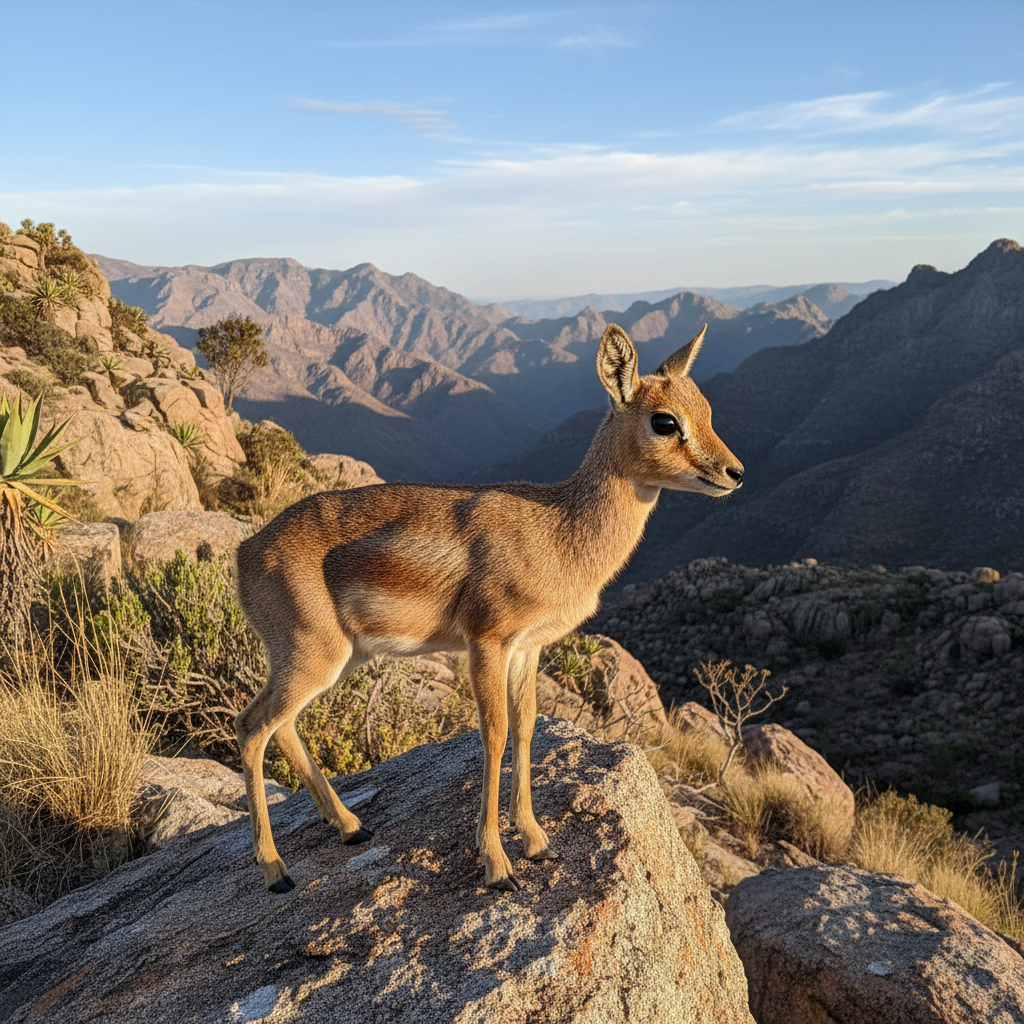
AI Generated
Klipspringer
Oreotragus oreotragus
The Klipspringer is a tiny, agile antelope perfectly adapted for life on rocky outcrops across Africa. Discover its unique hooves, remarkable climbing ability, diet, and conservation status.
Description
The Klipspringer (Oreotragus oreotragus) is a small, exquisitely adapted antelope renowned for its agility and mastery of rocky terrain. Its name, derived from Afrikaans, literally means "rock jumper." These diminutive antelopes stand only about 43-60 cm (17-23.5 inches) at the shoulder and weigh a mere 8-18 kg (18-40 lbs), with females typically being slightly larger than males. Their most striking feature is their unique hooves, which are cylindrical and tipped with rubbery pads, allowing them to stand on the very tips of their toes, providing an exceptional grip on steep, uneven surfaces. The coat is coarse and brittle, colored in shades of grizzled yellow-brown to grey-brown, providing excellent camouflage against the rocks. The underside is white. Only the males typically bear small, spiky horns, usually about 10-15 cm (4-6 inches) long, which are short, straight, and heavily ringed at the base. Their large, rounded ears and prominent dark glands in front of their eyes are also characteristic.
Habitat & Range
Klipspringers are widely distributed across sub-Saharan Africa, with a fragmented range extending from the Cape of South Africa northward through East Africa to parts of Ethiopia, Sudan, and Angola. Their habitat is exclusively rocky areas, including mountain ranges, rocky hills, outcrops (kopjes), and gorges. They are highly specialized for these environments and are rarely found on flat ground. Their distribution is thus dictated by the availability of suitable rocky habitats within the broader African landscape. They are well-adapted to arid and semi-arid conditions, often living in areas where water sources are scarce, as they can obtain most of their moisture from their diet.
Behavior
Klipspringers are primarily diurnal, active during the cooler parts of the day, early morning and late afternoon, and sometimes into the night. They are typically monogamous, forming strong pair bonds and living in small, stable family units consisting of a breeding pair and their latest offspring. Both sexes participate in territorial defense, marking their territories with dung middens and secretions from their pre-orbital glands. When alarmed, a Klipspringer will often utter a sharp, whistling alarm call before making incredible leaps and bounds up steep rock faces, seemingly defying gravity. Their incredible balance and powerful hind legs enable them to navigate treacherous terrain with unparalleled ease, making them extremely difficult for predators to catch. They typically rest in sheltered rock crevices or under overhangs during the hottest part of the day.
Diet
Klipspringers are browsers, feeding on a wide variety of plant material found in their rocky habitats. Their diet consists primarily of leaves, shoots, flowers, fruits, and lichens from succulent plants, shrubs, and trees. They are highly selective feeders, choosing the most nutritious and palatable parts of plants. Due to their ability to derive much of their moisture from the vegetation they consume, Klipspringers can survive for long periods without drinking water, a crucial adaptation for their often dry, rocky environments. This specialized diet ensures they have access to vital nutrients and hydration even in harsh conditions.
Hunting & Identification Notes
Identifying the Klipspringer is relatively easy due to its small size, stocky build, and characteristic stance on its tiptoes. Its grizzled, coarse coat, which matches the color of many rock formations, provides excellent camouflage. The male's short, spiky horns are another key identification feature. When hunting, their agility and ability to traverse almost vertical rock faces make them an exceptionally challenging quarry. Spotting them amidst the rocks requires patience and sharp eyesight. Their alarm whistle is distinctive and can alert other wildlife. Ethical hunting focuses on mature males and requires a precise shot due to their small size and the difficult terrain. Their unique hooves leave distinctive tracks that are diagnostic of the species in rocky areas.
Conservation Status
The Klipspringer is currently classified as 'Least Concern' by the IUCN Red List of Threatened Species. This status is attributed to its wide distribution across Africa and the fact that much of its preferred rocky habitat is unsuitable for human settlement or agriculture, thus protecting it from extensive habitat loss. While local populations can be affected by poaching or habitat degradation, particularly where rocky areas are converted for other uses, the species as a whole remains stable. They are present in numerous national parks and protected areas throughout their range, which further contributes to their conservation. Their natural elusiveness and the inaccessibility of much of their habitat also offer a degree of protection from human disturbance.