
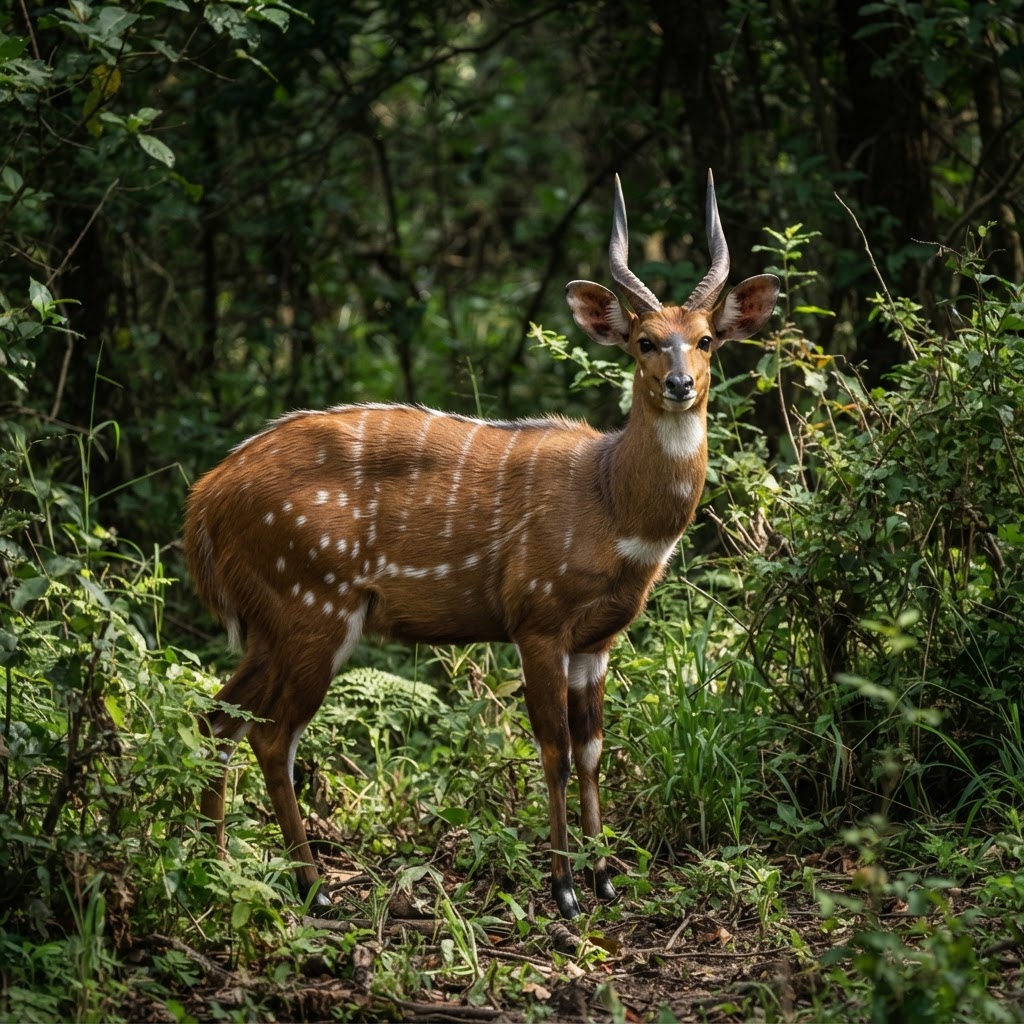
AI Generated
Harnessed Bushbuck
Tragelaphus scriptus scriptus
The Harnessed Bushbuck is a solitary and elusive antelope found in West and Central African forests and dense bush, known for its striking coat patterns.
The Harnessed Bushbuck (Tragelaphus scriptus) is a medium-sized forest and woodland antelope found across large parts of West and Central Africa. It is recognized by its compact build, rich reddish-brown to dark-brown coat and the white stripes and spots that give the animal its “harnessed” appearance.
Adult males are larger and generally much darker than females. Mature rams develop a heavier neck and shoulders together with long, spiral horns, while females are hornless and usually lighter and more reddish in color.
Habitat & Range
The Harnessed Bushbuck occurs across much of West and Central Africa, including countries such as Senegal, Ghana, Nigeria, Cameroon, Gabon, the Central African Republic and the Democratic Republic of the Congo.
It inhabits dense woodland, forest edges, riverine vegetation, thickets and agricultural mosaics with sufficient cover. It is highly dependent on dense vegetation for shelter and is rarely found far from cover.
Behavior
Harnessed Bushbuck are generally solitary and highly secretive.
They are most active during the early morning, late afternoon and night, spending much of the day concealed in dense vegetation.
When disturbed, they may freeze and remain hidden before breaking cover suddenly. Mature males can be aggressive if wounded or cornered.
Diet
The Harnessed Bushbuck is primarily a browser, feeding on leaves, shoots, herbs, shrubs, flowers and fallen fruit.
It may also graze on fresh grasses when available, particularly along forest margins and in clearings.
Hunting & Identification
Harnessed Bushbuck are typically hunted by slow walk-and-stalk, tracking and careful glassing of forest edges, riverine strips and clearings during the first and last hours of daylight.
Shots are usually taken at short to moderate range because the animal rarely moves far from thick cover. Medium plains-game rifles in the .270, 7mm and .30-caliber classes are well suited when paired with appropriate expanding bullets.
Mature males are identified by their dark coloration, heavier build and well-developed spiral horns. Older rams generally show thicker horn bases, deeper spiral development and more pronounced neck and shoulder mass.
Trophy evaluation focuses primarily on horn length, basal mass, spiral development and symmetry.
Because bushbuck taxonomy is complex and several regional forms are recognized in traditional hunting classifications, geography and coat pattern are important when assigning the correct trophy category.
Conservation Status
The Bushbuck is classified as Least Concern by the IUCN (2016).
The species remains widespread and adaptable, although local populations may be affected by habitat loss, agricultural expansion, bushmeat hunting and increasing human pressure.
Sources
Mammal Diversity Database — Tragelaphus scriptus
https://www.mammaldiversity.org/taxon/1006281/
IUCN Red List — Bushbuck
https://www.iucnredlist.org/species/22050/115167862
Animal Diversity Web — Tragelaphus scriptus