
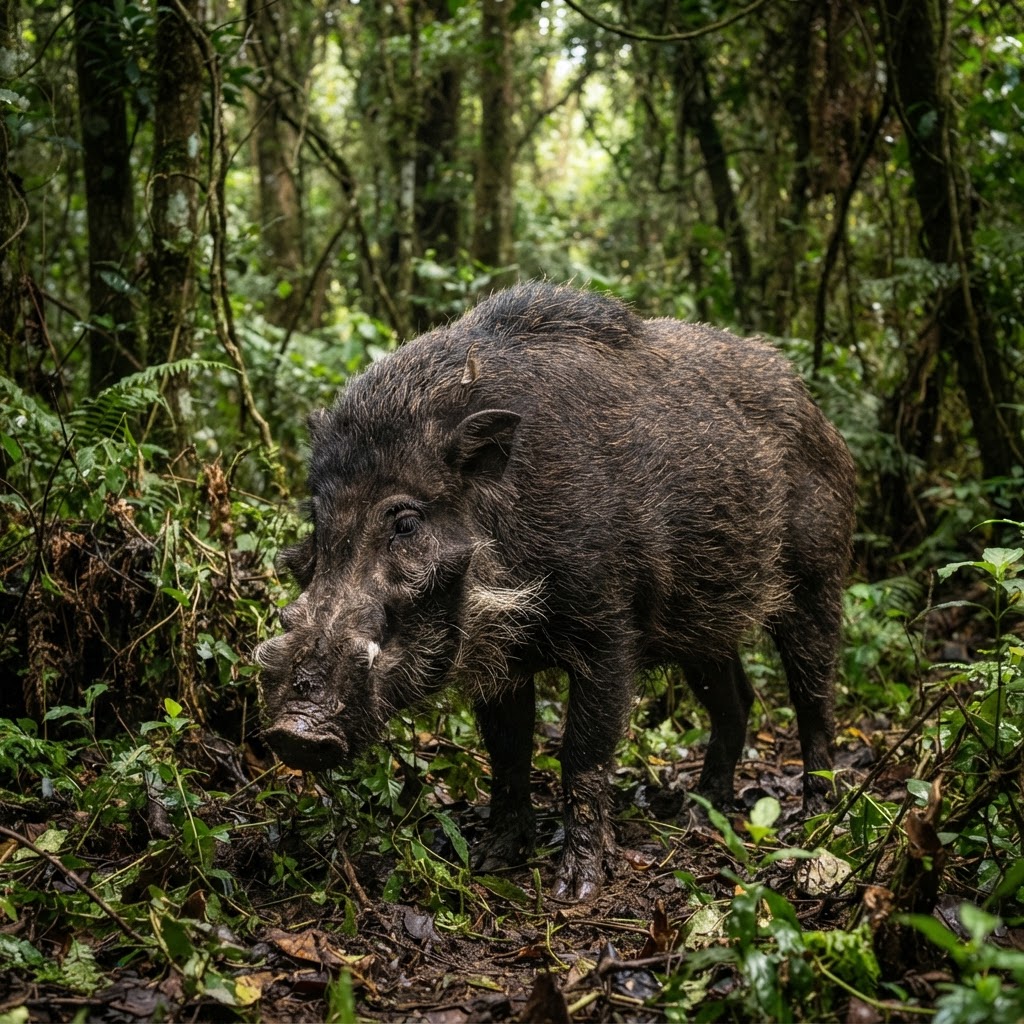
AI Generated
Giant Forest Hog
Hylochoerus meinertzhageni
The Giant Forest Hog is the largest wild pig in Africa, characterized by its shaggy hair, large head, and distinctive facial warts.
The Giant Forest Hog (Hylochoerus meinertzhageni) is the largest wild pig in Africa and one of the continent’s most distinctive forest mammals. It is recognized by its massive body, dark coarse coat, broad head and prominent facial swellings, particularly in mature males.
Adult males are considerably larger than females and may weigh more than 200 kg (440 lbs). Mature boars develop pronounced cheek pads, a heavy forehead and large canine tusks, while females are smaller and more lightly built.
Habitat & Range
The Giant Forest Hog has a fragmented distribution across parts of West, Central and East Africa, including Uganda, Kenya, Ethiopia, South Sudan, Cameroon, the Central African Republic, Democratic Republic of the Congo and several West African countries. Mammal Diversity Database
It is associated mainly with forest, montane woodland, forest edges and dense vegetation near open grazing areas. In East Africa it can occur at surprisingly high elevations, particularly in montane forests.
Behavior
Giant Forest Hogs are generally social and are often found in small family groups consisting of females, young and one or more adult males.
They are most active during the cooler hours of the morning and late afternoon, although activity patterns vary depending on disturbance and habitat.
Despite their size, they can move quickly through dense vegetation and may become aggressive when wounded or cornered.
Diet
The Giant Forest Hog is primarily a grazer, feeding heavily on grasses, herbs and other low-growing vegetation.
It may also consume roots, fruit, leaves and other plant material, but unlike many other wild pigs it relies heavily on vegetation rather than an omnivorous diet.
Hunting & Identification
Giant Forest Hog are typically hunted by tracking, still-hunting and glassing forest edges, clearings and feeding areas during early morning and late afternoon.
Shots are usually taken at short to moderate range because animals often remain close to dense cover. Medium to heavy plains-game rifles are appropriate, with cartridges in the .30-caliber class and above commonly used. A tough expanding bullet is advisable because mature boars are heavily built through the shoulders.
Mature males are identified by their large body, massive head, pronounced facial swellings and well-developed tusks. Older boars typically show heavier cheek pads and a darker, more imposing overall appearance.
Trophy evaluation focuses primarily on tusk size and overall maturity. Careful identification is important, as females may also appear large at distance but lack the pronounced head structure of an old boar.
Conservation Status
The Giant Forest Hog is classified as Least Concern by the IUCN (2024). The current Mammal Diversity Database also records the species as Least Concern. Mammal Diversity Database
Although widespread, populations are fragmented and can be affected locally by habitat loss, forest conversion and hunting for bushmeat.
Sources
Mammal Diversity Database — Hylochoerus meinertzhageni
https://www.mammaldiversity.org/taxon/1006364/
IUCN Red List — Giant Forest Hog
https://www.iucnredlist.org/species/41769/100471546
Animal Diversity Web — Hylochoerus meinertzhageni
https://animaldiversity.org/accounts/Hylochoerus_meinertzhageni/