
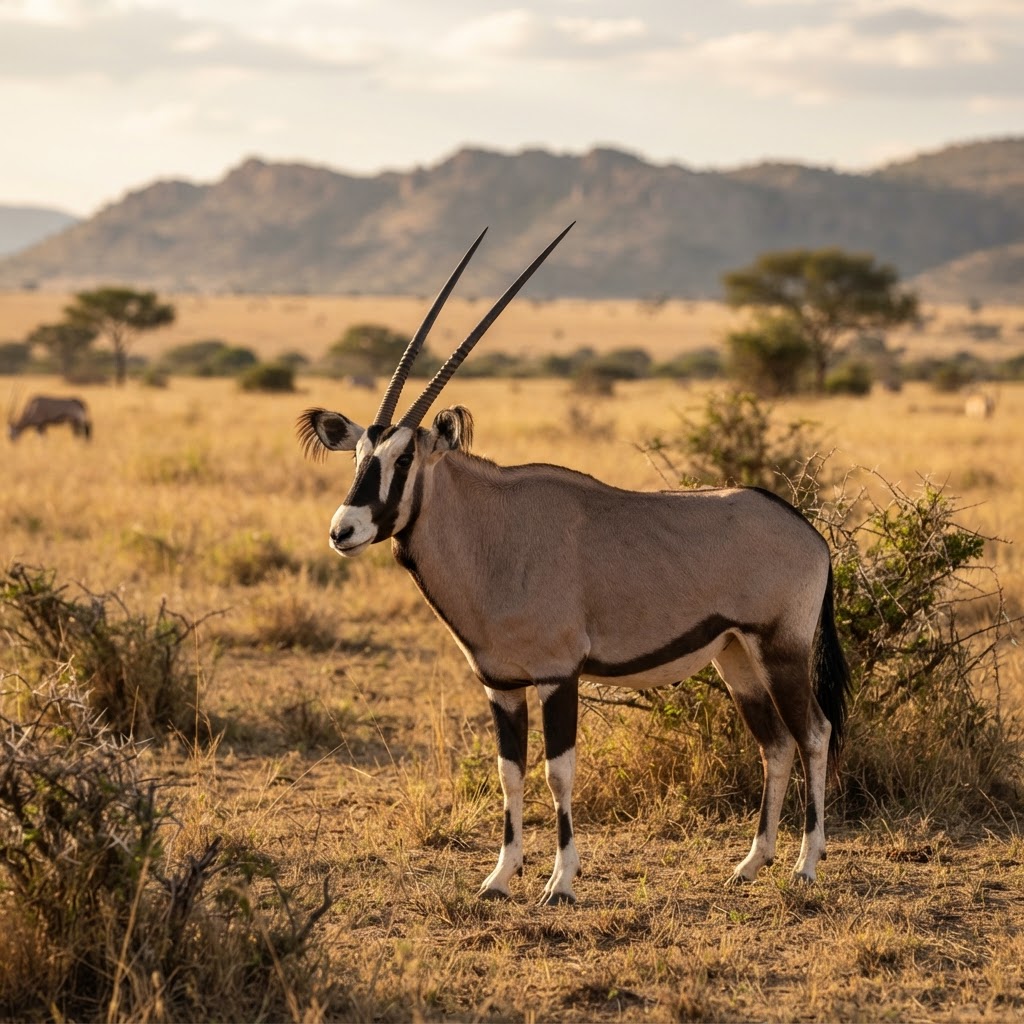
AI Generated
Fringe-eared Oryx
Oryx beisa callotis
The Fringe-eared Oryx is a desert-adapted antelope found in East Africa, distinguished by its long, straight horns and fringed ears.
The Fringe-eared Oryx (Oryx beisa callotis) is a large East African antelope closely related to the Beisa Oryx. It is recognized by its long, straight horns, pale grey coat, bold black facial markings and the distinctive tufts of hair along the lower edges of the ears that give the subspecies its common name.
Both males and females carry horns, although mature bulls are usually heavier and more robust. The horns are long, nearly straight and strongly ringed at the base, while the dark facial pattern contrasts sharply with the pale body.
Habitat & Range
The Fringe-eared Oryx occurs mainly in southern Kenya and northern Tanzania.
It inhabits dry savanna, semi-arid grassland, open bush country and lightly wooded plains. The species is well adapted to hot and dry environments and can survive for long periods without direct access to standing water.
Behavior
Fringe-eared Oryx are social and are usually found in small to medium-sized herds.
They are most active during the cooler parts of the day and often rest during midday heat. Herds may move over considerable distances in response to rainfall and changing grazing conditions.
When threatened, they rely on speed, endurance and their long horns for defense.
Diet
The Fringe-eared Oryx is primarily a grazer, feeding mainly on grasses.
During dry periods it may also browse on leaves, shoots and other available vegetation. Much of its moisture requirement can be obtained directly from food.
Hunting & Identification
Fringe-eared Oryx are typically hunted by spot-and-stalk in open savanna and semi-arid country. Glassing from elevated ground is often used to locate mature animals before beginning an approach.
Because the terrain is frequently open, shots are commonly taken at moderate to longer range. Flat-shooting plains-game rifles in the .270, 7mm and .30-caliber classes are well suited when paired with appropriate expanding ammunition.
Mature bulls are identified by their heavier body, thicker neck and greater horn mass. Since both sexes carry long horns, body size, horn thickness and overall build are important when judging a mature male.
Trophy evaluation focuses primarily on horn length, basal mass, straightness and symmetry.
The characteristic fringe of hair along the ear margins, together with geographic range, helps distinguish the Fringe-eared Oryx from the Beisa Oryx and other regional oryx forms.
Conservation Status
The Fringe-eared Oryx is generally assessed as part of the broader Beisa Oryx complex. The Beisa Oryx is classified as Endangered by the IUCN (2018).
Population declines have been linked to habitat loss, livestock competition, drought, hunting pressure and increasing fragmentation of dryland ecosystems.
Sources
IUCN Red List — Beisa Oryx
Mammal Diversity Database — Oryx beisa
https://www.mammaldiversity.org/
Animal Diversity Web — Oryx beisa