
AI Generated
Forest Sitatunga
Tragelaphus spekii
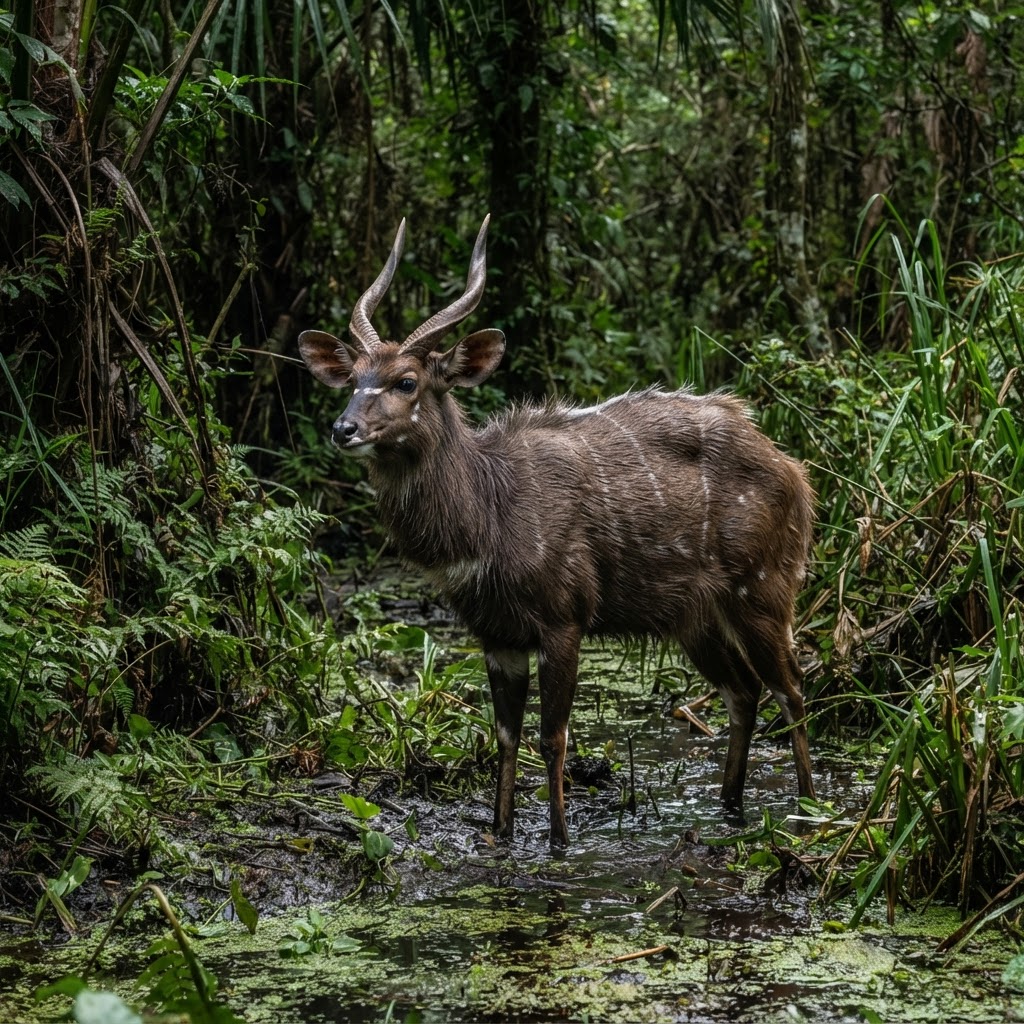
The Forest Sitatunga is a swamp-dwelling antelope with splayed hooves, perfectly adapted for walking on marshy ground in African forests.
The Forest Sitatunga (Tragelaphus spekii gratus) is a medium-sized, swamp-adapted antelope found in the forest and wetland regions of Central and West Africa. It is recognized by its elongated hooves, shaggy water-resistant coat and the long spiral horns carried by adult males. Odense Zoo
Adult males are larger and darker than females, often becoming deep brown with age, while females remain lighter and more reddish. Only males carry horns. Both sexes have specially adapted, widely splayed hooves that allow them to move efficiently across soft mud, floating vegetation and swampy ground. Lex
Habitat & Range
The Forest Sitatunga occurs in wetland and forest habitats across parts of Central and West Africa, including Cameroon, Gabon, the Republic of the Congo, Democratic Republic of the Congo and neighboring regions.
It is strongly associated with swamps, marshes, riverine forest, reed beds and flooded clearings. Dense aquatic vegetation provides both food and protection, and sitatunga may spend much of their lives in or immediately around water. Wikipedia
Behavior
Forest Sitatunga are generally solitary or found in small groups and are highly secretive.
They are excellent swimmers and can move quietly through deep water and dense marsh vegetation. When threatened, they often retreat into water or thick reeds and may remain almost completely submerged with only the nose exposed. Odense Zoo
Activity is greatest during the cooler parts of the day and at night.
Diet
The Forest Sitatunga is primarily a browser and grazer, feeding on reeds, grasses, sedges, leaves, shoots and aquatic vegetation.
Its diet varies according to seasonal water levels and the availability of fresh vegetation within its wetland habitat. Odense Zoo
Hunting & Identification
Forest Sitatunga hunting is typically centered around swamps, river systems and flooded forest clearings. Hunters often spend long periods glassing openings, reed edges and feeding areas from elevated or concealed positions.
Because visibility is usually limited and animals may only expose themselves briefly, patience is often more important than covering large distances. Shots are generally taken at short to moderate range, although longer opportunities can occur across larger swamp clearings.
Medium plains-game rifles in the .270, 7mm and .30-caliber classes are well suited when paired with appropriate expanding ammunition.
Mature males are identified by their dark coloration, heavier body and long, well-developed spiral horns. Trophy evaluation focuses primarily on horn length, basal mass, spiral development and symmetry.
The Forest Sitatunga should be distinguished from other regional sitatunga forms by geography as well as traditional hunting classification.
Conservation Status
The Sitatunga (Tragelaphus spekii) is classified as Least Concern by the IUCN, with the widely used species-level assessment dating from 2016. Animal Diversity Web
Although the species remains widespread, local populations may be affected by wetland destruction, agricultural development, bushmeat hunting and increased human access to remote swamp habitats.
Sources
Animal Diversity Web — Tragelaphus spekii
https://animaldiversity.org/accounts/Tragelaphus_spekii/
Odense Zoo — Tragelaphus spekii gratus
https://www.odensezoo.dk/besoeg-zoo/havens-dyr/sitatunga/
Store norske leksikon — Sitatunga
Netnatur — Sitatunga hunting