
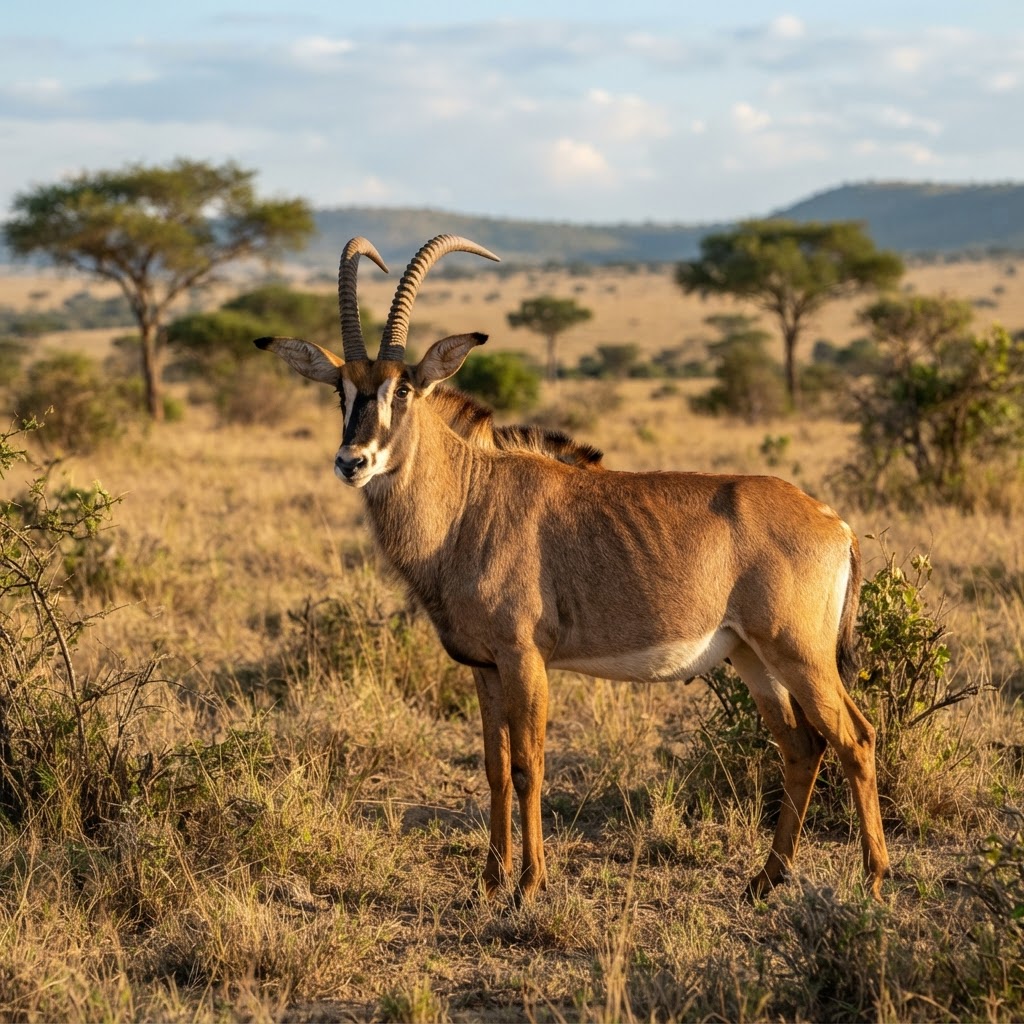
AI Generated
East African Roan Antelope
Hippotragus equinus langi
The East African Roan Antelope is a large, majestic antelope characterized by its reddish-brown coat and impressive scimitar-shaped horns.
The East African Roan Antelope (Hippotragus equinus) is a large, powerfully built antelope found in scattered populations across East Africa. It is recognized by its robust body, long ears, black-and-white facial markings and the long, backward-curving horns carried by both sexes.
Adult males are larger and heavier than females, with thicker horn bases, a more muscular neck and a darker overall appearance. Both sexes carry strongly ridged horns, but mature bulls usually develop greater mass and length.
Habitat & Range
The East African Roan Antelope occurs in parts of Tanzania, Kenya, Uganda and neighboring regions, although populations are now highly fragmented.
It inhabits open woodland, lightly wooded savanna and grassland, often in areas with access to permanent or seasonal water. Roan generally prefer habitats with a mixture of grazing and enough cover for security.
Behavior
Roan Antelope are social and usually live in small to medium-sized herds led by a dominant female.
Mature males may hold territories or remain on the edge of female groups, while younger bulls often form bachelor groups.
Roan are alert and can be aggressive when threatened. They are capable of defending themselves effectively with their long horns and are less inclined to flee immediately than many smaller antelope.
Diet
The East African Roan Antelope is primarily a grazer, feeding mainly on medium to tall grasses.
It prefers good-quality grazing but can also use coarser grasses during dry periods. Access to water is important and influences herd movement and habitat use.
Hunting & Identification
East African Roan are usually hunted by spot-and-stalk or by tracking and glassing open woodland, savanna and grassland edges during the cooler parts of the day.
Shots are typically taken at moderate range, but the open nature of much roan habitat can lead to longer opportunities. Medium to heavier plains-game rifles are appropriate, with cartridges in the .30-caliber class and above commonly used for mature bulls.
Mature males are identified by their heavier body, thicker neck, darker facial markings and more massive horn bases. Older bulls often show greater horn length, deeper curvature and a heavier overall frame.
Trophy evaluation focuses primarily on horn length, basal mass, curvature, spread and symmetry.
Because roan populations are often isolated and several regional forms have historically been recognized in hunting classifications, geography is important when assigning the correct trophy category.
Conservation Status
The Roan Antelope is classified as Least Concern by the IUCN, with the current species-level assessment dating from 2016.
Despite this global classification, many East African populations are small, fragmented or declining due to habitat loss, livestock pressure, disease and hunting pressure.
Sources
Mammal Diversity Database — Hippotragus equinus
https://www.mammaldiversity.org/
IUCN Red List — Roan Antelope
Animal Diversity Web — Hippotragus equinus