
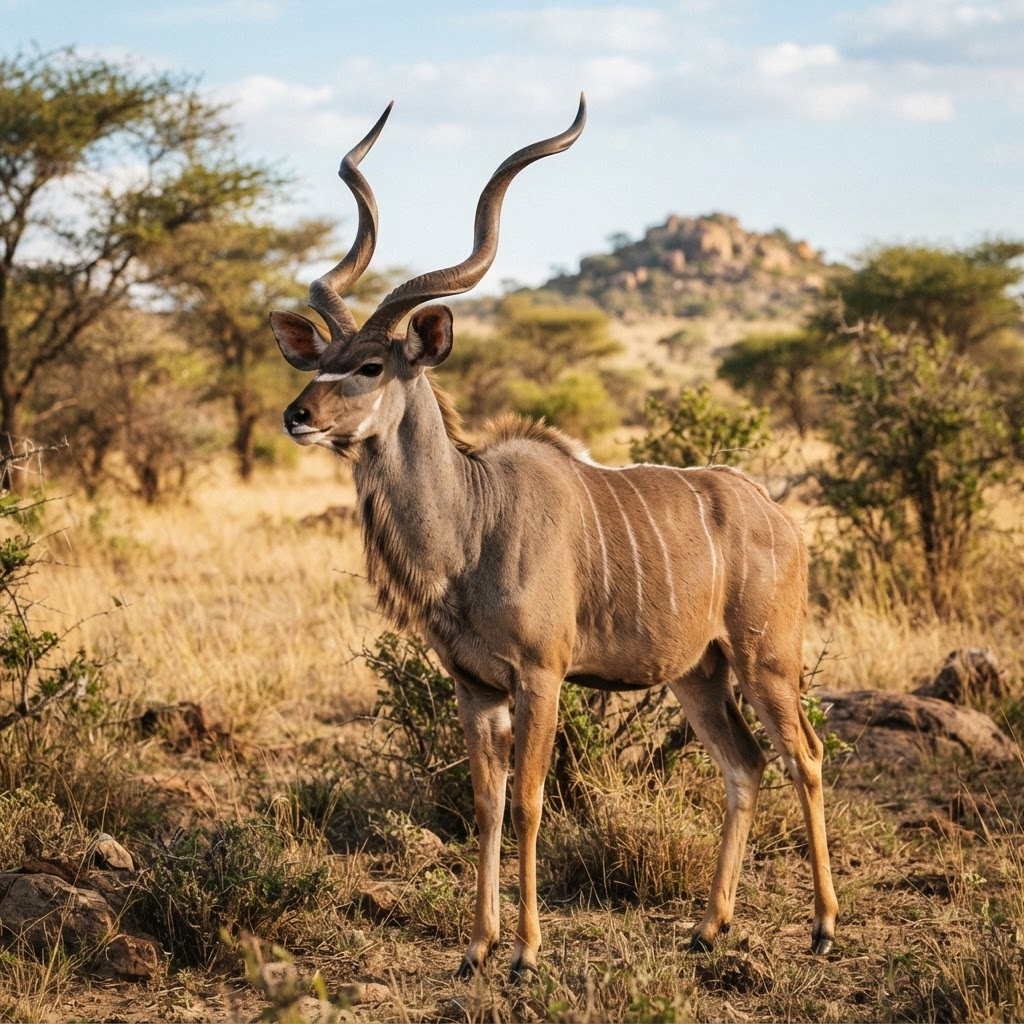
AI Generated
East African Greater Kudu
Tragelaphus strepsiceros bea
The East African Greater Kudu is a majestic antelope subspecies known for its impressive spiraled horns and striped coat, inhabiting woodlands and bushlands.
The East African Greater Kudu (Tragelaphus strepsiceros) is a large spiral-horned antelope found across parts of East Africa. It is recognized by its tall, slender build, grey-brown coat, pale vertical body stripes and the spectacular spiralling horns carried by mature males.
Adult bulls are significantly larger than females and develop heavier necks, darker coloration and long corkscrew horns with age. Females are hornless and generally lighter and more reddish-brown.
Habitat & Range
The East African Greater Kudu occurs across parts of Tanzania, Kenya, Uganda, Ethiopia and neighboring regions.
It inhabits dry woodland, bushveld, rocky hills, river valleys and broken country with a mixture of dense cover and open feeding areas. Kudu are especially well adapted to rugged terrain and thick bush.
Behavior
East African Greater Kudu are generally shy and cautious.
Females and young often form small groups, while mature bulls may be solitary or associate in loose bachelor groups outside the breeding season.
They are most active during the cooler hours of early morning and late afternoon and rely heavily on cover when disturbed.
Diet
The East African Greater Kudu is primarily a browser, feeding on leaves, shoots, shrubs, herbs and woody vegetation.
It is highly adaptable and can survive in dry environments by feeding on a wide variety of plant species.
Hunting & Identification
East African Greater Kudu are typically hunted by spot-and-stalk, tracking and glassing wooded slopes, valleys and bush-covered hills during the first and last hours of daylight.
Shots are usually taken at moderate range, although longer opportunities can occur in more open terrain. Medium to heavier plains-game rifles in the .270, 7mm and .30-caliber classes are widely used, with cartridges such as the .30-06 and .300 Winchester Magnum being well suited to larger bulls.
Mature bulls are identified by their heavy body, darker coat, thick neck and long spiral horns. Older bulls usually show deeper curls, heavier horn bases and worn horn tips.
Trophy evaluation focuses primarily on horn length, basal mass, spread, depth of curl and symmetry.
Because Greater Kudu populations vary geographically, location is important when distinguishing East African forms from southern and northeastern populations in traditional trophy classifications.
Conservation Status
The Greater Kudu is classified as Least Concern by the IUCN, with the current species-level assessment dating from 2016.
The species remains widespread, although local populations can be affected by habitat loss, livestock expansion, disease and hunting pressure.
Sources
Mammal Diversity Database — Tragelaphus strepsiceros
https://www.mammaldiversity.org/
IUCN Red List — Greater Kudu
Animal Diversity Web — Tragelaphus strepsiceros
https://animaldiversity.org/accounts/Tragelaphus_strepsiceros/