
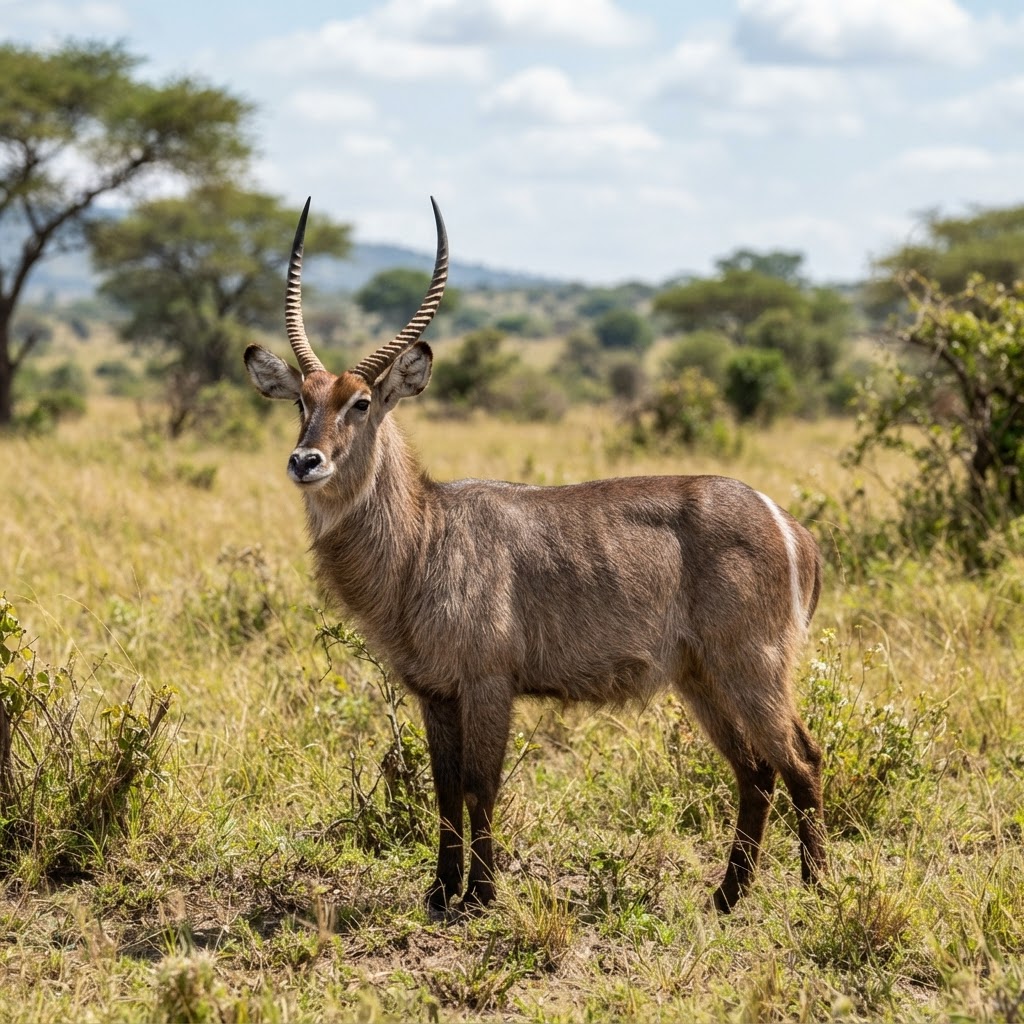
AI Generated
East African Defassa Waterbuck
Kobus ellipsiprymnus defassa
The East African Defassa Waterbuck is a large antelope found near water bodies in East Africa, recognized by its shaggy coat and distinctive white ring on its rump.
The East African Defassa Waterbuck (Kobus ellipsiprymnus defassa) is a large antelope found across parts of East and Central Africa. It is characterized by a heavy build, shaggy grey-brown coat, white facial markings and the long, strongly ridged horns carried by males.
Adult males are significantly larger than females and develop a thick neck and shoulders with age. Females are hornless. Unlike the common waterbuck, the Defassa form shows a broad white patch across the rump rather than a distinct white ring.
Habitat & Range
The East African Defassa Waterbuck occurs in parts of Kenya, Tanzania, Uganda, Rwanda, Burundi and neighboring regions.
It inhabits savanna, woodland, river valleys, floodplains and other areas close to permanent water. Waterbuck are strongly associated with rivers, lakes and wetlands and usually remain within relatively easy reach of water and cover.
Behavior
East African Defassa Waterbuck are generally found in small groups, although larger concentrations may occur around productive grazing areas.
Females and young often form loose herds, while mature males may be solitary or territorial. They are most active during the cooler parts of the day and often rest in shade during midday.
When disturbed, they usually move toward thicker cover or water.
Diet
The East African Defassa Waterbuck is primarily a grazer, feeding mainly on grasses.
It prefers fresh, nutritious growth but can also utilize coarser grasses during drier periods. Access to permanent water is important and strongly influences its daily movements.
Hunting & Identification
Defassa Waterbuck are typically hunted by spot-and-stalk, often by glassing river valleys, woodland edges, floodplains and open feeding areas during early morning and late afternoon.
Shots are generally taken at moderate range, although longer opportunities can occur in open country. Medium to heavier plains-game rifles are commonly used, with cartridges in the .270, 7mm and .30-caliber classes all well suited when paired with appropriate expanding bullets.
Mature bulls are identified by their large body, thick neck, darker coloration and long, sweeping horns. Older bulls usually show heavier horn bases and a more massive overall appearance.
Trophy evaluation focuses primarily on horn length, basal mass, spread, curvature and symmetry.
The broad white rump patch is an important field mark and helps distinguish Defassa Waterbuck from the common waterbuck, which carries a more clearly defined white ring around the rump.
Conservation Status
The Waterbuck (Kobus ellipsiprymnus) is classified as Least Concern by the IUCN, with the current species-level assessment dating from 2016.
The species remains widespread, but local populations may be affected by habitat loss, livestock competition, hunting pressure and degradation of riverine and wetland habitats.
Sources
Mammal Diversity Database — Kobus ellipsiprymnus
https://www.mammaldiversity.org/taxon/1006363/
IUCN Red List — Waterbuck
https://www.iucnredlist.org/species/11035/50189355
Animal Diversity Web — Kobus ellipsiprymnus