
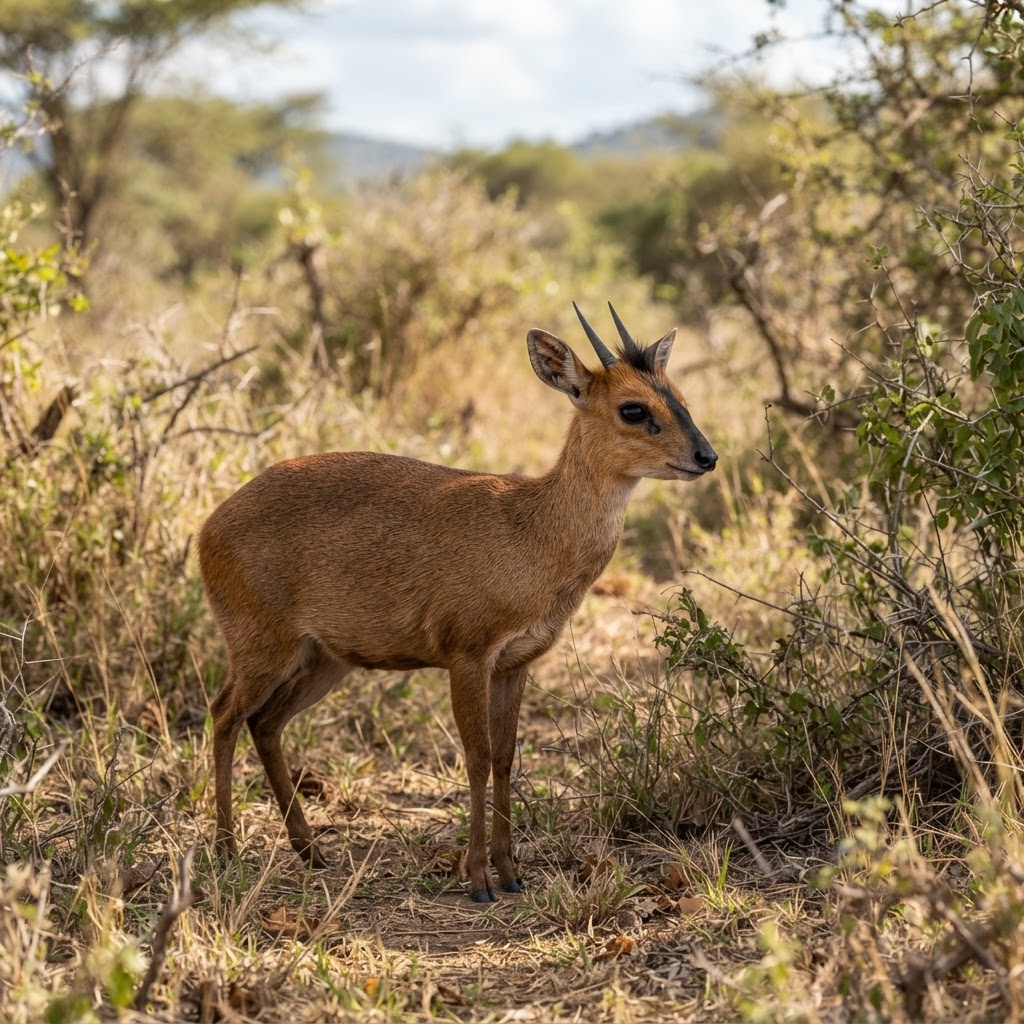
AI Generated
East African Bush Duiker
Sylvicapra grimmia massaica
The East African Bush Duiker is a small, shy antelope found in diverse habitats across East Africa, known for its secretive behavior.
The East African Bush Duiker (Sylvicapra grimmia hindei) is a small, adaptable antelope found across parts of East Africa. It belongs to the widespread Common or Grey Duiker group and is recognized by its compact body, grey-brown coat, dark facial markings and the short, straight horns carried by males. Traditional hunting classifications generally treat hindei as the East African form. Shakari Connection
Adult males are slightly more heavily built than females and carry short, upright horns, often partly concealed by the tuft of hair between them. Females are generally hornless. Body coloration varies from grey to tawny-brown depending on habitat and region. Animal Diversity Web
Habitat & Range
The East African Bush Duiker occurs across parts of Kenya, Uganda, Tanzania and neighboring regions of East Africa. It inhabits savanna woodland, bush country, forest margins and areas with a mixture of open ground and dense cover. Jagtrejser
It is highly adaptable and can survive in environments ranging from relatively dry bushland to higher-elevation grassland and woodland.
Behavior
East African Bush Duikers are generally solitary or found in pairs and are secretive despite being relatively widespread.
They are most active during the early morning, late afternoon and night. When disturbed, they may remain motionless for a short period before suddenly breaking cover in a series of quick, bounding movements.
Their habit of diving rapidly into vegetation is the origin of the name “duiker.”
Diet
The East African Bush Duiker is primarily a browser but has a very flexible diet.
It feeds on leaves, shoots, herbs, flowers, fruit and other plant material and may occasionally consume insects or other small animal matter. This adaptability contributes to its ability to occupy a wide range of habitats.
Hunting & Identification
East African Bush Duiker are usually taken while walking and stalking through bush country or encountered opportunistically while hunting other game. Hunting around woodland edges, clearings and feeding areas during the first and last hours of daylight can be particularly productive. Jagtrejser
Shots are generally at short to moderate range because the animal spends much of its time near cover. Light to medium plains-game rifles are suitable, with cartridges in the .243 to .270 class providing more than adequate performance when paired with appropriate expanding ammunition.
Mature males are identified by the presence of well-developed, straight horns and a slightly heavier head and neck. Trophy evaluation focuses primarily on horn length, basal mass and symmetry.
Because the East African Bush Duiker belongs to a geographically variable species complex, location is important when determining the correct trophy classification. In Tanzania, for example, several regional forms may be grouped under the wider East African Bush Duiker hunting category. Book Your Hunt
Conservation Status
The Common Duiker (Sylvicapra grimmia) is classified as Least Concern by the IUCN, with the most widely cited current species assessment dating from 2016.
The species remains widespread and adaptable, although local populations can be affected by habitat conversion, subsistence hunting and increasing human pressure.
Sources
Animal Diversity Web — Sylvicapra grimmia
https://animaldiversity.org/accounts/Sylvicapra_grimmia/
Kenya Mammal Checklist — Sylvicapra grimmia
https://pmc.ncbi.nlm.nih.gov/articles/PMC6350106/
Diana Hunting / Uganda — East African Bush Duiker
https://www.diana-hunting.com/hunting-area/kafu-river-basin
Shakari Connection — East African Bush Duiker / Sylvicapra grimmia hindei