
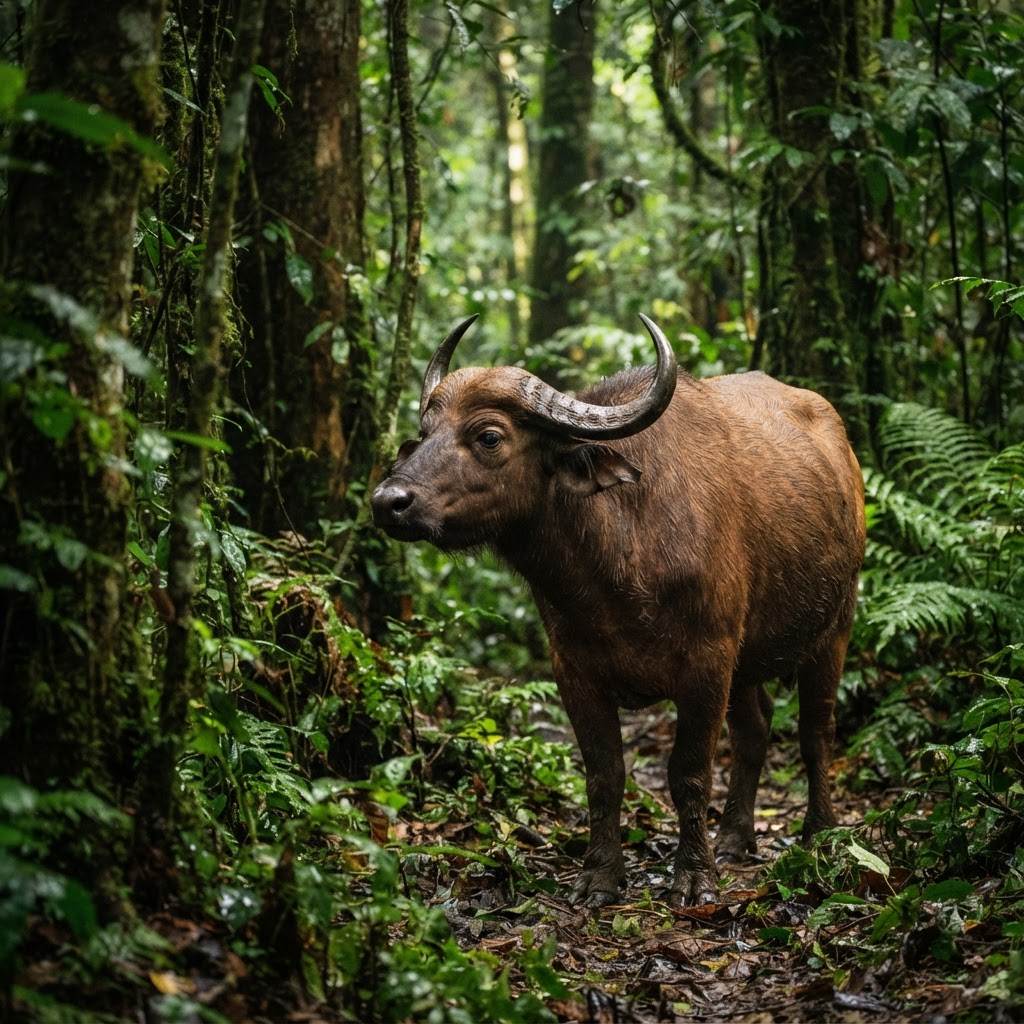
AI Generated
Dwarf Forest Buffalo
Syncerus caffer nanus
The Dwarf Forest Buffalo is a smaller subspecies of African buffalo, adapted to dense forest habitats in Central and West Africa.
The Dwarf Forest Buffalo (Syncerus caffer nanus) is the smallest recognized form of African buffalo and is native to the tropical forests of West and Central Africa. It is much smaller and lighter than savanna buffalo, with a compact body, reddish-brown coat and relatively short horns.
Adult males are larger and more heavily built than females, although both sexes carry horns. The horns extend outward from the head and curve slightly backward and upward, but they do not develop the massive bosses seen in mature Cape Buffalo bulls.
Habitat & Range
The Dwarf Forest Buffalo occurs across the rainforest regions of West and Central Africa, including countries such as Cameroon, Gabon, the Republic of the Congo, Central African Republic and Democratic Republic of the Congo.
It is strongly associated with dense tropical forest, forest clearings, swampy areas and river systems. Forest openings and natural clearings are particularly important for grazing and social activity.
Behavior
Dwarf Forest Buffalo are social animals and are usually found in small herds, often much smaller than the large herds formed by savanna buffalo.
They spend much of their time in dense forest but regularly move into clearings and open areas to feed. Herds are typically made up of females, calves and one or more adult males.
They are cautious and can disappear quickly into thick vegetation when disturbed.
Diet
The Dwarf Forest Buffalo is primarily a grazer, feeding on grasses and other herbaceous vegetation found in forest clearings and along riverbanks.
It may also browse on leaves, shoots and other plant material, particularly where grasses are less abundant.
Hunting & Identification Notes
The Dwarf Forest Buffalo is identified by its small body size, reddish coloration and relatively short, lightly built horns.
Mature bulls are generally darker and heavier than younger animals and females. Trophy evaluation focuses on horn width, length, mass and overall symmetry rather than the heavy boss development associated with Cape Buffalo.
Hunting typically takes place in dense rainforest environments, where visibility can be extremely limited. Tracking, spoor interpretation and knowledge of forest clearings are therefore especially important.
Because several forest and savanna buffalo forms occur across Central Africa, geography, body size, coat color and horn structure are all important for correct identification.
Conservation Status
The Dwarf Forest Buffalo remains widespread in parts of Central Africa but faces pressure from habitat loss, commercial bushmeat hunting and increasing human access to remote forest areas.
Large protected forests and well-managed hunting areas play an important role in maintaining viable populations.
Sources
Mammal Diversity Database — Syncerus caffer
https://www.mammaldiversity.org/taxon/1006277/
IUCN Red List — African Buffalo
https://www.iucnredlist.org/species/21251/50195031
Animal Diversity Web — Syncerus caffer