
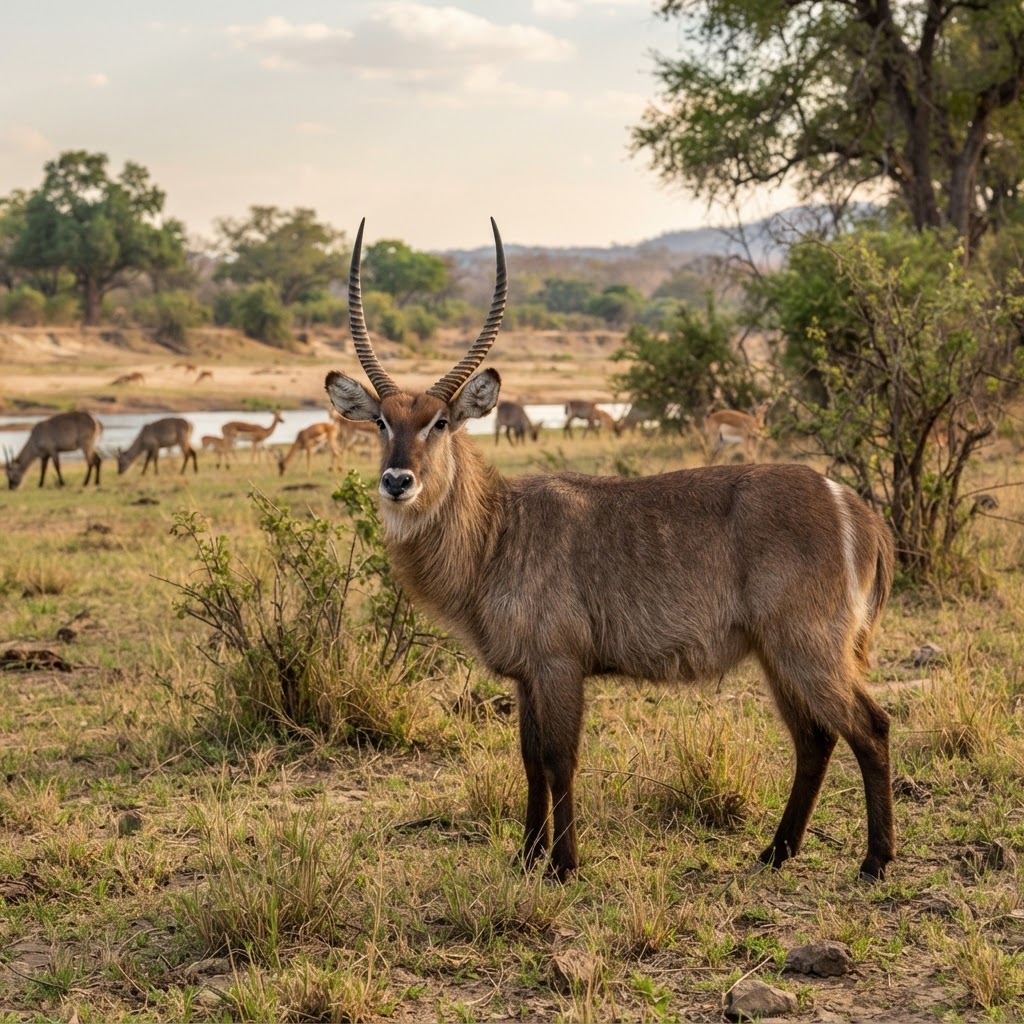
AI Generated
Crawshay Defassa Waterbuck
Kobus ellipsiprymnus crawshayi
The Crawshay Defassa Waterbuck is a subspecies of defassa waterbuck, native to East Africa, known for its shaggy coat and ringed horns.
The Crawshay Defassa Waterbuck (Kobus ellipsiprymnus crawshayi) is a large antelope of south-central and eastern Africa. It has the heavy build, shaggy coat and long, ringed horns typical of Defassa Waterbuck, with mature males developing a powerful neck and shoulders.
Adult males are noticeably larger than females and are the only sex to carry horns. These curve backward and upward in a broad sweep and become increasingly heavy with age. The coat is generally grey-brown to reddish-brown, with lighter areas around the muzzle and throat.
Habitat & Range
The Crawshay Defassa Waterbuck is associated mainly with parts of Zambia, Malawi and neighboring regions of south-central Africa.
It typically inhabits river valleys, floodplains, woodland and savanna close to permanent water. Like other waterbuck, it rarely occurs far from rivers, lakes or wetlands and depends on nearby cover for security.
Behavior
Crawshay Defassa Waterbuck are generally found in small groups, although larger concentrations may occur where food and water are abundant.
Females and young often remain together, while mature males may be solitary or hold territories in suitable habitat. They are most active during the cooler hours of the day and tend to stay close to cover and water.
Diet
The Crawshay Defassa Waterbuck is primarily a grazer, feeding mainly on grasses.
It prefers fresh growth but can also make use of coarser vegetation when conditions are dry. Access to permanent water strongly influences both feeding patterns and local distribution.
Hunting & Identification Notes
Mature males are identified by their heavy body, thick neck and long, sweeping horns.
Trophy evaluation focuses mainly on horn length, mass, spread and symmetry. Older bulls usually show heavier horn bases and a more mature body shape.
Because several Defassa Waterbuck forms are recognized in traditional hunting classifications, correct identification should consider both geography and horn characteristics.
Hunting often takes place along river systems, floodplains and woodland edges, where mature bulls can be located by glassing feeding areas and water sources.
Conservation Status
Defassa Waterbuck remain widespread in parts of eastern and central Africa, although local populations can be affected by habitat loss, livestock competition and hunting pressure.
The Crawshay form has a more restricted distribution than the species as a whole and therefore depends heavily on well-managed protected areas and hunting concessions within its range.
Sources
Mammal Diversity Database — Kobus ellipsiprymnus
https://www.mammaldiversity.org/taxon/1006363/
IUCN Red List — Waterbuck
https://www.iucnredlist.org/species/11035/50189355
Animal Diversity Web — Kobus ellipsiprymnus