
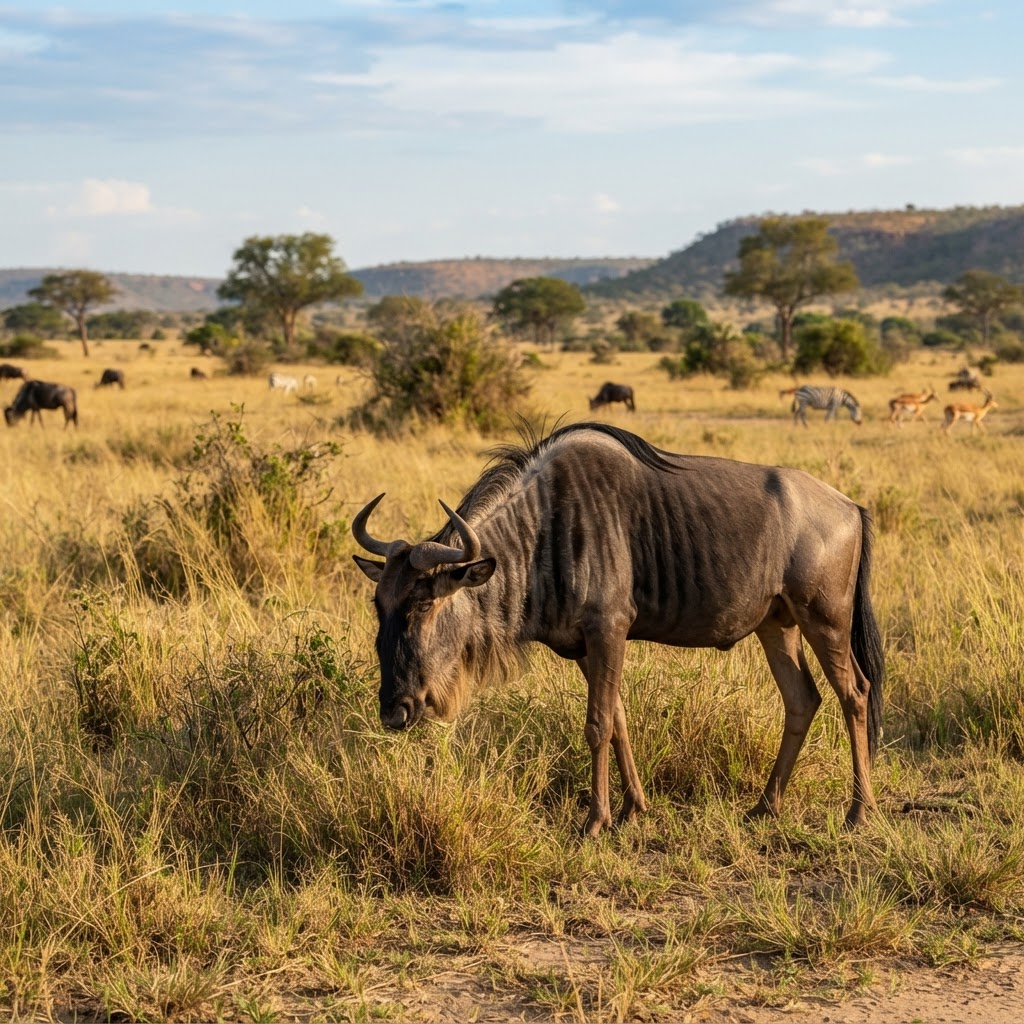
AI Generated
Cookson Wildebeest
Connochaetes taurinus cooksoni
The Cookson Wildebeest is a subspecies of blue wildebeest found in the Luangwa Valley of Zambia, known for its distinct markings.
The Cookson’s Wildebeest (Connochaetes taurinus cooksoni) is a distinctive subspecies of blue wildebeest found primarily in Zambia’s Luangwa Valley. It has the characteristic heavy shoulders, sloping back, broad muzzle and curved horns of the blue wildebeest, but is generally more localized and geographically restricted.
Adult males are larger and heavier than females, with thicker horn bases and a more muscular neck and shoulder area. Both sexes carry horns, although those of mature bulls are usually more robust.
Habitat & Range
Cookson’s Wildebeest is found mainly in eastern Zambia, particularly in the Luangwa Valley and surrounding savanna ecosystems.
It inhabits open grassland, wooded savanna and floodplain areas, where seasonal rainfall and access to grazing strongly influence movement and distribution.
Behavior
Cookson’s Wildebeest are social antelope and are commonly found in herds.
Females and young often form larger groups, while mature bulls may establish territories or remain in bachelor groups outside the breeding season.
They are highly alert animals and rely on speed, herd vigilance and open terrain to avoid predators.
Diet
Cookson’s Wildebeest is primarily a grazer, feeding mainly on grasses.
It prefers fresh, nutrient-rich growth and may move between grazing areas in response to seasonal rainfall, flooding and changes in grass quality.
Hunting & Identification Notes
Mature bulls are identified by their heavier body, thicker neck and more developed horn bases.
Trophy evaluation focuses mainly on horn spread, mass, shape and symmetry. Older bulls generally show heavier horn bosses and a more worn, mature appearance.
Because Cookson’s Wildebeest has a relatively restricted natural range, correct identification should consider both geography and the traditional hunting classification of the subspecies.
Hunting usually takes place in open or lightly wooded country, where glassing can be used to identify mature bulls before a stalk.
Conservation Status
Cookson’s Wildebeest has a much more limited distribution than the common Blue Wildebeest and is therefore more dependent on the protection and management of its core range in Zambia.
Local populations may be affected by habitat change, disease, livestock competition and hunting pressure, although important populations remain within protected and managed wildlife areas.
Sources
Mammal Diversity Database — Connochaetes taurinus
https://www.mammaldiversity.org/taxon/1006358/
IUCN Red List — Blue Wildebeest
https://www.iucnredlist.org/species/5229/50185020
Animal Diversity Web — Connochaetes taurinus