
AI Generated
Common Waterbuck
Kobus ellipsiprymnus
The Common Waterbuck is a large antelope known for its adaptability to wet habitats and distinctive characteristics, found throughout sub-Saharan Africa.
Description
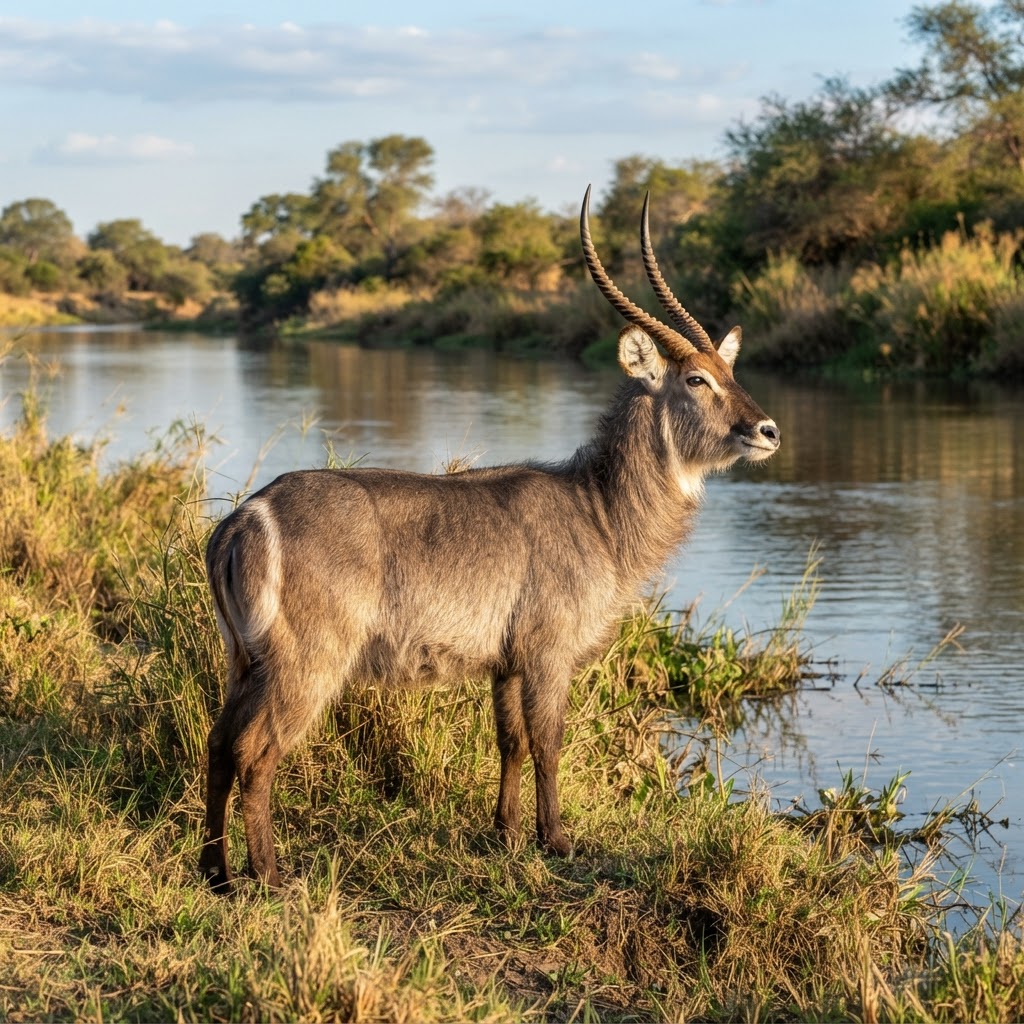
The Common Waterbuck (Kobus ellipsiprymnus) is a large, robust antelope distinguished by its long, slender legs and a characteristic shaggy coat. The males, which are larger than females, have a brownish-grey coat adorned with a lighter stripe running along their bodies, while females generally have a paler, more uniform coloration. Males possess impressive spiral horns that can reach lengths of 80-90 cm. Their large, white tail and the distinct ring of white fur surrounding their rear make them easily recognizable in the wild.
Habitat & Range
Common Waterbucks are predominantly found in sub-Saharan Africa, thriving in tropical and subtropical regions. They typically inhabit areas near water sources, such as rivers, lakes, and marshlands, which provide both food and necessary hydration. Their range extends across a variety of countries including Botswana, South Africa, Namibia, and Zambia, with some populations also found in East African countries like Kenya and Tanzania, favoring grassy wetlands and savannas.
Behavior
These antelopes are known for their semi-aquatic lifestyle, often seen wading in water or resting in the shade of nearby trees. Common Waterbucks are generally social animals, forming herds usually comprising females and their young, while males are often more solitary, especially when they reach maturity. Mating occurs year-round, but peaks can be observed during the rainy season when food is abundant. When threatened, the Common Waterbuck has a unique defensive behavior, preferring to flee towards water where they can disappear by submerging themselves, thus evading predators.
Diet
The diet of the Common Waterbuck is primarily herbivorous, consisting mainly of grasses, particularly in wetland habitats where they find lush vegetation. They are known to graze early in the morning and late in the afternoon when it is cooler, seeking out sweet grasses and tender shoots. They may occasionally feed on leaves and herbs, particularly during dry seasons when grasses are scarce. Their reliance on water sources means they are often restricted to areas that can sustain their dietary needs through rich plant growth.
Hunting & Identification Notes
For hunters and safari guides, identifying the Common Waterbuck is straightforward due to its significant size and distinctive features. Males can be recognized by their larger, more heavily built bodies, characteristic spiral horns, and marking patterns. Females, while lacking horns, exhibit a similar body shape but are more slender and lighter in color. When tracking in the wild, look for signs such as droppings and disturbed grass where they feed. As a precaution, be aware that they are often accompanied by other animals, which may provide insight into their location.
Conservation Status
The Common Waterbuck is currently classified as "Least Concern" by the International Union for Conservation of Nature (IUCN), with stable population numbers across many regions in their range. However, habitat loss due to agricultural expansion, human settlement, and hunting pressures have resulted in localized declines. Conservation efforts include regulated hunting and habitat conservation strategies to ensure sustainability. Organizations are working to maintain and restore wetland habitats critical for their survival while promoting ecotourism that educates the public on the importance of preserving these magnificent animals.