
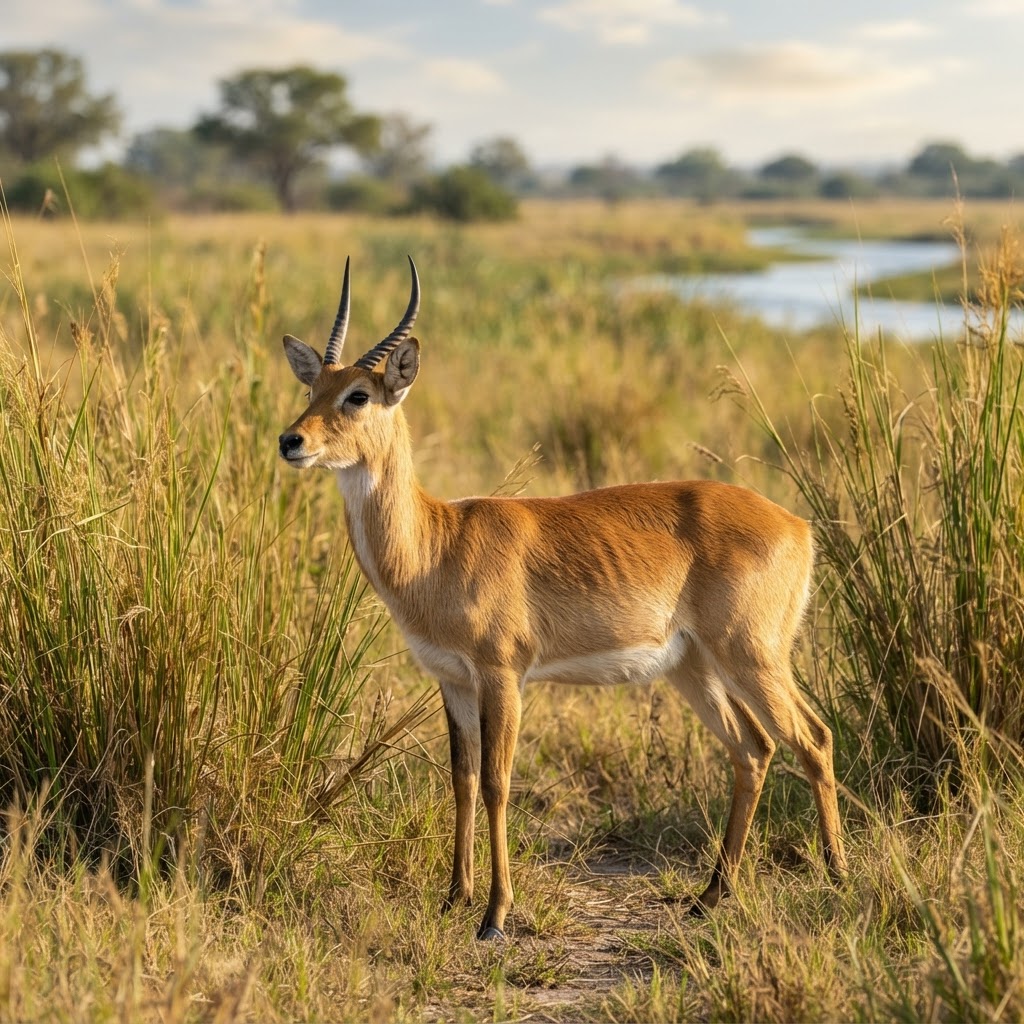
AI Generated
Common Reedbuck
Redunca arundinum
The Common Reedbuck is a medium-sized antelope with a distinctive whistling alarm call, thriving in the grasslands and floodplains of sub-Saharan Africa. Known for its elegant appearance and secretive nature.
Description
The Common Reedbuck (Redunca arundinum), also known as the Southern Reedbuck, is a graceful, medium-sized antelope native to the grasslands and wetlands of sub-Saharan Africa. Standing about 80-100 cm (31-39 inches) at the shoulder and weighing between 45-90 kg (99-198 lbs), males are generally larger and heavier than females. Their coat is typically a yellowish-grey to reddish-brown, often lighter on the underside, with a distinguishing white belly and throat. A key identification feature is a dark glandular patch beneath each ear. Only males possess horns, which are rather short, stout, and strongly ridged, curving forward and upward to form a distinctive forward-pointing hook. Their bushy tail is relatively short, white underneath, and flicked constantly when alarmed. They have a long neck, large ears, and powerful legs, suited for their preferred habitat.
Habitat & Range
Common Reedbucks are widely distributed across sub-Saharan Africa, from Gabon and Angola in the west to Kenya and Tanzania in the east, and south through Mozambique, Zimbabwe, Botswana, and South Africa. They are intrinsically linked to habitats with tall grasses, reedbeds, and dense bush, particularly near water sources such as rivers, dams, and floodplains. These environments provide both cover from predators and abundant grazing. They are rarely found in open plains or dense forests, preferring the transitional zones where cover and grass are readily available. Their home ranges are relatively small and often centered around permanent water.
Behavior
Common Reedbucks are primarily crepuscular and nocturnal, being most active during dawn, dusk, and throughout the night, when they emerge from dense cover to feed. During the hottest parts of the day, they rest concealed in tall grass or reeds. They are typically found in pairs or small family groups consisting of a male, one or two females, and their offspring. Adult males are territorial and will defend their territories, often performing an elaborate display that includes a distinctive, loud whistling alarm call when threatened. This whistle is a characteristic sound of their habitat. When alarmed, they exhibit a characteristic rocking canter, with their white tail held erect, before plunging into thick cover.
Diet
Common Reedbucks are almost exclusively grazers, feeding predominantly on various species of grass. They show a preference for fresh, green grasses and young shoots, often moving to areas that have recently been burned or have new growth. They are selective feeders, choosing high-quality forage. While they can endure periods without drinking, they typically require regular access to water, especially during drier seasons or when their diet consists of less succulent vegetation. Their diet ensures they obtain sufficient moisture and nutrients to sustain their body size and energy requirements.
Hunting & Identification Notes
The Common Reedbuck is identifiable by its medium size, yellowish-grey to reddish-brown coat with a white underside, and the unique forward-curving, ridged horns of the males. The dark glandular patches below the ears are a useful field mark. Their preference for tall grass and reedbeds, combined with their excellent camouflage and secretive nature, makes them a challenging species to hunt. They rely heavily on cover and their whistling alarm call. Hunters often need to locate them by their distinctive whistle or by spotting movement in tall vegetation. A careful stalk and precise shot placement are crucial, as they can quickly disappear into cover. Trophy assessment typically focuses on the length and symmetry of the male's horns.
Conservation Status
The Common Reedbuck (Redunca arundinum) is currently classified as 'Least Concern' by the IUCN Red List of Threatened Species. This classification is due to its relatively widespread distribution and stable population numbers across much of its range. However, local populations can face threats from habitat loss and degradation, particularly the destruction of wetlands and grasslands for agriculture and human settlement. Poaching also poses a localized threat in certain unprotected areas. Despite these pressures, the species remains well-represented in numerous national parks, game reserves, and private conservancies throughout sub-Saharan Africa, which play a vital role in its ongoing conservation. Effective management of these protected areas helps ensure the long-term viability of the Common Reedbuck.