
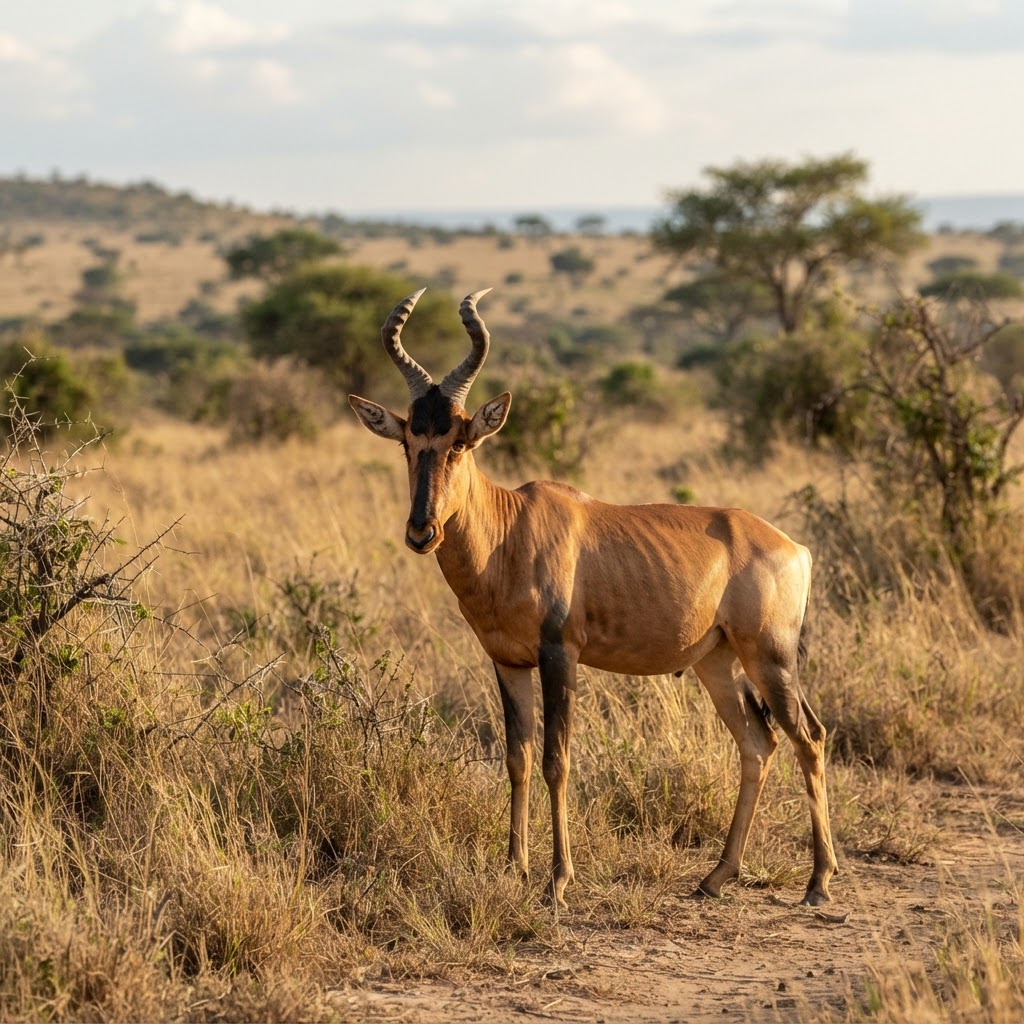
AI Generated
Coke Hartebeest
Alcelaphus buselaphus cokei
The Coke Hartebeest is a subspecies of hartebeest found in East Africa, characterized by its reddish-brown coat and elongated face.
The Coke’s Hartebeest (Alcelaphus buselaphus cokii) is a medium- to large-sized antelope found primarily in East Africa. It is recognized by its elongated face, sloping back, reddish-brown coat and the strongly ridged, angular horns carried by both males and females.
Adult males are generally heavier and more robust than females, with thicker horn bases and a more muscular neck and shoulder area. The horns rise upward before angling outward and back, creating the characteristic hartebeest profile.
Habitat & Range
Coke’s Hartebeest occurs mainly in Kenya and northern Tanzania.
It inhabits open savanna, grassland and lightly wooded plains, often in areas with good visibility and abundant grazing. The subspecies is particularly associated with East Africa’s classic open plains ecosystems.
Behavior
Coke’s Hartebeest are social antelope and are commonly seen in small to medium-sized herds.
Females and young usually form groups, while mature males may defend territories during the breeding season. They are alert animals with excellent eyesight and are capable of maintaining high speeds over open ground.
Activity is greatest during the cooler parts of the day, although they may continue feeding for long periods when conditions are favorable.
Diet
Coke’s Hartebeest is primarily a grazer, feeding mainly on grasses.
It is well adapted to consuming relatively coarse vegetation and can make use of grasslands that are less attractive to more selective grazers. Seasonal rainfall has a strong influence on feeding areas and herd movement.
Hunting & Identification Notes
Mature males are identified by their heavier build, thicker horn bases and overall horn development.
Trophy evaluation focuses primarily on horn length, mass, width, shape and symmetry. The angular horn form is one of the clearest identification features.
Because several hartebeest forms occur in Africa, correct identification should take both geography and horn shape into account.
Hunting typically takes place in open country, where long-distance glassing can be used to identify mature animals before a stalk begins.
Conservation Status
Coke’s Hartebeest remains locally common in several protected and managed areas of East Africa.
Population pressures include habitat conversion, livestock competition, fencing and fragmentation of traditional movement areas. Well-managed wildlife areas remain important for maintaining stable populations.
Sources
Mammal Diversity Database — Alcelaphus buselaphus
https://www.mammaldiversity.org/taxon/1006355/
IUCN Red List — Hartebeest
https://www.iucnredlist.org/species/811/50185320
Animal Diversity Web — Alcelaphus buselaphus