
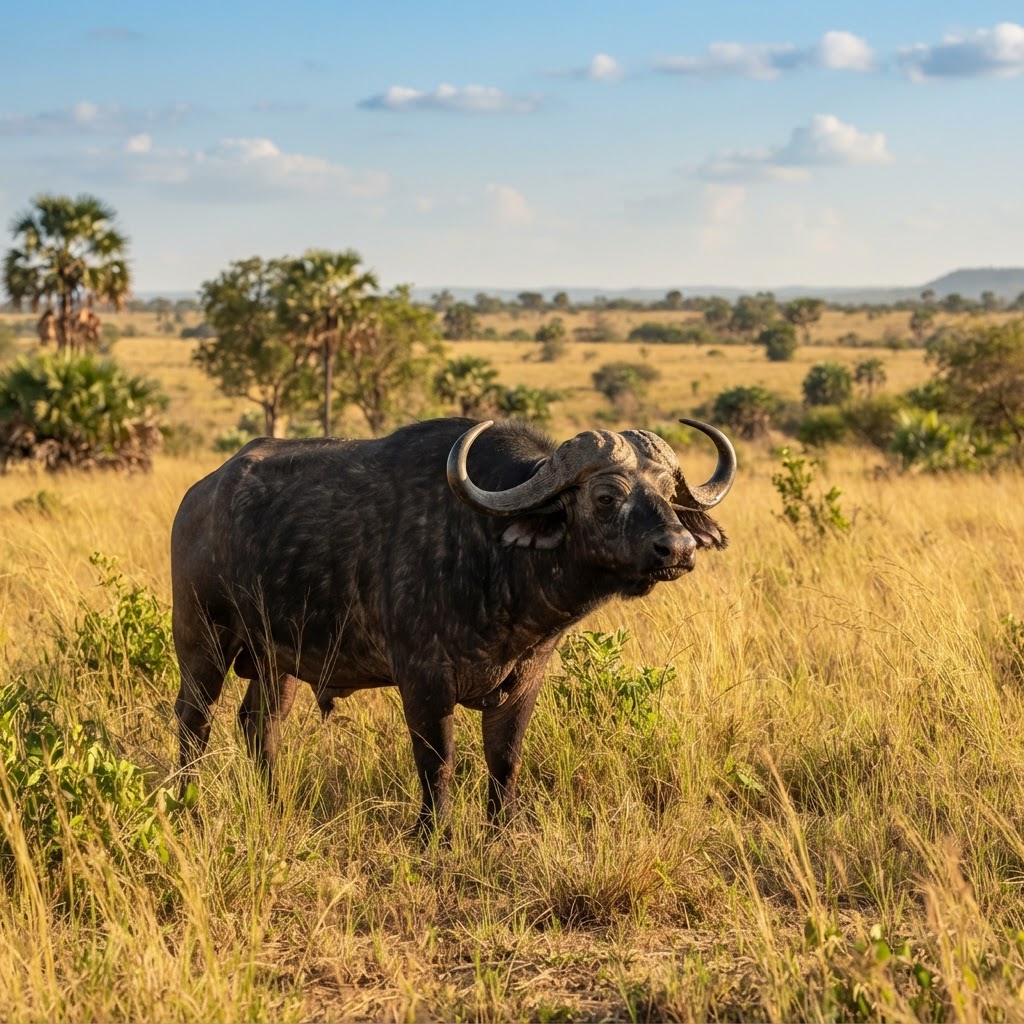
AI Generated
Central African Savanna Buffalo
Syncerus caffer brachyceros
The Central African Savanna Buffalo is a robust subspecies, lighter in color and size than its Cape counterpart, thriving in central savannas.
The Central African Savanna Buffalo (Syncerus caffer brachyceros) is a large, powerfully built buffalo found across the savannas and woodland regions of West and Central Africa. It is generally smaller and lighter than the Cape Buffalo, with a more reddish-brown to dark-brown coat and less massive horn development.
Adult males are larger and heavier than females and carry thick, outward-curving horns. The horn bosses are typically less heavily developed than those of mature Cape Buffalo bulls, while females have smaller and more slender horns.
Habitat & Range
The Central African Savanna Buffalo occurs across parts of Central and West Africa, including countries such as Cameroon, the Central African Republic, Chad and neighboring regions.
It inhabits open savanna, woodland, floodplains and areas where grassland is mixed with patches of thicker cover. Access to water is important, and herds often move seasonally in response to rainfall and grazing conditions.
Behavior
Central African Savanna Buffalo are highly social and usually live in herds ranging from small groups to much larger concentrations where habitat and water conditions are favorable.
Older bulls may leave the main herd and live alone or in small bachelor groups. Buffalo are most active during the cooler parts of the day and may rest in shade or near water during the hottest hours.
When threatened, they can be extremely defensive and may stand their ground rather than flee immediately.
Diet
The Central African Savanna Buffalo is primarily a grazer, feeding mainly on grasses.
It may also browse on leaves and shrubs when grass quality declines. Seasonal rainfall strongly influences feeding patterns, movement and herd distribution.
Hunting & Identification Notes
Mature bulls are identified by their heavier body, thicker neck and well-developed horns.
Trophy evaluation focuses on horn spread, mass, shape and boss development. Compared with the Cape Buffalo, the Central African Savanna Buffalo usually has a lighter horn structure and less pronounced bosses.
Because several African buffalo forms can occur relatively close to one another, geography, body size, coat color and horn shape are all important for correct identification.
Buffalo hunting typically requires careful tracking and close-range identification, particularly in areas with tall grass or woodland cover.
Conservation Status
African buffalo remain widespread in many protected and managed areas, although local populations may be affected by habitat loss, livestock competition, disease and hunting pressure.
Central African populations are particularly dependent on large, connected savanna and woodland landscapes with reliable water sources.
Sources
Mammal Diversity Database — Syncerus caffer
https://www.mammaldiversity.org/taxon/1006277/
IUCN Red List — African Buffalo
https://www.iucnredlist.org/species/21251/50195031
Animal Diversity Web — Syncerus caffer