
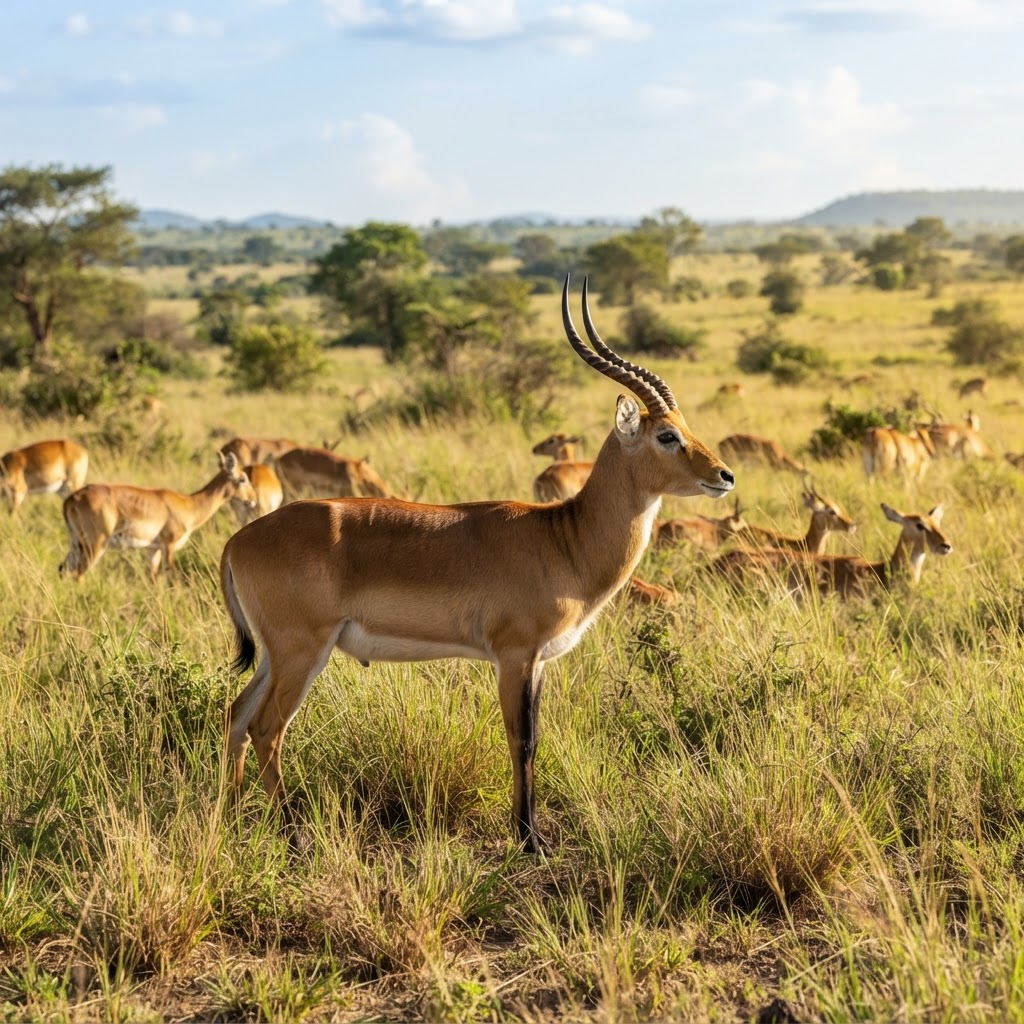
AI Generated
Central African Kob
Kobus kob kob
The Central African Kob is an antelope found in central Africa, known for its reddish-brown coat and impressive lyre-shaped horns.
The Central African Kob (Kobus kob kob) is a medium-sized antelope found across the savannas and floodplains of Central and parts of West Africa. It is recognized by its reddish-brown coat, pale underparts and the strongly ridged, lyre-shaped horns carried by males.
Adult males are larger and more heavily built than females. Females are hornless and usually lighter in color. Mature males often develop a darker neck and shoulder area, especially during the breeding season.
Habitat & Range
The Central African Kob occurs across parts of the Central African Republic, South Sudan, northern Democratic Republic of the Congo, Uganda and neighboring regions.
It is closely associated with open grasslands, floodplains, wetlands and lightly wooded savanna, usually in areas with reliable access to water.
Seasonal flooding plays an important role in its distribution and feeding patterns.
Behavior
Central African Kob are highly social and may occur in large herds.
During the breeding season, males often establish and defend small territories, particularly in traditional mating grounds known as leks. Females move between these territories and select breeding males.
Outside the rut, males may form bachelor groups while females and young remain in larger herds.
Diet
The Central African Kob is primarily a grazer, feeding on grasses and other herbaceous vegetation.
It prefers fresh, nutritious growth and often follows seasonal changes in water levels and vegetation quality across floodplains and savanna.
Hunting & Identification Notes
Mature males are identified by their heavier body, darker coloration and well-developed, ridged horns.
Trophy evaluation focuses primarily on horn length, mass, spread and symmetry. Older males generally show heavier horn bases and a more pronounced outward and upward sweep.
Because several kob forms occur across Africa, correct identification should take geography, coat coloration and horn shape into account.
Hunting is typically conducted in open grassland and floodplain country, where glassing from distance can help identify mature males.
Conservation Status
The kob remains locally common in some protected landscapes, but populations have declined in parts of its range.
Major pressures include habitat conversion, livestock competition, uncontrolled hunting and disruption of wetland ecosystems.
Large protected areas and well-managed hunting concessions remain important for maintaining viable populations.
Sources
Mammal Diversity Database — Kobus kob
https://www.mammaldiversity.org/taxon/1006362/
IUCN Red List — Kob
https://www.iucnredlist.org/species/11036/50189881
Animal Diversity Web — Kobus kob