
AI Generated
Central Africa Bongo
Tragelaphus eurycerus eurycerus
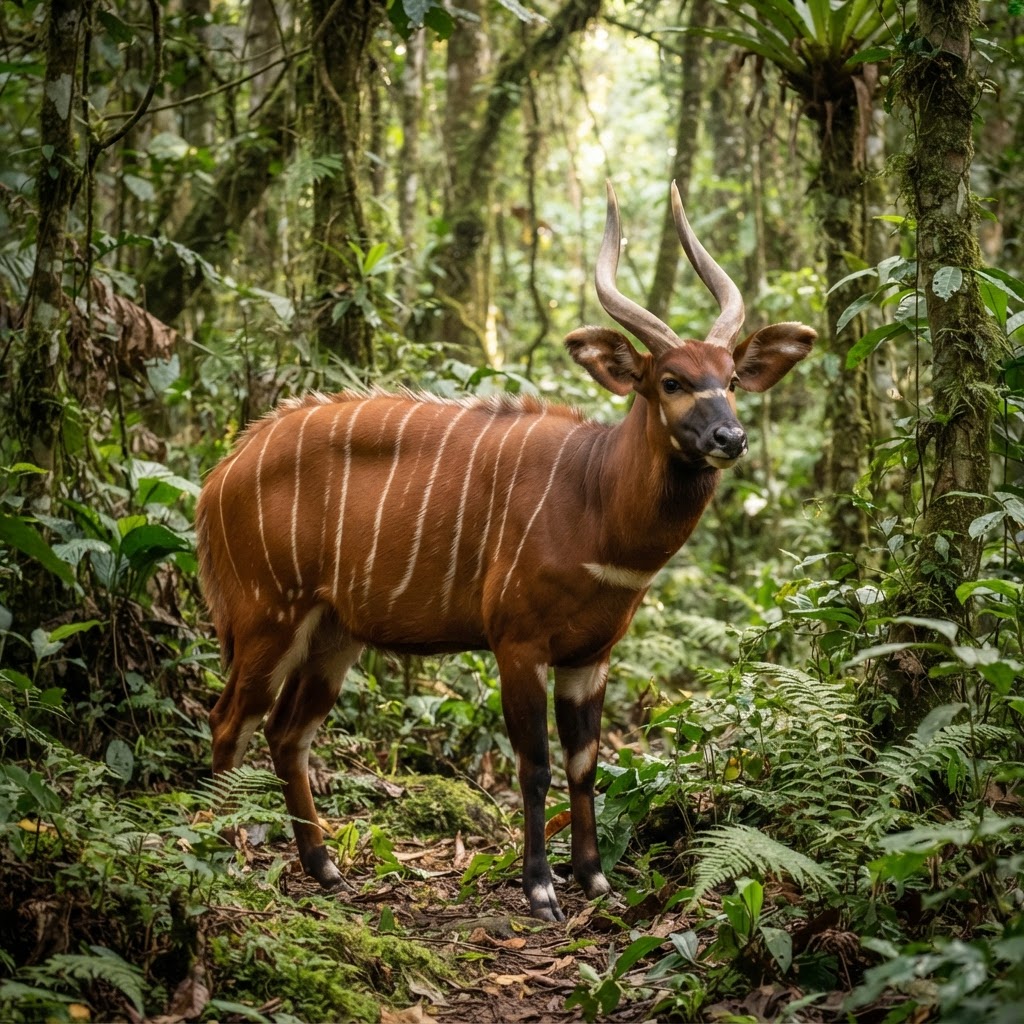
The Central Africa Bongo is a striking forest antelope with a reddish-brown coat and white stripes, found in the rainforests of Central Africa.
The Central African Bongo (Tragelaphus eurycerus eurycerus) is one of Africa’s largest and most striking forest antelope. It is recognized by its rich chestnut-red coat, bold white vertical stripes and long spiral horns carried by both males and females.
Adult males are larger, heavier and generally darker than females, often developing a deep mahogany coloration with age. Both sexes carry massive, slightly spiralled horns, although those of mature bulls are typically thicker and more heavily built.
Habitat & Range
The Central African Bongo occurs in the dense tropical forests of Central Africa, including parts of Cameroon, the Central African Republic, Republic of the Congo and Democratic Republic of the Congo.
It is strongly associated with primary and secondary rainforest, forest clearings and areas with dense understory vegetation. Bongos often use natural forest openings and mineral-rich clearings where they feed and obtain essential salts.
Behavior
Central African Bongos are secretive and difficult to observe because of the dense habitats they occupy. They are most active during the early morning, late afternoon and at night.
Females and young may form small groups, while mature bulls are often solitary. Despite their heavy build, bongos move quietly and efficiently through thick forest vegetation.
When disturbed, they usually retreat rapidly into dense cover rather than relying on prolonged running in open terrain.
Diet
The Central African Bongo is primarily a browser, feeding on leaves, shoots, herbs, shrubs, bark and other forest vegetation.
It also feeds on fallen fruit and may visit mineral licks regularly. Its broad diet allows it to make use of the highly varied vegetation found in tropical rainforest ecosystems.
Hunting & Identification Notes
The Central African Bongo is identified by its large body size, reddish coat, white vertical stripes and long spiral horns carried by both sexes.
Mature bulls are generally darker, heavier through the neck and shoulders and carry thicker horn bases than females. Trophy evaluation focuses primarily on horn length, mass, spread and symmetry.
Hunting bongo is typically associated with dense rainforest conditions, where visibility is limited and tracking is often more important than long-distance glassing. In many areas, experienced trackers and specialized forest dogs play an important role in locating mature animals.
Correct identification is essential because both sexes carry horns and can appear similar in dense vegetation.
Conservation Status
The Central African Bongo is generally considered more numerous and widespread than the critically endangered Mountain Bongo of Kenya, but populations remain vulnerable to habitat loss and hunting pressure.
Commercial bushmeat hunting, forest conversion and increasing human access to previously remote rainforest areas are among the principal threats to wild populations.
Sources
Mammal Diversity Database — Tragelaphus eurycerus
https://www.mammaldiversity.org/taxon/1006280/
IUCN Red List — Bongo
https://www.iucnredlist.org/species/22047/115164600
Animal Diversity Web — Tragelaphus eurycerus