
AI Generated
Cape Buffalo
Syncerus caffer
The Cape Buffalo, or Syncerus caffer, is a robust herbivore native to Sub-Saharan Africa, known for its strength and social behavior. Often found in herds, it is a popular subject for hunting and wildlife studies.
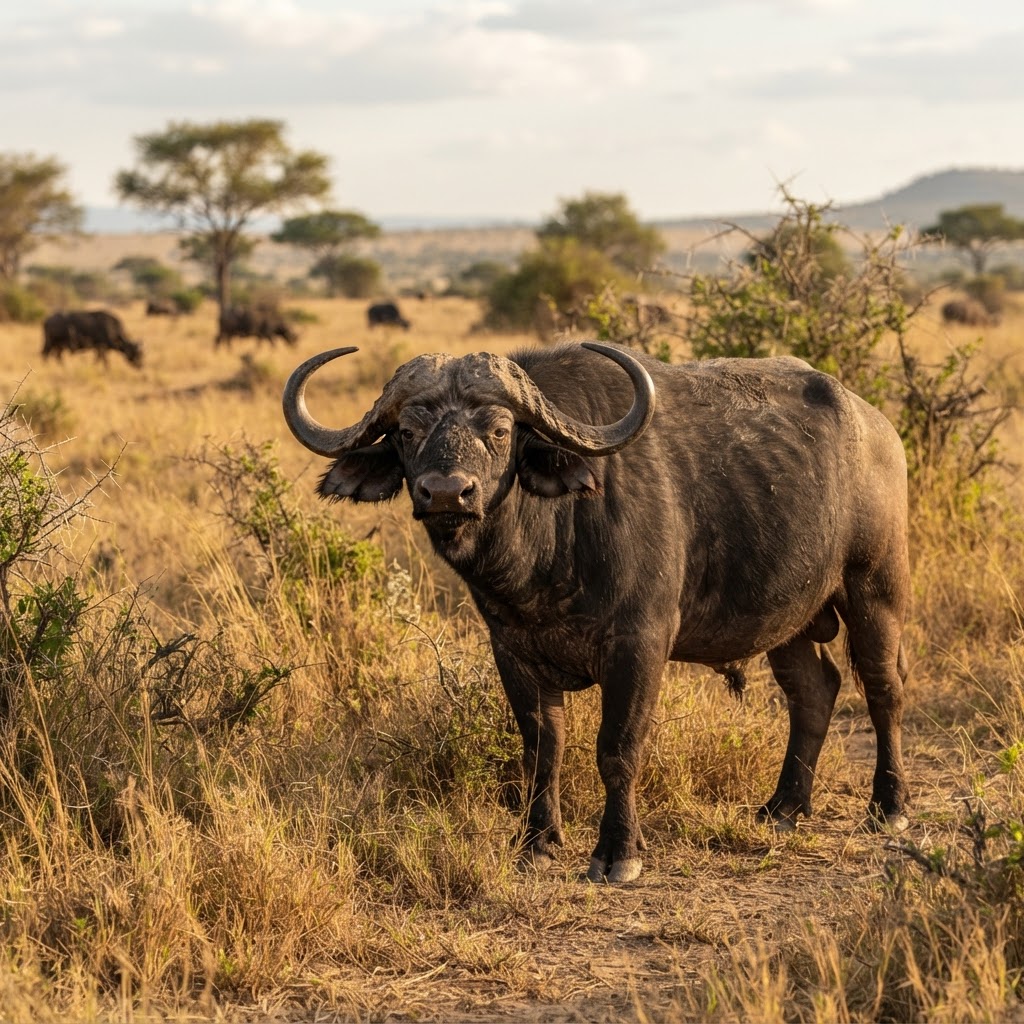
The Cape Buffalo (Syncerus caffer caffer) is the largest and most heavily built form of African buffalo. It is one of Africa’s most iconic dangerous-game species, recognized by its massive body, dark coat and the heavy horn bosses developed by mature bulls.
Adult males are substantially heavier than females and may exceed 700 kg (1,540 lbs), with exceptional bulls considerably larger. Mature males develop thick horn bases that meet across the forehead to form a solid boss, while females have lighter, narrower horns and a less massive head and neck.
Habitat & Range
The Cape Buffalo occurs across much of eastern and southern Africa, including South Africa, Namibia, Botswana, Zimbabwe, Mozambique, Zambia, Tanzania and other neighboring regions.
It inhabits savanna, woodland, riverine areas, floodplains and bushveld. Reliable access to water is important, and herds often move between feeding areas and water sources according to season and rainfall.
Behavior
Cape Buffalo are highly social and often form large herds consisting of females, calves and younger bulls.
Older bulls may leave the main herd and live alone or in small bachelor groups, often referred to as “dagga boys.” These older bulls are commonly found in thicker cover, near water or in secluded feeding areas.
Buffalo are alert, powerful animals and can become extremely defensive when wounded or cornered.
Diet
The Cape Buffalo is primarily a grazer, feeding mainly on grasses.
It prefers fresh, nutritious grazing but can also use coarser vegetation when conditions are dry. Seasonal rainfall, fire and water availability strongly influence herd movement and feeding patterns.
Hunting & Identification
Cape Buffalo are most commonly hunted by tracking and walk-and-stalk, often after fresh spoor is located near water, feeding areas or herd movement routes.
Shots are frequently taken at relatively close to moderate range, often inside 100 meters in thicker bush, although longer shots can occur in more open country. Because of the animal’s size and toughness, heavy dangerous-game rifles are normally used. The .375 H&H is a common legal minimum in many African hunting destinations, while larger calibers such as .416 and .458 are widely used.
Mature trophy bulls are identified by overall body mass, thick neck and shoulder development, and especially the horn structure. A hard, fully developed boss is one of the clearest signs of maturity.
Trophy evaluation focuses on horn spread, boss development, mass, drop and overall symmetry. Wide horns alone do not necessarily indicate an old bull, so maturity should be judged from the complete animal rather than spread alone.
When hunting buffalo, shot placement is critical. The heart and lungs sit relatively low and forward in the chest, protected by heavy bone and muscle. Hunters should always follow the guidance of the professional hunter and use ammunition specifically designed for large dangerous game.
Conservation Status
The African Buffalo is currently classified as Near Threatened by the IUCN.
Cape Buffalo populations remain strong in many protected areas and well-managed hunting regions, particularly in southern and eastern Africa. Local populations can nevertheless be affected by habitat loss, disease, poaching, livestock competition and fragmentation of wildlife areas.
Sustainable hunting, protected areas and large connected ecosystems continue to play an important role in maintaining healthy buffalo populations.
Sources
Mammal Diversity Database — Syncerus caffer
https://www.mammaldiversity.org/taxon/1006277/
IUCN Red List — African Buffalo
https://www.iucnredlist.org/species/21251/50195031
Animal Diversity Web — Syncerus caffer