
AI Generated
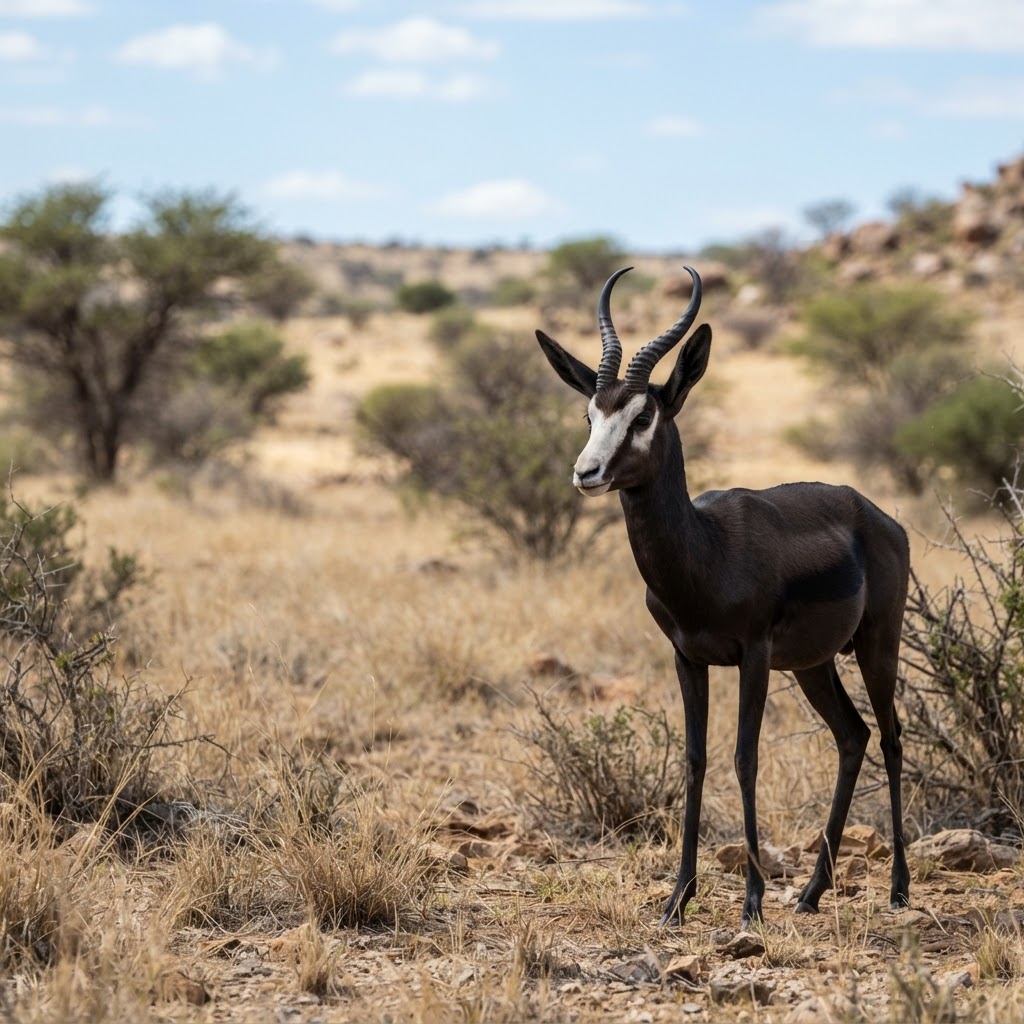
Black Springbok
Antidorcas marsupialis
The Black Springbok is a striking color variation of the iconic Springbok, known for its deep chocolate brown to black coat. Discover its unique traits, behavior, and conservation on the South African plains.
Description
The Black Springbok (Antidorcas marsupialis) is a captivating and highly sought-after color morph of the common Springbok, Africa's national animal. Unlike the typical reddish-brown Springbok, this variant exhibits a coat ranging from a deep chocolate brown to a striking jet black, often with a contrasting white facial stripe and white underparts, much like its lighter-colored counterparts. This distinctive coloration is a genetic mutation that has been selectively bred on game farms, particularly in South Africa, to enhance its unique aesthetic appeal. Physically, the Black Springbok retains all the characteristics of the standard Springbok: a slender body, long legs, and a shoulder height typically ranging from 71 to 86 cm (28 to 34 inches). They weigh between 27 and 42 kg (60 and 93 lbs). Both sexes possess distinctive, ringed, black horns that curve backward and then forward, though those of the males are generally thicker and longer. A unique feature is the dorsal flap of skin containing stiff white hairs, which can be raised during 'pronking' displays.
Habitat & Range
While the common Springbok is widespread across the arid and semi-arid grasslands of Southern Africa (South Africa, Namibia, Botswana, Angola), the Black Springbok is primarily found in managed populations on private game reserves and farms, predominantly in South Africa. These areas aim to maintain the genetic purity and unique coloration of the morph. Their preferred habitats are open, treeless plains and savannas, where they can easily spot predators and engage in their characteristic pronking displays. They are well-adapted to dry environments, capable of thriving in areas with sparse vegetation and limited water resources, often obtaining sufficient moisture from their diet.
Behavior
Black Springboks exhibit the same fascinating behaviors as the common Springbok. They are highly social animals, typically forming herds that vary in size depending on the season and availability of resources. During the wet season, large mixed herds may gather, while in drier periods, smaller groups of females and young, bachelor males, or territorial males are common. They are diurnal, spending their days grazing and browsing. Their most famous behavior is 'pronking' or 'stotting', a series of stiff-legged jumps with an arched back and the head pointing downwards, often accompanied by the raising of the dorsal crest. This display can serve as an anti-predator signal, a form of play, or a demonstration of fitness. Springboks are incredibly fast, reaching speeds of up to 88 km/h (55 mph), making them one of the fastest antelopes.
Diet
Like all Springboks, the Black Springbok is a mixed feeder, primarily grazing on grasses but also browsing on shrubs, succulents, and forbs. They are opportunistic and highly adaptable, adjusting their diet to what is available in their arid environment. During periods of drought, succulents become a crucial part of their diet, providing essential moisture. This ability to extract water from plants allows them to survive for extended periods without needing to drink, a key adaptation to their dry habitats.
Hunting & Identification Notes
For hunters and wildlife enthusiasts, the Black Springbok is instantly identifiable by its striking dark coat, which contrasts sharply with its white facial markings and underbelly. The horns, typical of the Springbok, are present in both sexes. When observed in their natural (or semi-natural) environment, their pronking behavior is a clear indicator of the species. Hunting of Black Springbok is typically conducted on private game farms where populations are managed. Ethical hunting practices focus on selective culling to maintain healthy populations and genetic diversity within the color morph. Due to their speed and wariness, a clean shot often requires patience and skill. Their coloration, while beautiful, does not alter their physical capabilities or behavioral patterns from the common Springbok.
Conservation Status
The Springbok species (Antidorcas marsupialis) as a whole is classified as 'Least Concern' by the IUCN, due to its widespread distribution and large, stable populations across Southern Africa. The Black Springbok, as a color morph, benefits from this robust conservation status. Its existence and proliferation are largely due to selective breeding and management on private game reserves, which actively maintain these distinct populations. Therefore, while not a separate species requiring independent conservation assessment, the Black Springbok's future is secure within these managed environments, contributing to the overall genetic diversity and aesthetic value of the Springbok as a whole. Protected areas and sustainable ranching practices ensure their long-term survival.
Latest Trophies
